Finding Purpose and Resilience Through Green Beret Fitness
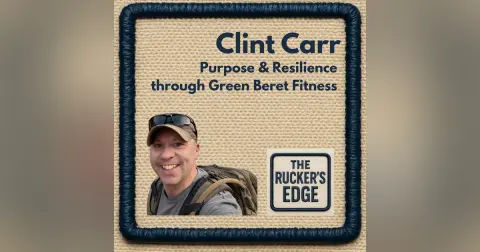


In this episode of The Rucker’s Edge, Clint Carr from CarrvingTrails.com joins the show to share his journey of personal growth, endurance, and transformation through rucking.
Clint opens up about how he went from grinding 60-hour work weeks to finding purpose through Green Beret Fitness (GBF) events - technical endurance challenges that blend navigation, mountain rucking, and resilience.
From his first GORUCK event to grueling GBF mountain courses and 24-hour endurance races in Ocala, Florida, Clint reveals what these challenges taught him about mental toughness, emotional resilience, and self-discovery.
We also dive into his “Seeker’s Oath”, a personal philosophy born from miles of reflection under weight—reminding us all that the journey isn’t about competition, but about discovering who you are when things get hard.
Whether you’re a new rucker looking for inspiration or a seasoned endurance athlete wanting to sharpen your mindset, this conversation delivers hard-earned lessons you can carry on your next ruck.
Links & Resources
- Clint Carr’s website: CarrvingTrails.com
- Connect with Clint on Instagram @Carrving_Trails
- Learn more about Green Beret Fitness events: greenberetfitness.com
- Connect with The Rucker’s Edge on Instagram: @theruckersedgepod
Notes
- Music Credit: "Play This Game" by Black Rhomb.
- I'm not a doctor, and this podcast is for informational and entertainment purposes only. Please consult with your physician before starting any new exercise or physical activity.
0:09 Have you ever been miles deep into a ruck and found yourself reflecting on a recent decision you've made or a conversation you've had? You probably started off focused on the pack, the pace, and the route ahead. But somewhere in between mile four and mile eight, your body locked into a rhythm and your mind drifted somewhere else. Well, today's guest built an entire philosophy around that transformation, and he documented on a blog that he calls Carving Trails. Today, I'm joined by Clint Carr from carvingtrails .com. He's a guy who went from working 60 -hour work weeks with little to no time to take care of his physical or mental health to wrecking his way through some of the toughest endurance events out there with Green Beret Fitness. We talk about how those brutal miles and sleepless nights led to self -discovery, purpose, and his personal code, what he calls the Seeker's Oath. In this episode, you'll learn what Greenbrae fitness events are like, how Clint trains his body and mind for 24 -hour mountain challenges, and why chasing growth through rucking might just change the way you approach life. You're listening to the Rucker's Edge podcast, a show all about rucking that is designed to help you improve your rucking routine, lose weight, and ultimately gain your strength and energy back. Each episode dives into the science, stories, and strategies behind rucking. You'll learn from top ruckers, coaches, nutrition experts, and performance specialists who break down what it takes to train smarter, recover faster, and stay ready for the next challenge.
1:36 So whether you're new to rucking or an experienced rucker that's already logged hundreds of miles, this is the show for you. I'm your host Spencer. Thanks for listening in. Clint has some really profound things to say, and I'm happy to share this episode with you. All right. Here's my conversation with Clint Carr. Clint, thanks for joining us today. I'm really happy you're here. Great to be here, Spencer. I'm looking forward to what you have for questions, what you want to learn from me on my journey, and I'm looking forward to sharing it all. Great. Now that sounds excellent. Now you have some extensive experience in Green Beret Fitness and I have so many questions that I want to learn from you. I guess we'll just start, you know, for listeners who might not be familiar with Green Beret Fitness, could you briefly describe it? Yeah, definitely. Green Beret Fitness, often referred to as GBF, is one of these event companies similar to Go Ruck, but not quite like Go Ruck. Green Beret Fitness is more like an individual -type event company, and they're broken up into a few different divisions.
2:43 The mountain division is the one that I'm most familiar with and something that really I believe in and what we do there. endure and training which is some gym based workouts 12 hour and 24 hour events and that's continued everything here is continuing to evolve which is great um there's also tactical and then also something that i the last one is something that greg greg is the owner greg really believes in is giving back and he has a Great love for dogs in particular. And another thing that we do called Operation Theo is giving toys to children at hospitals.
3:28 We don't give them directly to the children, but we deliver those to the hospital and the hospital would distribute them. Wow. So that's the, yeah, it's really a great company that has. All kinds of different facets and things. And the more I spend time with Greg, the owner, obviously we've become friends at so many events. I just believe in what he's doing. That's awesome. And did I see correctly that Operation Theo just concluded just recently for this year? Yeah, the Washington one just finished. That was this last weekend. So they're all across the nation? Yeah, we've got Virginia and Florida, I believe Ohio as well. And then there's some others that we've been working on trying to get launched.
4:15 And I believe those are happening within the next couple weeks. That's great. Wow. It's really nice to hear, you know, these types of communities given back to the overall community where y 'all live. That's really cool. So how did you first come across GBF, I guess? And what about it caught your attention? You know, Seattle Ruck Club was a ruck club that I found by accident on my way to this journey because I was looking for other people that were actually out there rucking. And so I joined one of their rucks that I found through Facebook and met some of those guys, which happened to be after a go -ruck light. I did a triple light in May of 23. I don't know if any of the Seattle Ruck Club guys were there.
5:03 But long story short, I got to talking to those guys through social media. Chris is Chris Ruck. Ruck is not his last name, but I don't know him any other different. Yeah. And Brandon is another guy. Those two operate. Seattle Ruck Club. And in the buzz, we were talking about a different event, a local 25K ruck. So I joined them actually on that 25K ruck. And that was through some smaller mountains over here in Washington on the peninsula. We finished that as a team, which was great. A lot of camaraderie, met some really good people through that event. And we moved over towards what's next, right? And so I'm always looking to everybody that I come across, what's next?
5:54 What are you doing? And Chris had mentioned one of the GBF events, Operation Iron Peak. And when he mentioned it to me, this event seemed like crazy. I heard navigation through the mountains. And to me, What that meant was, you know, orienteering through a mountain, something I didn't have any experience with, which was concerning. So I don't know, a week or two passed after that. And I actually went to the Green Beret Fitness website, looked up Iron Peak, and it was written similar to some of the other events where I'd done where you have a list of required gear that you need to carry with, a minimum weight. And then what I did find out is that it was an actual course on trails. So at that point, when I figured out it was on trails and not orienteering through a mountain, that's when I signed up. Cool. Here in Louisiana, we don't have the luxury of going through mountains, but that's something that I would like to do. And I think that's the most appealing to me in terms of Green Beret Fitness and all the events. Not all of them, maybe, but most of them seem to be through some sort of mountain landscape. I remember seeing on your blog post, you posted a few photos from you doing Iron Mountain. You're at the peak and it just looks so beautiful. That's such a great reward.
7:22 But I wanted to ask you, what was your life like before finding GBF? What were you looking for at that point in your journey? You know, I had thought. that the right thing in the in this world to do was just work hard that was the discipline my dad brought me up with as he was a marine and so I thought my purpose was to go to work every day do the best that I could climb the ladder make lots of money and then that was the key I was to that point right I was kind of the top and what really got me involved with rucking was the fact that I took a chance on a business opportunity and failed wildly and when I say failed wildly we're talking about excess of a million dollars lost lost my house and so I was I was faced with you know restarting based on one not so great decision and so what I did is I spent that next year, I actually returned back to the company that I'd left, not in the same position, but honestly, it didn't matter at that point. I just needed to provide for my family.
8:35 And if you can believe it or not, I went back and checked and I knew I worked a lot, but I averaged somewhere between 58 and 60 hours a week that year that I came back. We had tons of work. It allowed me to put some money back in the bank. get us back on our feet. And I was relaxed thinking, okay, I did what I came to do here at work. I'm still here. I'm not, I'm not leaving here. Right. I think that's really important to know is that this is a great company that I work for. And when I hit this point, it was like, okay, relief. I don't need to put more money in the bank. I don't need to do these things, but I need to figure out something. And so I had started getting back into running. There were a couple of coworkers that were running at lunch. So I started running with them and, you know, I just, I struggled to keep up with them. And this is kind of. Like everything that I've experienced since then is that everything I do has a struggle with it. And there was some lessons to it. Whatever those are, I look back and try and figure out what they are, reflect and build upon that. So we, I was sitting down with my wife. I don't know if this was the end of January, beginning of February 23. And Special Forces World's Toughest Tests came on. And I was watching it with my wife and I just looked
10:05 at her and I said, man, if there was anything a civilian could do that's similar to this, 100 % I'm in. And so we're still watching the show and not even two minutes later, my wife says, look, I found you something. And it happened to be GORUCK. And I was like, okay, this is it. And so I had purchased a backpack and a weight plate at that point after some research, because that's what I do. I research things. And within a week or two weeks of that show, I had 20 pounds on my back and went for my first rock of two miles. Wow. Wow. Okay. So first of all, Clint, I can't imagine the stress that you took on after venturing out to start this business. And then.
10:55 Ultimately have to go back to the company that you're working for all while supporting. You have a family that you're supporting. So going through all that, that had to be one of the most stressful times, if not the most stressful time in your life. And so how were you feeling after that first two mile ruck? It was the punishment that I was looking for. It was a 1530 pace with 20 pounds on my back. I was sweaty. I was tired. My legs were stiff. By any measure, it isn't that long. I didn't know anything about shuffling, so I power walked that whole thing at a 15 -30 pace. Mind you, I had just spent the last year sitting at a desk and not doing anything, gained a bunch of weight. It took a lot of effort to do that, but that was the pain that I was looking for. I don't mean to get a little emotional, but to be honest. You know, I needed to prove something to myself like I was I could do something hard. I can figure it out because there were times I couldn't get out of bed. Like I'd wake up in the morning, the interim time from when I shut down that business to coming back to work here at Patriot Fire. There were times literally I could not get out of bed. And this became a motivator not only to quote unquote punish myself, but to. to do something good and positive for
12:25 myself. And it's transferred in a lot of different ways to regular life. I'm not even really sure how to. go into detail, but we'll probably touch on it. Sure. And, you know, I don't want to say it's a distraction, but it certainly is a tool that you use to kind of harness energy that you had maybe pent up or you're looking to redirect and you found something that you ultimately ended up being passionate about. So I'm glad that you found this because it definitely set you up on a much better path than potentially what could have been. I want to ask you about your first GBF event. You know, what was it and what was it like stepping in into that world? Man, I remember that day so well. I had camped the night before with a couple guys from Seattle Rock Club. And that was and we slept underneath the stars on a cot. I hadn't done that in years. It reminded me of spending time with my younger brother.
13:21 We lived on a farm and doing that sort of thing. So the get off the day before was perfect. We were in a remote area of Washington, just south of the Enchantments. If anybody's familiar with that beautiful, beautiful country. And then, you know, the next morning we have breakfast and we head up to Iron Peak. There was a guy there, Tom Norwood, and he shows up in sandals and I'm just long haired hippie guy. Turns out to be a great friend. I talk to him often and super, super cool dude. But anyways, you know, you see this guy in sandals and I'm just really confused about this whole thing. I'm in GORUCK boots and GORUCK shorts and GORUCK wool shirt.
14:07 And this guy's just like. I didn't even know what to think, but I don't hold judgment against anybody. I'm the last guy that should judge anybody. And I had respect for him. And there were some athletes there. You know, there were some older guys and there were some ladies. And it was just a good group, a good mixed group of people. That's actually where I first met Greg, of course. Sam, who's a big part of my journey. And Charlie, who is another fantastic gentleman. I look forward to meeting more and we have an adventure scheduled later this year, which I'm excited about. So, but back to Iron Peak, the whistle blew, Greg said, go, I'm going up the mountain and every GBF event has a tough climb to start with. But I didn't know that at the time, but I'm climbing up this hill and I'm just thinking this is. This is exactly what I came for. You know, I wanted to see what I was made of. And so that's how it started. And Charlie was just in front of me. And apparently I was making a little bit better time than him. He's from Florida. It's pretty flat. And he let me go by in front of him. And about from that point forward, there was two other moments within that race where I had coincided with some other ruckers out there.
15:28 But for the most part, the rest of the race was all by myself. Is that typical of GBF events where it's kind of everyone's stacked up in the beginning and then everyone starts to develop distance between each other and almost becomes a solo activity at that point? It can be. You know, there are people that go out there with partners or some sort of... plan to not get separated from people. But I would say generally speaking, yeah, it can be a solo event. And this is probably why it speaks to me so, so purely in the things that I learned is that you're out there by yourself. And there is nothing like you have, you don't have a choice when you're halfway out on a 13 mile ruck in the mountains and you go up a peak and you drop down a peak and you're in a valley.
16:16 The only way to get back to where you started is to go back up that mountain or finish the course. Who sets the courses? Who makes the decision, okay, this is the route we're going to go? Greg does. So it's a passion of his. I know he's mentioned some stories about him traveling around. The United States, also the world, but most importantly, the United States, when he was a serviceman, spent a lot of time in the States and did a lot of adventuring. And that's where this idea of GBF came from, was his experiences out there. I'd like to highlight two events of yours that I found inspiring. I'm talking about your performance in Ocala 2024 through you doing it again in 2025.
17:03 Let's start out with the description of the event. Can you describe the terrain? Tell me where it is and remind me how long the course is. Well, there's Greg's version and there's my version. Greg will tell you it's through a swamp and there's alligators and bears all over the place. I tend to not look at things that way. I look at it as it was. It's a pretty decently maintained trail because there's a lot of foot traffic on it. There's a lot of people that try and do FKTs, fastest known times. And there's people that are just going from the top to the bottom. So the trail is 65 -ish miles, Greg will tell you, which is really 67. He will also tell you it's flat, which there's probably closer to 3 ,000 feet of elevation gain, but relatively flat over that distance. And it starts in the evening.
17:58 which is good and bad. I mean, some guys would probably like to start in the morning, but then that puts you in the evening later in the race. Starting at night, you're probably awake during the day before you head out there. And so maybe it's harder because you've stayed awake. But I actually do love... that trail in the evening i don't really see anything unless the moon was out and that first time in 24 we did have quite a bit of light and that was pretty special but it's a it's a just a standard trail um there are a lot of little roots and rock i wouldn't even say rocks i'm not even sure because it was dark but man that first year i stubbed my toe about a thousand times each one of them and i just remember that what was the The time frame or the time difference between your first event and Ocala 2024. 24. Well, every year is a 24 time hack in order to pass and get your dog tags.
19:04 You've got to finish this 67 miles in 24 hours. First year. Yeah. First year I went with a team. which definitely there's some pros and cons to team and solo. And I believe we finished it like 23 and a half hours, maybe 23 hours and 40 minutes. I remember Sam, who at this point, we're just developing a friendship at that point. And she had said she was concerned that I wasn't going to make it because I'm not sure. Some people saw some things in me. Sam isn't the only one. Greg obviously did and some others. And they wanted to see me finish this thing. So 23 hours and 40 minutes, we'll call it, was the first one. Gotcha. Okay. I see. So barely making the cutoff. Yeah. And it was perfect weather conditions, to be honest with you. So how did you process that event afterwards? Did it shake your confidence or did it give you fuel for your drive? Or how did you take that event afterwards? It was a pretty emotional moment. To that time, at that finish line, the longest ruck I had was 26 .2 miles with 45 pounds, and it wasn't fast. It definitely was not fast. I remember that day very well. But finishing, when I came across that finish line, there was definitely a lot of emotion that came out, guaranteed a few tears.
20:30 When I finished, it was about proving to myself that... If I wanted to go do something, I definitely could. And I had help. There's no doubt about it. I had excellent help from David Connect, from Margie Vale, Michael Deller. Those three people were with me throughout that. Jim McVeigh set the pace in the beginning in our team. I met some other really great people along the way as well. Remind me again, when was your first GBF event? July of 23. Okay. So just about half a year after you've started doing GBF events, you did Ocala 24. Okay. You went back and did Ocala in 2025. What specific changes did you make leading up to the 2025 event, you know, physically, mentally, or even logistically? Because it sounds like you've done, you completed several GBF events between those two timeframes. So looking back at your blog, looking through 2024, you did a lot of events. So I guess I'm just kind of curious, like, How did you prepare differently for the 2025 Ocala versus 2024? If I told you that I didn't train specifically for Ocala 25, you wouldn't believe me. But 100 % I didn't.
21:49 What I did do is I maintained consistency throughout the year, which you touched on it. I did a number of events. I did a local 25K. I did a... Rainier to Ruston relay race with some co -workers. GBF Operation Vegas, where I experienced altitude sickness for the first time because we got up to nearly 12 ,000 feet in altitude. Operation Yosemite, which was my first event in thunder and lightning with rain. These are all about a month apart in between. Then I attempted...
22:29 Operation Century, which is another race that really sits with me heavily today. I made it 42 miles out of the 100, and that was through Idaho, Wyoming. I had some altitude sickness there as well, but that one I gutted through way better than I did at Vegas. And then a non -rucking event was Barkley Fall Classic, and that was in September of 24. We don't really need to get into that. I'm happy to if you'd like to, but it's not a rucking event. It's just something else I wanted to challenge myself with. And then what I was really focused on was Operation Dagger. And that was in November of 24. So that's just a few months before Ocala. So that really was what I was focused on at the moment. I was not looking at Ocala. So what did I do differently?
23:28 I trained specifically for 24, but I was in a whole different place in 25. Interesting. And talk to us about Dagger. Walk us through that event. Can you describe the specifics about it? I guess terrain and yeah. Dagger's completely different. It's not a typical mountain event. That was something Greg had come up with. And put out there and I saw it and I thought it brought me back to that moment when my wife and I were watching Special Forces, World's Toughest Test. And, you know, that to me, Dagger, the way it was advertised with standards and certain things that we needed to to physically complete that.
24:15 That is what I thought I was looking for was Dagger. So Dagger turned out to be. Yeah, push -ups, sit -ups, some other gym -type tests. We did some rowing. There was time on the beach in the water. There was rucking on the beach. There was rucking from point to point. There was buddy carries. It was essentially a very military -esque type event, similar to what maybe a go -ruck selection might be. I don't know that you could compare the two. I just, that's not what I do, but it definitely had some, some mystique to it. And I knew at the moment I wanted something to continue to push my edge and figure out who I really was. I see. And you mentioned you there's, there's a rowing aspect. So do they have, is it set up in stages where you do like, maybe like a, like. I know in DECA, there's like 10 stages of different workouts you have to complete.
25:21 Is that sort of what they set up for Dagger? Not really. I mean, if I were to imagine how the military would actually operate, I feel like this was it. So we show up at a gym, and in this gym, You know, we start off with a kit chat. Well, first off, we start off, our cars were not parked correctly. And there were a handful of us that were not backed into our spots and we were not parked in the correct locations. That was quickly corrected. And it was clear that my friend Greg was not my friend Greg. He was, he was, I don't know what the name, he was my commander at that moment. I do as he said.
26:08 That's kind of how it started there. So we moved into the gym. We did a kit check and we moved into some of the movements like push -ups, sit -ups. I believe we had a warm -up before then. The rowing aspect was just a mental test to tire us out, if I were to guess or read Greg's mind, before we went out and actually did some of the other work heading into that evening. I see. Okay. That makes sense. You mentioned experiencing something unexpected out on the beach. What happened and what did that moment mean to you? Yeah. Dagger is one of those things that we're out on the beach. There were three of us left at that moment.
26:53 I don't remember if it was midnight or 2 a .m., but we had to go ruck down the beach. And I would say compared to the other guys, I don't know if I was a stronger rucker, but in that moment, I was moving a little bit quicker than them. And I had separated myself from them. And I internally, I knew I was breaking the rules. We were supposed to work together as a team, but I just needed some space in that moment. There was energy from one of the guys that wasn't jiving with where I was at in my own head. And I didn't want that to move over to me. And so I just. created some separation. The moon was out. I turned around, came back past them and kept moving. And there was just this moment where I felt like my dad was there and my dad had passed. And when he passed, I just felt like I needed to live in his legacy and his legacy. He was a businessman.
27:58 owned his own business, which kind of translates to why I went out on my own. But in that moment, he was there. I have no doubt that he was there. And the feeling that I got of him being there was that I didn't have to be him. That wasn't what my legacy was supposed to be set up as. My legacy was supposed to go and be my own person. And one of the sayings he always said is we're grown up was you be you you know you don't try and be somebody else and that's what i got in that moment and he was there wow and not only yeah not only was he there but uh he he spoke to me and i i think about him he actually he he's my dad but he's not my real dad he's my stepdad but he he grew me up as his own you'd never know that i wasn't his blood kids you know and It's just an extremely emotional moment.
29:00 I can only imagine. Experiencing something like that mid -event, did that fuel you to finish strong? That's a great question because that didn't actually occur to me. I don't feel like it fueled me. As we moved through that next... evolution and things, you know, of course I had that moment with me, but one thing I do extremely well is I compartmentalize things. And so that wasn't something that I was dealing with in the moment. I kept it with me, of course, but as we continue to move through the evolutions, it wasn't something that I was bringing back up.
29:46 I see. That is a pretty strong moment in your life to have an experience like that. in the midst of something that's so physically challenging. I'm going to ask you this. How have moments like that where the physical fades and something deeper sort of takes over, how has that changed how you see yourself or the purpose behind the challenges that you're taking on? You know, I do so many events for that exact reason. It's not to prove that I can go do anything. I'm not chasing medals. I think I just did a blog post about that. I'm chasing that inner self. What can I learn about myself? How can I improve myself? It's a rebuild of who I was. It's creating an identity. That's really always been my goal. And every time I do these events, because they are so hard, they just tell me and teach me. So many things about myself. Oh, gosh, there was this something I came across yesterday. I'd love to find it and love to share it here. Sure. Yeah. If you can bear with me. Absolutely. What I did is I came up with an oath. And this will be kind of where I head from here. Because all of these events have led to this point today. I know we're looking
31:16 at some events that happened. eight, nine months ago, but it's an evolution. That's why I continue to do all these events. So it's called the Seeker's Oath. And it's taken me some time to put it together because I'm trying to figure out who the heck I am. I do not train to win. I train to discover what remains when everything else is stripped away. Betrayal is not my escape, is where I face my deepest truth. When comfort calls, I choose clarity. When doubt rises, I step forward. There is no finish line. only the next opportunity to become more than I was. I walked this path willingly, not to find who I am, but to become who I am meant to be. Wow. I really like that.
32:02 I really like that phrase midway where you said where doubt rises, you step forward. That kind of pinpoints your fearlessness, your fearlessness into one start, try to start a business, your fearlessness to do all these events. And really, it shows your courage. And to hear you talk about the growth that you've experienced through these really difficult feats is really phenomenal. And that's sort of one of the things that I really like about rucking in general is that it gives me time to pause and kind of clear my head and work things out mentally. And you're clearly taking that and doing it on a much deeper, more significant level. And it's really, really cool to hear you talk about it. And it clearly, you know, doing these physical events, it means so much to you. Thanks for sharing that, Clint.
32:52 I really, really appreciate that. And have you published a blog post about that? I guess I missed it if you did. No, I haven't. You know, what happens is I come up with a lot of these things and I'm not necessarily ready to let them out. Sure. And let's talk about the blog post a little bit. You know, that's not when I post blogs. Yes, I'd like to help people, but it's also a therapeutic thing for me. It helps me process what's going on in my mind and put it out there. I'm absolutely amazed at how many people actually click on the blog, to be honest with you, because it's my journey. And sometimes I feel, number one, I always want to be authentic to myself.
33:39 I'm not out trying to outdo anybody. I'm not trying to compare myself to anybody. I'm just trying to give out raw information that helps people. And ironically, the blog probably helps me more than it helps anybody else from the psychological standpoint and therapy, because I don't see a therapist, but it is my therapy for sure. More with Clint in just a moment, including his blister prevention and nutrition strategies during these long GBF events. But I want to take a quick break to say thanks for listening to the podcast. Please text this episode with a fellow Rucker that might find it interesting or a friend that could benefit from Rucking. Sharing this episode would help the show grow and help more people improve their health and lives. Okay, back to it. Let's take it back to Ocala, Ocala 2025. So a few months after Dagger is Ocala 2025. Tell us about that event. What was your mindset going into it and what was the result? It's a pretty relaxed one.
34:41 I flew over and I stayed with some friends that live in oh tampa and david connect was another one of those friends that was staying with me and i'll go back to him he was the guy that helped me and helped me train for the first one and so i stayed with him and greg burnham um who i've come to know through ocala as well super great guy and i stayed there and it was just a relaxing time like there was no pressure or anything so that was Incredible to hang out with those guys and learn about Greg and his military past and all that fun stuff. And then we headed to the race day of. We showed up there an hour or two before. I love to go and meet people that I've talked to through social media or whatever.
35:30 And so I'll search them out, make sure I say hello to them. They're pretty relaxed, to be honest with you. And then when it was time to check in and go. I just find my peace, my calmness. I kind of have, at that point, I didn't really know how I was going to tackle the race. I think deep down, I know how I'm going to tackle the race. But I like to tell everybody, because this is truly how I feel, is that I don't really know. That doesn't come out of me until I take the first couple steps. And what happened in 25? Yeah. And what happened in 25 was, I'm not going to let myself down. I'm going to go see what I'm made of. And I had, I mean, I, I think for the first 30 miles, I was at a 16 minute pace.
36:18 And I was just bound and determined to, to push myself and see what I could do. And that's where I ended up about 30 miles in about 40 miles in. We slowed significantly. I struggled with a couple of things out there, but at the end of the day, that was a great race. And then you finished second, if I remember correctly. I did finish second. Gosh, there's so many good moments in that race. Finishing second actually isn't one of the best moments. One of the best moments to me, I remember coming into, it was just daylight coming up in checkpoint four. And I was struggling.
37:03 And I'm walking in. Sam had taken some video. And Greg and Sam are there at that checkpoint, as they usually are for the leaders. And they told me I was in first place. I couldn't freaking believe it. But I'm calm there. I'm struggling because my body's hurting. And I really appreciate it. all of the energy that they gave me. I, number one, I couldn't actually believe that I was in first place. Yeah. Right. Marissa Theophanitis is an extremely quick rucker. She's a petite gal, but she's strong as hell. At some point I passed her navigation, her and she ended up doing an extra 10, 12 miles. The guy, gentleman that, that hit the course record the year before in perfect conditions, he quit, he quit it. And it turned out I was only 30 or 40 minutes behind him. What was different about this 25 versus 24 was we had humidity. We had a handful of trees down along the trail that we had to navigate around. We had thunder, lightning, and rain.
38:11 And my favorite moment in that race was when it started to rain and I took my hat off. I generally wear a hat and you see that in all my pictures. pirate flag patch on it. It's my family emblem, I would say. I just rinsed my face off. I could feel all the grit from the salt. It felt like a shower out in the middle while I was out there. It was reinvigorating. It was new. Pacific Northwest, rain does not bother me one bit. In fact, I welcomed it because it was, I don't know if our lows got down to 55, maybe. Might have only been 60 at that time. But for me, that's really warm from being up here in the Northwest. Okay. Yeah. Gotcha.
38:58 No, that's cold for me in Louisiana. That's really cool to hear. Yeah. You get refreshed. You're rejuvenated. You're good to go. Yeah. So I want to move into maybe give it with your experience, your extensive experience doing all these long rucks. I want to provide you an opportunity to give some insight to the audience that might be starting their rucking journey. The GPF courses that you mentioned, they're remote and I'm pretty sure they're often unmarked. Am I correct? Or do they mark them with ribbons or something like that? No ribbons. You are 100 % on your own for navigation there. So what's your system for navigating?
39:39 I really love the watch. So I will use Strava as a map builder. And what I love about Strava is that it has heat maps. And it sounds like some other people out there who do maps have that. But I'm a subscriber for Strava. It's not a free deal. But I will go and take Greg's map from AllTrails, which is... as I like to call it, quote unquote, more of a guide than anything because all trails accuracy is pretty low. So I will map that out on Strava based on the heat maps because people are generally out and on those trails. And then I'll transfer that to my watch. And my watch, I don't get paid for anything. It's a Coros Apex Pro 2. And it alerts you when you get off trail. And it's, I mean, I don't know how this watch. Yeah, I don't know how this watch can be so accurate. I know Garmin does the same thing. But literally, if I'm 25 feet off, it beeps at me from the map that I created. So I know to go back. Obviously, my goal is never to get lost. But hands down, navigation on any GBF mountain event is extremely important.
40:52 I know people that use maps. I know people that use phone apps. I love to have my hands free, which is why I gravitate towards the watch. You mentioned pacing when talking about previous events. How do you manage your pace and mental focus when your hours are deep into these events and you're becoming exhausted? I mean, look, I'm no different than anybody else. I go through the same mental struggles as everybody else at whatever pace it is. I don't necessarily set a pace for me, but certainly by feel. I think within these races, in all that I've done over the last couple of years, one thing that I understand how to manage is effort. And that effort is not pushing myself too hard, but pushing myself hard enough, if that makes any sense. Yeah, that makes a lot of sense. Would you say your goal is to complete it? And not necessarily, I mean, you did, you did mention you're not chasing medals.
41:51 So maybe it kind of sounds like ultimately your goal is to be consistent and complete these events. Am I off? Of course I want to win. Like I'm not going to, I'm yes, I'm not chasing medals. I want to win. I want to be top, whatever. Sure. But in the moment, that's not what I'm thinking about. You're right. It's. I'm really honestly there to learn more about myself. That's what I'm looking for. Every event that I put on my schedule is 100 % about testing and figuring out who I am. I see. Okay. A few more here that I want to touch on. First one, foot care, because when you're doing these events, you're going on these long journeys. Foot care is so vital. What's your setup like for socks, shoes, blister prevention, whatnot? Oh, boy. If I told you that I've gone through 24 pairs of shoes and probably a dozen different types of socks, would you believe me? I can only imagine. Yeah. Yeah. So I've narrowed it down to wide toe box shoes, either Ultras or Topo. Topo seems to be the ones for me these days. Ultra Ventures and the Terra Ventures are the two that I gravitate towards the most. And then as far as socks are concerned, if it's a long ruck, 100%, I'm going to be lubricating my feet. I used to use powder, anti -friction powder, and that's probably still on my blog.
43:20 But I've shifted now towards trail toes, and that's really eliminated a lot of my blister issues. And so then I'll lubricate my feet. I'll put on NGNG. toe liner socks and then i really do like the mud gear rucking socks or i also do love the go ruck merino wool socks both of those are about the same thickness and and provide pretty good um pretty good protection and the goal between the two yeah the goal between the two socks is that the friction is created between the two pairs of socks and not the socks in your feet sure Yeah, you're adding a little layer there. I got you. So, yeah, I think you're the second guest of mine that has recommended mud gear socks. I thought I've never tried their gear. I might have to give it a go. The toe liner socks. Those are the socks that go, basically, each toe has their own dedicated spot within the sock. So you're lubing up, you're putting those on, and then you're putting on a sock outside of that, and then you're using a wide toe box shoe, and that works for you. Yeah, definitely.
44:28 And then mountain events, I'm 100 % using the lace lock system on there. And the other, also the other tip is get your shoes a half size larger. Okay. For the added layers of socks that you're putting on? Or just for room? All the above. Gotcha. Another vital key with doing these long events is nutrition. So how do you approach nutrition during these long events? What's your fuel strategy before, during, between checkpoints? Nutrition strategy, 100 % is day to day, making sure that you eat well. I've had a couple of nutritionists, I think three now. And actually the best advice has come from my coach and telling me what I need to eat, hitting your protein, hitting your carbs, hitting your macros. But you're adjusting carb intake and fats based on what you're doing for that day. So you're setting yourself up months, weeks, days in advance with proper nutrition there. And then when it comes to the race leading up, obviously you're going to... add 20 or 40 grams of carbs each day the three or four days leading up to the event as you're heading into taper and then for the event itself breakfast is oatmeal with blueberries and honey and nothing super special or when you're traveling which is the most difficult time it might just be a
45:59 pb and j or sandwich and some scratch hydration and then during the race I try and eat every half hour, which can be a real pain in the butt because it feels like those half hours just clock by so quickly. So it's a balance of carbs, gels, goos, mini paydays. What else do I eat? Cookies, applesauce. Costco has these great little fruit compacted bars that I'll eat. Yeah, okay. And then liquids is generally either scratch or hyperlite.
46:42 Hyperlite is 100 grams of sugar and 1 ,000 milligrams of sodium. I tend to get really tired of that when I'm out there just because of the strength of it. So what I will end up doing is I will carry two bladders, one with water and one with hyperlite. Scratch is a little bit more forgiving. And if it's not a hot race, I'll run scratch. Because that's only 30 grams of carb and 600 milligrams of sodium and seems to give me what I need if I'm not going to overheat. Gotcha. And then lastly, you know, if someone listening wants to take on their first GBF event, what's one thing they should do in their preparation? Or maybe one thing they shouldn't do in their preparation either or. That is a great question.
47:28 Navigation. Right. I think anybody can go finish any GBF event, whether they think they can or can't. The key is making sure you don't get lost. Gotcha. Well, before we move on to the rapid fire round, I just want to say thanks again for joining me today, Clint. I really appreciate it. And I've really enjoyed this conversation. Thanks so much for sharing your wisdom with us today. Thanks for having me. This has been a pleasure and I hope it helps somebody along their path. Excellent. Excellent. Okay. Let's do this rapid fire round before we conclude. What was your first ruck sack when you first started rucking? Go ruck 4 .0. Okay. And if you could only ruck one trail for the rest of your life, what trail would that be? The Operation Yosemite Trail.
48:15 Nice. The one with all the thunder and lightning? Do you want to go back and redo that one? Yeah. It definitely had some thunder and lightning, which was awesome. But what was special about that is Thousand Island Lakes. Everybody in this world should have to go see that. It's a spiritual place. Awesome. What's your favorite non -rucking workout? Swimming. And I don't do enough of it. Okay. Full body. Yeah. I hear you. Do you have the headphones on when you're training or do you have them out? I do not listen to any music. I have never listened to music. I think if you want to figure out who you are and you want to focus on what you're doing, music is not or podcast, no offense, is not the way. Absolutely. None taken. I feel the same way. I do a little bit of a mix. I put music in sometimes and sometimes I just go on these rucks without anything in my ears and I'm just left with my thoughts and really like those. Last one. What is your bucket list rucking trail? I've kind of been toying around with the idea of getting down into the Redwoods. I think I could put together 120, 112 mile route through the Redwoods. And I think that would be something pretty dang cool. I'm still working through details and seeing if that's really what I want to do, but it's something I've put some research into. Cool. Well, Clint, that's it, man. Again, really appreciate you being here and best of luck with all your future GPF events, man. I appreciate that. Thank you
49:48 so much, Spencer. All right, that wraps up my conversation with Clint. You can read more about Clint's GBF experiences and his self -discovery journey over at carvingtrails .com. That's carving with two R's. You can connect with him on Facebook at Clint Carr, again with two R's, or on Instagram at carving underscore trails. If you want to reach out to me, head on over to theruckersedge .com or on Instagram at theruckersedgepod. If you enjoyed today's episode, make sure to follow or subscribe to the show so you're notified when new episodes are released. Okay, that's it for today. Thanks again for listening to this episode of The Rucker's Edge.