How an Elite Rucker Trains While Balancing a Career and Life

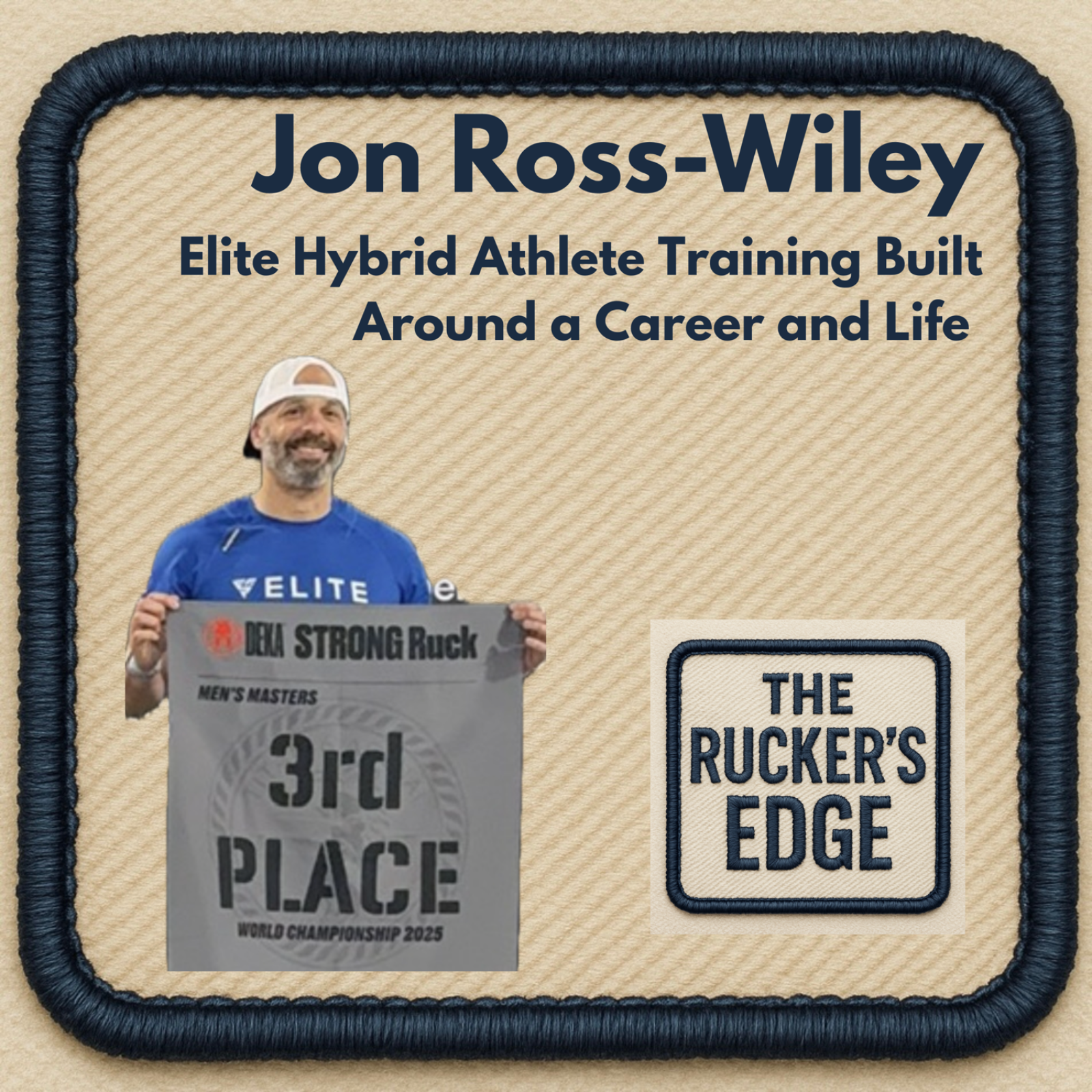


How do you train for elite hybrid fitness races while balancing work, a fulfilling life, and everyday responsibilities?
In this episode, we sit down with Jon Ross-Wiley, a competitive hybrid athlete with podium finishes in DEKA Ruck events and experience racing some of the toughest obstacle courses in the sport.
Jon shares how he structures his training, how he balances life as a full-time school principal with high-level competition, and what it takes to push through events like the Spartan Ultra and DEKA races.
The conversation also explores the mindset required for endurance competition, how injuries can change your perspective on training, and why doing difficult physical challenges can reshape how you approach everyday life.
Whether you're a competitive athlete, a rucker looking for new challenges, or someone trying to stay consistent with training, this episode offers practical insight into what it takes to stay committed to fitness long-term.
Links & Resources:
Jon's gear/supplements:
- The Frontline Athletic rucksacks Jon uses
- H2O Audio (headphones):
- HumanN (supplements):
- Additional gear Jon uses in his training
The Rucker's Edge – Official Site
Follow The Rucker’s Edge on Instagram: @theruckersedgepod
Notes:
- Music Credit: “Play This Game” by Black Rhomb.
- I'm not a doctor, and this podcast is for informational and entertainment purposes only. Please consult with your physician before starting any new exercise or physical activity.
0:00 What does it actually take to train for one of the toughest hybrid fitness races in the world while balancing a full-time career, family life, and everyday responsibilities? If you've ever wondered how elite athletes structure their training, stay consistent for years, and keep pushing their limits into their 40s, 50s, 60s, and beyond, today's episode is going to give you a behind -the-scenes look. My guest today is John Ross-Wiley. John is a competitive hybrid athlete who has podium finishes in DEKA Ruck events and has competed in some of the toughest obstacle races out there, including the brutal Spartan Ultra 50K. But what makes John especially interesting is that he's not a professional athlete. He's a full -time elementary school principal, a father, and someone who has built elite performance into a busy life. In this conversation, we talk about what his training week actually looks like, how he balances work, family, and competitive racing, what DEKA races involve and how to train for them, the injuries that nearly stopped his season, and why doing hard physical challenges changes how you see everything else in life. Whether you're training for a race, building your rucking routine, or just trying to stay consistent with fitness, there are a lot of lessons in this conversation.
1:11 You're listening to the Rucker's Edge podcast, the show all about rucking that is designed to help you improve your rucking routine, lose weight, and ultimately gain your strength and energy back. Each episode dives into the science, stories, and strategies behind rucking. You'll learn from top ruckers, coaches, health experts, and performance specialists who break down what it takes to train smarter, recover faster, and stay ready for the next challenge. So whether you're new to rucking or an experienced rucker that's already logged hundreds of miles, this is the show for you. I'm your host, Spencer. Thanks for listening in. Before jumping into today's conversation, I wanted to take a second and ask for a favor. If this show has helped you in any way, it would be amazing if you could drop me a quick review and rating on whatever app you're using to listen to this podcast right now. It helps me bring new episodes every week, and more importantly, more people looking to improve their fitness will be able to discover the podcast so you can help someone else start or improve their rucking.
2:03 Thanks so much. All right, here's my conversation with John Ross Wiley. John, thanks so much for joining me here on the Rutgers Edge podcast.
2:51 I'm really excited to hear. I have a lot of questions about your training that you do for all these DECA events that you're doing and I'm really excited to kind of dive deep into how you prepare your body for those events. So welcome to the Rutgers Edge podcast. Thanks so much. I really appreciate you having me on here. Oh yeah, absolutely. I see you have your waterproof headphones on right now. I saw a post on Instagram that you posted. Was it either today or was it yesterday where you were just like absolutely drenched and those suckers were covered in sweat? I was like, those can't be working anymore. Yeah, yeah, yeah. There were a couple of those this week that were just real sweat fests. And yeah, they really hold up. So these are my tried and true H2O Audio headphones. Nice. Yeah. And I saw, I think DECA used one of your photos for a promo for a DECA event in Ohio. Is that right? Uh, Chicago. Yeah. I was super pumped. I've always seen those promos every year and I always thought it'd be really cool if one day it was, it was me in the promo. And then before I saw it, someone in our, our frontline athletic group chat said, Hey, we know this guy sent it to me. So yeah, I was excited, especially because this year I'm actually going to that particular race. Awesome.
4:05 Yeah, so I want to talk about these Decker races that you're competing in. Before we get to that, I mean, so I know of a few top three finishes that you've had in Decker Ruck events, but I know a little bit about you and that you're balancing work, life, family responsibilities. I'm just so curious, someone that's performing at your level, what does a normal week actually look like for you? Oh, yeah, it's a good question. My kind of, I guess, run of show, if I put it that way, for me is, you know, it starts typically with the alarm at five in the morning. And that's when the kind of the day gets going. And it's either the alarm or the dog, one or the other, but always right around five and then, you know, head down. And I'm very fortunate that over the years I've been able to put together a pretty nice little home gym in the basement. So most times I'm going just downstairs, which is nice.
5:06 Sometimes I'm going to a gym in Port Chester, New York called Elite Fitness and Performance. Great gym. Do that to mix it up sometimes. But yeah, it's early morning workout. Try to wrap that up by 6 .30. And then it's usually a really quick shower because I always push it with the workout. Squeeze a little too much out of it in the morning. Yeah, get a little too into it. Quick shower, and then I head to work. And I'm an elementary school principal at an all -girls school, actually. So my days are busy, but a lot of fun as well. And yeah, sort of the typical after -school wind -down kind of thing. And sometimes I'll sneak in another mini -workout there with the dog walk. I'll throw the ruck on and make the mile or so a little bit of a low -key. Cool.
5:55 Bonus workout. And then I guess the other thing is, I'll just say that the night ends with laying out the workout gear for the morning. That's kind of one of my go -tos is to have everything set up so that when I wake up in the morning, it's right there and I have no excuse. All right. So I'm curious a little bit about your athletic background. You mentioned in our pre -call that we had prior to starting the podcast that you were a former lacrosse and football athlete, I think it was in high school and college. So I know what you were doing kind of in high school and college around your age. And then you started doing some, some decade events in the 2020s. I think it was, what was, what was your fitness like between those two timeframes? So after college, I was trying to find ways to stay active, kind of running from time to time, nothing really formal, no real program. And I kind of, I wish some of the things that I was, I do now were around at that point because it would have been just great. But yeah, no real, no real program.
6:59 Just tried to say a little fit, a little pickup basketball here and there, things like that. And then eventually I ended up finding a men's lacrosse league that was sort of done by age group. And so I jumped back into lacrosse a little bit for a while and that was fun. got me active. It wasn't super, super, I mean, the level was good. The level was definitely competitive, but it didn't really scratch that itch that I was looking for. And then Spartan races came into the picture for me. I did a couple other smaller series of obstacle races, but Spartan was the main one. And my first one was in 2014. And yeah, I just started doing Spartan races, did it for fun to check it out and slowly made the progression from there to... hey you know this is this is fun too i think i'm getting a little bit better at this and it's really fun to train for these and if i do these certain things the races are i can be a little bit more competitive and then yeah it's kind of progressed through that got into like the age group more competitive races and started to you know kind of get in that top 10 area and that once i was in there it was just really hooked into it met some great people And then that transitioned after Spartan. It made its move towards the hybrid fitness with Deca and High Rocks to a lesser extent. Cool. Now, I think you've done, was it the Killington Ultra Spartan? Yeah. So that's the 50K with something
8:31 like 50 obstacles or something ridiculous. Is that right? Yeah, if I'm remembering correctly, because I think I mostly have. like blocked it out because it was so hard, but it was, it was, I originally, I think I may have told you this on the pre -call. I originally signed up for the beast, which is basically like the half marathon ish type distance. And yeah, maybe she's in the, I'm probably misremembering this, but like 25 obstacles, something like that. And the Tuesday before the Saturday race, I just thought, you know, this is going to be really hard no matter what. So. Let me just I can't really call it upgrading it, but I guess upgrade my registration to the to the ultra and just make it. And so, yeah, it was it was basically two of those loops with a little bonus loop in there in the middle.
9:22 And yeah, you know, 50 plus obstacles probably. And there's a I think it was maybe a 14 hour or something like that time cap. And I literally. Used every single second of it. At the halfway point where they have you check in and you can fuel up and things like that, I was well ahead of schedule. And I was like, I got this. This is no sweat. And then second half just was brutal. And every little time hack, every couple of miles, I was getting closer and closer and closer to not making it. I want to say I finished the race with maybe 10 minutes left. Wow. Started in the dark and ended in the dark. Wow. Yeah. Yeah, that's unfathomable. Humbling, to say the least.
10:07 I could imagine. So you said it's comprised of maybe two loops or something like that? Yeah, it was the beast course twice. Okay. Plus they worked in a little evil bonus section that I remember just being so steep. Did they shock you in that one? Don't they have like a gauntlet? No, that's tough. Oh, that's Tough Mudder. Yeah, that's right. That's right. For those of our listeners that aren't familiar with obstacle courses, what sort of obstacles do they have set up for y 'all to do? So some would be as sort of straightforward as getting over a seven foot wall, right? So you're approaching it, you have to jump up and basically do like a, almost like a muscle up over it. And there's different techniques to do that. So those are sort of more straightforward. They're more like technical grippy type works, obstacles that they have.
10:58 Everything from monkey bars at different levels to different grip holds that are on a rig that you're swinging from one to the next, kind of like a, almost like a trapeze type situation. There are some heavy carries like the, the, the Killington's has, you know, the, you get this bucket. I don't even know how much it weighs, call it at a minimum 50 pounds, but I know, I know it's heavier and you're just carrying it. up this of this course sandbag same thing carrying it up the course it's just super heavy trying to think what else the the big thing at the end is the the finish line well it's only about a two foot jump but you jump over fire to finish and that's a pretty cool feeling so makes for a pretty cool photo i would imagine too oh i had i had a whole series of a kind of like a quote -unquote signature jump i was doing with like a full You know, spread eagle over the top of it. And the photography was always great.
11:55 They always had someone right there. So I have like about five or six that came out really great. Oh, that's awesome. That's awesome. So doing that, that Killington 50K Ultra, did that experience teach you anything about yourself or your training or how you should start adjusting your training or anything like that? Yeah, that's a great question. All of these races and the Ultra certainly did this. but all of obstacle course racing and the training for it, it's kind of that sort of that saying of like, you can do hard things. Yeah. So it, it really changes. These races have kind of changed my entire reference for what feels challenging and that you can apply that across any, anything. So it's, you know, it's silly things like. I don't know. I'm in traffic. This is awful. You just go into that different mindset of I've done things way harder than this. I've been in a situation that's uncomfortable for 14 hours. I can be in this situation for 20 minutes.
12:59 It's going to be okay. That might be a bad example, but it's the kind of thing where it's applicable across a lot of areas of life. It also taught me to check my ego a little. Just seeing like, ah, I'm sure I could just, why don't I just double down on this race and jump into it? I don't know how smart that was to be. But in the end, I made it through. Yeah. You're not that 19 -year -old lacrosse player anymore. Exactly right. So I know with the amount of training that you're doing for DECA and the amount of training that you were doing for all those obstacle courses, did you ever get injured? Because, I mean, you're kind of putting yourself in some pretty difficult situations. injuries come along with your training or those events? Yeah. Interestingly, I, I have had a couple injuries, but what's none of them have actually come in a race knock on wood, which has been great. One happened. I had a tour of my meniscus on a, on a hike one time, just a fun hike. I just felt it's one of those deals where I just said, and I do all this crazy stuff all the time and I'm fine. And I go out on this hike and terrible, you know, it was just. Oh, man. I was so upset. Ultimately, I was able to move through that with PT and no surgery, thankfully.
14:16 And then the other sort of, I guess I would call it major, although in the grand scheme of things, not major. I herniated a disc in my back and that was during a training session. Really, it came down to essentially just going too fast and not being mindful of form. It was one of those deals where I was doing, you know. deadlifts and a few other things for time. And I just got sloppy with it and, you know, nothing acute. I didn't feel it in the moment, but the next day it was like, I did something yesterday that wasn't good. And it ended, it sort of showed itself as what felt like kind of sciatic nerve pain. And I had had that before, so I didn't give it a whole lot of. attention but it just wasn't going away and it went to the doctor and they said yeah the reason why you're getting this pain shooting down your leg is not from your sciatic it is from your sciatic nerve but it's because you have this disc just sitting on it because it's herniated oh yeah so that was not fun and it came right a couple months before deco world championships so it took me out of the game for that which was what year was that that would have been let's see 23 okay gotcha yeah what was there i would imagine you probably had to stop training for a certain amount of time to let that heal up i did i just had to shut it down for for a while i was able to
15:47 do some you know minor things i was going to pt i could you know doing some walking and things like that and it was driving me crazy that took a lot of patience and i just i i really tried to Be smart about it. Listen to the doctors. Because I wanted to come back as fast as possible and not push it. I did ask when this all happened. I did ask the doctor. I said, do you think I can do this world championship in two months from now? And she asked me what was involved in it. And I explained all the different deca zones. And she all but laughed at me. And I was like, there's no way you can do this unless she said, unless you want to ensure that you're going to, we need to have do surgery. Gotcha. Yeah.
16:36 And it obviously that's not the road I wanted to take. Right. No, no, definitely not. So yeah, obviously bounce back. I'm curious. What do you think helped you bounce back and, and get back to competing? Just your patients like you alluded to before. Yeah. Not jumping the gun. Yeah. I mean, I just, during that time, I, I, Again, I was reminded how important it is to be able to move my body like that and to be intense with my workouts and in competition and all of that. Again, kind of reset my perspective on it. And so I took my time with a goal of making it back to world championships the next year. So with that really kind of tangible and concrete goal, it was easy to focus and say, I'm basically not going to do anything at this point unless it is toward that goal. So no kind of frivolous workouts. You know, I have a couple of friends who will suggest, let's go do this, fill in the blank, whatever it is. And typically I'm always sort of down for whatever. So like one of those, like, I think it's on a napkin. You see it like, that sounds like a terrible idea. What time should I be there? Let's do it. Yeah. One of those.
17:45 So, so I tried to, I'm trying to like really. Pull back on those things and stay focused on the goals. And then it's the, you know, the kind of community of folks that I sort of surround myself with that got me back to it as well. That year when I was hurt, I still went to world championships for the full weekend and volunteered and acted, you know, acted as a judge. And I actually, and I really mean this, I came out of that weekend nearly as fulfilled as I would have been. If I competed, because it's really about being around those people. And in my experience to date, that whole kind of DECA universe is one of the places that I feel like is just sort of universally positive. More with John in just a moment, including why he started rucking in the first place. But I want to take a quick break to say thanks for listening to the podcast. Please text this episode with a fellow rucker that might find it interesting or a friend that could benefit from rucking.
18:48 Sharing this episode would help the show grow and help more people improve their health and lives. Okay, back to it. So you only started rucking just a few years ago, right? I think, was it 24? Yeah. 25 maybe? So what inspired you to start rucking? So it was kind of this new, I always like to kind of... see what the next thing might be. The new, like, you know, new challenge could be for me. And I was at a DECA event that had both the regular DECA fit and the DECA fit ruck event. And I registered for both and I competed in the, in the DECA fit.
19:29 I want to say on that, I think that day, I think maybe I had a fourth place finish, which. These days, if it's not top three, I'm not happy anymore. Yeah, I get that. I try to get some perspective over it. It was okay. But then that afternoon, I did the ruck and I kind of went at it with a different approach because it was brand new. I had no zero expectations. I'd say I went at it with a decent effort, but definitely not anything that was at the level I'd done that morning. And partly it reminded me that I can have a lot of fun with these races when I pull back expectation.
20:13 I was just kind of almost felt like I was, I know I was going faster than this, but almost felt like I was jogging around the track and, you know, seeing people like all my buddies from the circuit and all that and just taking things slower and really being kind of present in that whole race. And then by the end of it, you know, I was definitely those, those 20 burpees at the end with the weighted burpees with the rock on, I was definitely torched. I mean, don't get me wrong. I was, I didn't go a hundred percent, but by the end of those, I was a disaster. Yeah. Done. But I looked at my time and I was like, it's kind of in the, in the mix for people, my age group. And I was like, well, that seems like.
20:55 I enjoyed that. I can definitely go harder next time and maybe I can be competitive in this. So I guess it was kind of that realizing that there's definitely fun in racing. I have to always remind myself, have fun when you're out there because my expectations for myself are so high. And so that got me into it. And then I kind of committed to it after that, especially after DECA moved to having the Masters division. Because I knew realistically, again, I was kind of getting used to being in that competitive group. I knew realistically that at that time, I guess being 50, I could train as much as I wanted to, but it was going to be a real challenge to hit some of the times that some guys a couple decades younger than me were hitting. And that's not to say that there are other people who are pretty close to me in age two who are. unbelievably fast that I'm chasing as well. But those times were just on another plane. And so once it moved to this master's division, which was 45 and up, and I kind of looked at my times against other people and that I said, you know, I can definitely be competitive here. So I kind of then committed to it. That's awesome. Now, a little insight into these DECA races. From what I remember, I think you've placed top three in two RUC events, third in the DECA Strong RUC World Championship, and third at the DECA Fit RUC in Austin. Yeah.
22:25 Both in 2025? Yes. How much weight are you carrying in those? How long do those events typically last? And can you give a brief description of those 10 different zones? Yeah, sure. I'll try to run through it quickly. DecaFit is still, it's under the Spartan umbrella. So Spartan Deca is an event. And then it's got, I guess, three basic domains. There's DecaFit, DecaMile, and DecaStrong. All of those three events have the same exact, almost exact zones to them. And then there's the ruck division, which you do those same things, just you add the ruck. For men, it's a 30 -pound ruck. And for women, it's 20.
23:12 And then with DecaFit, you're running 500 meters before each of the 10 zones. So by the end, you've run a 5K and done 10 workout zones. DecaMile, you are running 160 meters or a tenth of a mile before each of the zones. So you run grand total a mile. And then DecaStrong, there's no running. You just go through the 10 zones back to back. For the zones, I'll just go through them quickly. The first zone is reverse lunges. So here I'm picking up a 55 -pound ram, it's called. It's a cylinder made from recycled rubber material. And you hold that and you do 30 reverse lunges with it. So in the ruck division, you're doing that 55 plus you have 30 on your back to begin with. It's kind of a tough way to start. And then zone two is 500 meters on the rower. Zone three is 20 stepovers over a box. Zone four is sit -ups. And in most of, in the deck of fit, you're taking a med ball and you're doing a sit -up and touching the ball or throwing the ball to a target. And then going back down, you're doing that 25 times. In the strong and mile, you're just doing sit -ups, no target with the med ball. And then in the ruck, If you're doing it, no bed ball at all. You just take your ruck off and do the sit -ups with that as the weight.
24:38 Okay. Zone five is 500 meters on the ski erg. Zone six is a farmer's carry, 260 -pound dumbbells. Zone seven is 25 calories on the assault bike. And that's the make or break zone, pretty much. I sort of say that that's just where the rubber hits the road, depending on how you could manage that. Eight is taking a dead ball and taking it and putting it in fit. You're putting it over a small little wall back and forth, kind of like a little yoke. You put it over in the mile and in the strong, you're taking it and just throwing it over your shoulder. So shoulder overs. Nine, you're pushing something called the tank, which is basically like a sled, but it's on wheels and it's got a magnetic resistance to it. Pushing it and pulling it. back and forth five times for a total of 100 meters. And then you end with 20 weighted burpees with, again, you're using that ram. This time it's 44 pounds and you're doing burpees with that. And it's chest to the ground, chest to the ram on the floor, and then full extension overhead. And then when you're done, you place it down and go across the finish line and go into what they call zone 11. which for me is typically full fetal position. No shame at all of just writhing around in pain. Goodness, that is intense. Yeah, I can't imagine myself getting through all of that alive, let alone
26:11 making the podium. That's phenomenal, John. Holy cow. What keeps you going back to that starting line for these DECA rec events? Yeah, it's definitely the competition. It's that being able to have something really measurable to go after. It's one of the things I love about deck. It's so standardized that I can train for it. And effectively, I know basically how I should do at these events if everything comes together because I've done it before. There's no surprises. The other thing that keeps me coming back definitely are the people. Like I said before, so many great people, in particular, a lot of the guys who are in my age group. Because we compete against each other all the time. So we know each other from lining up against each other. And of course, each of us has our goals and we want to, you know, win or play. So that kind of thing. But everyone also is super supportive of one another. So on any given day, if I best somebody, they're going to high five me. On the next day, if they get me, I'm going to high five them. Of course, we'll all be disappointed with our own thing for a second, but it's kind of like, I'll get you next time. There's a friendly competition, which is great. And I met a lot of really wonderful people that way. That's great. It sounds like it's kind of like. Kind of like a shared suffering and camaraderie included in those events. That's really cool to find something like that. And
27:43 you also mentioned being part of the Frontline Athletic community. What role has that group played in your journey? So this is relatively new. So Frontline Athletic is the official RUC partner, along with a company called Titan 6 Actual. They're kind of in the RUC division sponsorship area for DECA. And so Frontline makes the rucksacks that I use. They have other products too, which are awesome. But I had a different ruck prior, saw Frontline at an event. They were loaning some out to people who came to the event, wanted to do the ruck event, but didn't bring their own to the event. And I know a lot of people were really happy with it, how it felt, super comfortable. And so I kind of reached out to them and had a great conversation with their owner and founder, Drew. And we just really kind of saw eye to eye on a lot of things. And this is right after World Championship 2. And I was kind of like, you know, this is going to be my thing now. And I would love to be associated with the Ruck company that is connected with, you know, another. brand that i love so much which is deca and so that all kind of came together and i officially came on as one of their ambassadors and that's been great i'm really happy to that we have a small little group chat that's really supportive again that's what i was saying before where they saw me saw a post with me on it and
29:14 posted it immediately like they were they're proud of their teammate kind of thing which is nice awesome yeah and uh and so that's great and it sounds like they're based out In the Midwest. And so it looks like a bunch of folks from Frontline are going to be at the Chicago DECA event. So we'll get a chance to meet some of the folks that I've only talked to online and have a great team moment. Yeah, no, that's great. So what is it about the Frontline pack that you like? You said it was comfortable. Anything else specific to it that really shines in these DECA events? Yeah, yeah. Super comfortable and... In every kind of way. And that really matters because you don't want to be thinking about your equipment in the race. Right. And previously, I was aware of, you know, the rucksack. I was aware, like, this is bugging me or this is chafing. Like, I could feel it. You know, like, those are distractions.
30:14 And literally from the material they're using, any place that... What has contact with the body is this great material that is just softer, kinder to the body. I don't race this way, but you could probably go shirtless and wear it and not experience any discomfort, which wasn't the case before. I would have, you know, my back would have been, you know, tore up. So super comfortable. And I've been able to. you know, figure out the right setup for me such that when I'm doing things like the burpees at the end, it's, you know, it's really sitting tight on my back, which is important because if you don't have the right setup, you go down and do a burpee and that weight comes over the top of your head and, you know, you have a 30 pound ruck plate hitting you in the base of your skull is not great. So it's, I think that's the key is that when I have it on, I'm aware of the weight, but I'm not aware of the pack itself, which is gives me a huge peace of mind. It's like an extension of your body at that point, right? That's the ideal.
31:23 You don't want to have to think about it when you're trying to attack any of these zones. When you started rucking, I kind of want to go back to your training with the ruck for the first time. Did you notice any? Did you notice that any physical changes when you started training with a ruck as opposed to previous training when you weren't? Yeah, I definitely noticed a couple of things. I was doing a fair amount of sort of like incline sustained walks with it. And I just, I could really feel the difference, particularly like through my calves. I could tell that there was extra work happening. Certainly, I could, you know, you think about you're carrying a fair amount of weight up on your shoulders and to some extent on your hips because, you know, I wear it with the hip belt to sort of balance that all out. But yeah, feeling a lot and my legs have gotten a lot stronger without sort of dedicated leg days in the gym, which is...
32:16 which is great. I really, really want to protect my knees. So, and what I've found is doing workouts with this, along with a few other things, I've really been able to strengthen the muscles around my knees and that's keeping me healthier, which is great. I've also noticed that everything else I carry is a lot lighter. So the bag I carry to work is a backpack also. Typically, if I've done a ruck workout in the morning and then I throw that over my shoulder to go to work, I just have to double check to make sure my laptop and everything's in there. Do I have everything? So that's, again, it's one of those, that's kind of the metaphorical part of it, right? Carrying heavy loads makes everything else feel lighter.
33:01 So that's kind of in real time, that's what's going on. And to some extent, the other thing I would say is I think it's helped me with my overall And I think that has to do with the core strength that comes along with what your body naturally has to do to support that extra weight on your back. Sure. For someone who trains regularly but has never signed up for an event like one of these DECA rec events, what would you say to them? Would you encourage them to sign up and do it? For sure. I think DECA in particular has a lot of great sort of entry points. And I think that I might say that you could start with kind of one of the team events, which is great. So you can kind of split up the work a little bit and get a taste of everything. Might be a great way to start. And then just get familiar with the movements without the ruck first. And then you can, you know, if rucking is part of your other workouts and things to start to build those. that into the training as well. And I would say starting with a lower weight than competition weight to start, because there's a lot of movements in there, like the box step overs and things, you know, you're putting yourself in a position where you could potentially have an injury if you're just jumping into it. And I think there's the first time I did the box step overs with the full weight, it was just so clumsy. It was so, my mechanics were all off. And that's when
34:33 I do it without the ruck, it's one of my fastest zones. Cause you can be really agile and just sort of just jump over it. And this was just, I can't do that. So it was good to, good to learn that. So I'd say it's, it's one of those things where you can build into it and all of the zones are, are doable for folks. There's nothing I should say, say for, for most folks, most folks are able to. To do it, there's nothing where you're going to come up against a sled that will not move unless you can push 400 pounds. It's not that. The tank that you're pushing in DECA is on wheels, and you can move it. It's got magnetic resistance. The harder you push it, the more it resists. So you can go faster, but it's harder.
35:21 And so that's where the strength meets it. But for someone like me, it typically takes maybe two and a half minutes to do that zone. someone who's just starting out maybe it takes five minutes to do the zone but you can do it you can you know if you're jumping into into it to learn it and not worry about so much about the time and have fun with it it's definitely a great place to start and and the team way the team is super fun you mentioned agility with a rucksack on i'm curious are you training with more weight than 30 pounds that's required for deco events yeah it depends on the day but most days most days yes Most days I have, and it's not by much, but I usually use like a 30 pound plate. And with the weight of the rucksack itself, I'm looking at probably around 32 ish pounds. So it's a couple extra pounds, which doesn't seem like much, but it is at the end of the day. I could see how that could move the needle. I mean, yeah. So then when it comes down to race time, I switch that out and go to a 25 pound plate. and then kind of fill in the ruck with you know t -shirts and things like that to get it like dialed in like i don't want to yeah i want it 30 .1 you know maybe 0 .1 just to be safe but i don't need to carry any more weight than that for the race and then there's other things you know where i'm doing something now that just kicked off in march called ruck race league Yeah. I did want to ask you about that. Tell me about that.
36:50 Yeah. I'm super psyched about it. It just started March 1st. They launched the first workout and the registration for the league closes on the 31st. So you can get it anytime this month. The first workout, which is you don't have to join to know it, but you need to join to be on the leaderboard and qualify potentially for their in -person finals is 75 minutes with 25%. of your body weight in the rock for max distance. Okay. So again, this is one of those, like you can walk for 75 minutes, you can mix it up, do whatever you want. Some people are going to, you know, the top, the top guys are going to blow it out of the water and can, you know, they can run pretty fast with 25 % of their body weight on. So for me, as a reference, when I do this workout, it's going to be 47 pounds on board.
37:44 Cool. For 75 minutes, see how far I can go. Are you going to give Giovanni a run for his money? I think he made finals last year, Adam, on the podcast. We were talking about it. And he's in the frontline crew. Yeah, yeah, yeah. So I don't know. I might have to start something up with him. I have to see. I'm not sure if he registered this go -around. I'd be surprised if he didn't. And yeah, again, yeah, some friendly competition there. But I'm going to give it a shot. And here's another example where I reached out to a guy who I know from DECA who's in it. Just he, Mark Jones, awesome guy. Yeah. Set the record, you know, you know, and reached out to him and I was like, what's a, what's a good distance for, you know, someone like me, he knows me. And so we were kind of batting it around and then he just kind of gave me how he was going at it.
38:33 For me, I was like, I'm going to throw the 47 pounds in and just go for it and see what happens. And he had a whole other kind of, we have the whole month. you can build like build into this like there's ways to i was like that's this is why you are who you are i would have just gone for it and wrecked myself and meanwhile he has a real well thought out plan that will ultimately probably give him like a really great time along obviously with his whole life's worth of training but you know you don't need to post your a great time until you know march 30th so right take the time and do it right have you have you done your first attempt at it yet I haven't because I did this big interval workout the other day and it really kind of blasted my hamstrings and they've been tight the last couple of days. And I know because I've done this before, I've pulled a, this is another injury I actually had doing one of the things I shouldn't be doing is that tight hamstrings and running under load is a bad combination because the hamstrings are so tightly wound. And one wrong step can really do some damage. So I'm waiting for them. They're almost back to where I want them. And I think I'm going to start the training and try to give a really good go, maybe somewhere mid -March at it. Take a look at the leaderboard because I'm a sucker for a leaderboard and see if I'm comfortable with where I'm sitting. And then maybe just give it one last go, you know, the last couple of days of March and see if I can
40:05 bump up, bump up a spot or two. That sounds like a good plan of attack. Well, I have one last fun question for you that I asked all my guests, but I just want to say this has been a lot of fun. I really appreciate you coming on to the podcast and sharing your story with your obstacle course experience and now these decade events that you're doing. Yeah, my pleasure. Really happy May time. Thanks, John. Happy May. Absolutely. Okay, last question. It's fun, kind of silly, but if you could create a bumper sticker about rucking, what would it be? Oh, if I could create a bumper sticker. It would probably be, let's see. It might just be literally like ruck colon. You can do hard things. Yeah, that's, that's kind of, that's, that's, that's where I am these days. Like throw it on there, do hard things.
40:52 That's a great message. All right. We'll end it there. Thanks, John. Appreciate you coming on, man. Good luck with ruck race league. Good ruck at the decade event in Chicago. Thanks so much. Thanks for having me. All right. That wraps up my conversation with John Ross Wiley. You can connect with him at John Ross Wiley on Instagram. If you're curious about the rucksack he uses from Frontline Athletics, I added a link in the show notes so you can go check it out. I also included links to a few other products that John uses in his training, like those waterproof headphones we talked about early in the episode. If you want to reach out to me, head on over to theruckersedge .com or on Instagram at theruckersedgepod. If you enjoyed today's episode, make sure to follow or subscribe to the show in your favorite podcast app so you're notified of new episodes. Okay, that's it for today. Thanks again for listening to this week's episode of the Rutgers Edge.