How Rucking Fits Into a Busy Life: Lessons from Weighted Steps Author Andrew Brandt
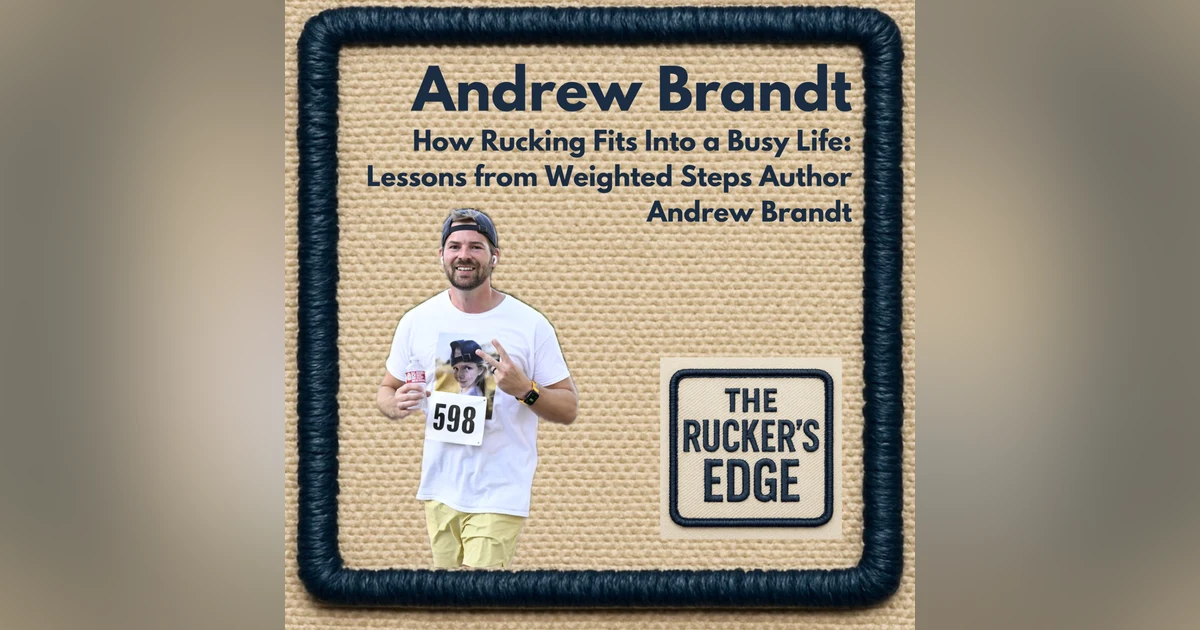


In this episode of The Rucker’s Edge, Spencer sits down with Andrew Brandt to explore how rucking fits into everyday life when work, family, and time constraints are real.
Andrew shares how he rebuilt his fitness through consistent rucking, why walking with load supports long-term health span, and how small daily efforts create sustainable progress. This conversation focuses on practical application: how to ruck without overcomplicating your schedule and how to keep moving forward even when life gets busy.
Listeners will walk away with a clearer understanding of how rucking supports consistency, mental clarity, and long-term health.
What You’ll Learn in This Episode
- How Andrew integrated rucking into a busy lifestyle
- Common consistency mistakes recreational ruckers make
- How to structure rucks around real life
- Why manageable load and frequency matter
- How rucking supports mental clarity and daily movement
Links & Resources
- Pick up a copy of Andrew's books:
- The Rucker's Edge – Official Site
- Follow The Rucker’s Edge on Instagram: @theruckersedgepod
Notes:
- Music Credit: "Play This Game" by Black Rhomb.
- I'm not a doctor, and this podcast is for informational and entertainment purposes only. Please consult with your physician before starting any new exercise or physical activity.
0:00 If you're already rucking, the real question becomes, how do you make rucking fit into your life for the long run? In this episode, Andrew Brandt joins me to talk about using rucking as a consistent, sustainable practice while balancing work, family, and everyday responsibilities. We get into how Andrew integrated rucking into his daily routine, why small repeatable efforts matter, and how rucking supports long -term health without demanding more time than most people actually have. This conversation is about making rucking something you can keep doing year after year. You're listening to the Rutgers Edge podcast, a show all about rucking that is designed to help you improve your rucking routine, lose weight, and ultimately gain your strength and energy back. Each episode dives into the science, stories, and strategies behind rucking. You'll learn from top ruckers, coaches, health experts, and performance specialists who break down what it takes to train smarter, recover faster, and stay ready for the next challenge. So whether you're new to rucking or an experienced rucker that's already logged hundreds of miles, this is the show for you.
1:00 I'm your host, Spencer. Thanks for listening in. Andrew Brandt is a writer, business owner, and father who discovered rucking as a practical way to build fitness while managing real -world responsibilities. He's the author of the book Weighted Steps. It's a guide designed to help new and experienced ruckers build consistency. He also authored the book Push, which is focused on long -term personal growth through daily habits. All right. Here's my conversation with Andrew Brandt. Andrew, thanks for joining me today on the Rutgers Edge podcast. It's really great to have you here. No, thank you for having me. I haven't had a chance to check out your book, Weighted Steps, but I understand that you share your personal story and we have had conversations prior to recording today about sort of where you were and where rucking entered your life and you started improving your fitness. I really want to learn, you know, what worked for you, what didn't work for you. And I want to start with, you know, you're a parent, you're a business owner, you're... You have a very busy life. You talked about how your health suffered over the last, I guess, decade or so. If you can walk us through what your life and health was like before you started taking control of your fitness.
2:07 Sure. So, you know, I'm I turned 40 next month. And so a year almost a year ago now, my wife scheduled our our summer vacation for the beaches of the Florida Panhandle. And it was on my 39th birthday. I stepped on the scale and didn't like what I saw. And I looked in the mirror and it was just this kind of flabby dad bod, which apparently women are into now, I guess. I don't know. I was not. I was about 30 pounds heavier than I'd ever been before and knew I needed to make a change there. And so very quickly, I started.
2:49 With kettlebells, I started running and I started this thing that I discovered called rucking. And I discovered this through Peter Atiyah's book Outlive. And in Outlive, he talks about how walking with weight is something that humans have been doing since we were humans, since we became homo sapiens. I think there's the book that says born to run. And I don't think humans were born to run. We were born to carry. We're born to walk and born to carry weight. And we do that better than any other animal on the planet. And so rucking quickly became not just a way for me for my personal health, but also became this thing for my mental clarity as well. You know, be able to put 20 or 30 pounds in a sack on my back and walk a few miles. All of a sudden, I wasn't making extra time for workouts or anything like that. But I had this time. carved out where I could think and discuss in my head the things that I needed to do for myself. Why was it that your fitness was slipping in the first place?
3:56 Was it just strictly your schedule being busy or were there other factors? There's a few other factors. One was a global pandemic. And, you know, in my in my late 20s, you know, 2016, 17, 2018, I was I played soccer. I ran marathons. I wasn't elite, but I was definitely fit. And then, yeah, 2020 kind of ground to a halt. On top of that, my wife and I had a baby in the summer of 2020. So I went from having a lot of time on my hands as, you know, a young. married guy, relatively young to all of a sudden we had a baby and that took priority for a long time.
4:37 And now that baby is five and a half years old and in school. So, you know, I don't want to make excuses for myself, but being able to take her to school and then I have time, you know, where I don't have to be at the office just yet. She's at school, you know, there's time there. And I decided to take that wisely and use that time for my personal and mental health. Awesome. And so at that time, like what did getting back into shape realistically mean for you? Yeah, it meant getting back to activity. You know, it's very easy for us to kind of live on our lively, oh gosh, what would you call it? Like the hamster wheel of life. You know, you wake up, you take the kids to school, you go to work, you come home, you make dinner, you take the kids to... Soccer practice, you come home again, you get the bath bed, you go to bed just to wake up and do it all again the next day. And so you have to stack on top of things there. Well, your partnership with your spouse, good time with your kids as well. And then if you prioritize those things, yeah, I think for a lot of guys, myself included, I think that we tend to put ourselves on the back burner. And there's nothing wrong with that, right? Nobody's ever going to fault you for being a good dad or a good husband or taking your kid to soccer practice or making sure that your wife has all of her honey do's that she has listed out for you. You have those
6:09 done. Nobody's going to tell you you're a terrible dad or a terrible husband for doing those things. But at the same time, we have to understand that. Our job as men and our job as husbands and dads is also to be around for as long as we can be for our families. And the major component of being around and not just being around, but being lively for as long as possible to have a long health span is movement. I share a very parallel story to you in that just, yeah, life's busy. I have kids. I have a wife. I have responsibilities. Fitness is not always on the front burner. How did you find time or where did you find time to work on your fitness? I'm going to be honest.
6:55 I know that I'm very, very lucky and fortunate to have. I dropped my daughter off at school. 7 .30, 7 .45. My office doesn't open until 10 a .m. We're open 10 to 6. I know a lot of guys, they don't have that hour and a half between drop -off and being at work. But I do know that there are moments in our days that we can carve out 20 minutes, 30 minutes. Let's say you can't get to a gym. And what you can do, though, is you can put a rucksack on your back and you can let your kids ride their bicycle around the block and you walk with them. Or after dinner, you and your wife, throw a rucksack on your back and take a walk after dinner. It's the middle of winter right now. You have to do it in the dark. What I found that I love so much about rucking is that it didn't require me to... say oh i have to go to the gym at this time or i need to make sure that i have my workout gear ready to go in the morning you know rucking somehow fit into those busy times as well you know where my daughter wanted to ride her bike well let me let me throw a let me throw the pack on my back and i'll walk with you on the sidewalk We get an hour or a mile, mile and a half in. She
8:27 gets some time outside. We get time to spend together. And you're working on your personal fitness. I don't think there's â that's not â luckily, rucking is not rocket science. Do you remember that first moment where you sort of realized or I guess rucking clicked that you can hang out with your daughter and get a workout in? Yeah, I think it was she just wanted to ride her bike around the around the block one Saturday morning and which is pretty normal. And usually I would just walk beside her. But then I it just clicked. I was like, wait a second. I can actually turn this into something for myself as well. I can I can throw my pack on my back and and do more than just walk, but walk with load, you know, get my heart rate up into that zone to category. You know, it's it's it's those. times where you find consistency over the intensity of the work. The author of Atomic Habits, James Clear, he says that the thing that separates the successful from the unsuccessful is not talent, but it's time. And it's not anything extraordinary.
9:35 He says that The thing that separates the extraordinary from the ordinary is not talent. It's just doing ordinary things for an extraordinary amount of time. And so if you find consistency in your performance, if you find consistency in carving out time for rucking like that to elevate your heart rate, to walk under load, even if it's just walking around a little bit around your neighborhood, consistency like that is what's going to... This is what's going to put you over that edge. So you started working on your fitness. Did you jump straight into rucking or did you try some of other types of exercises or workouts that you previously did in, I guess, healthier lifetimes of yours? You know, I was a runner before. I played soccer before. I enjoy running a lot. But at the same time, like I can't always, you know, with a five and a half year old, I'm either going to. Wait till she's at school or wait till my wife is at home. Whereas rucking is something that we can kind of do together.
10:39 Yeah. You know, playing outside or walking, even walking to the park. You know, I'll walk with a pack on my back. But no, I still I do a lot of different things. You know, I started with kettlebells. I started running. But rucking has been the thing that's it's not just the most consistent, but it's the thing that fits in to my daily life best. Yeah. Yeah, I get that. We've been with kids. Everything's a phase, their favorite food, their favorite fruit, their favorite activity, how you can hang out with them changes. And right now we're in the sweet spot of I get home from work. We immediately get outside. I throw a pack on and we walk to the park or I throw them in the stroller and they're playing with their toys and talking to each other while I'm rucking or running behind them. So I get it. It's definitely an exercise that you can fit into your life as opposed to making your life fit around going to the gym or hitting up the recreational league of softball or kickball, whatever you're... your community has, but yeah, that, that resonates with me. So you mentioned you, you first learned about rucking after reading or while reading outlive by Peter Tia. Yeah. My, my wife bought the book last year and I started reading it.
12:02 It, it, the subject matter kind of struck close to home pretty quick. My, so I had a, I have a daughter who's just turned five. She's five and a half. And at the same time, my dad, his health started going downhill pretty quick. My dad did not take care of himself physically. He was a lifelong alcoholic, was a smoker, and suffered from depression. And my dad is 61 years old and lives in a nursing home. And whenever I started reading Outlive, all of these things just started clicking in my head. I fortunately, alcohol is not my vice. Nicotine is not my vice.
12:47 Mine is caffeine. Man, I love coffee. But I started thinking a lot about how am I going to be around for my daughter who I was much older when she was born. I think my dad was 22 when I was born. I was 35 when my daughter was born. So when she's my age, I'm not going to be 60 or 61. I'm going to be 70. So how can I be around for her in, you know, as she grows up, as she goes to high school, as she graduates and goes on to college, you know, hopefully, you know, has a career, you know, all those all those things you hope and wish for that you get to see your child do.
13:28 But at the same time, how am I going to be able to ensure my health span lasts to see those times? I think Peter Attia says that, you know, at about 70. There's a sharp cliff when it comes to health and health span. And the goal is to have a ramp to that sharp cliff, have that ramp as long as possible so that fall isn't so sharp. Thanks for sharing that. That can certainly be difficult to live with with someone that has a sort of addiction like that or a habit like that. But it certainly has given you some insight on how you want to live your life. And props to you for taking control of that and steering your life in the direction that you want it to. I think so many people, I don't want to say just accept it, but don't put the work in to kind of get the results that they want. I think John Daly has this newsletter, RTFU, where he... One of the episodes he recently has, I spoke about this on a previous episode of mine. One of his blog posts was about leading and lagging indicators.
14:35 And, you know, lagging is kind of what you can measure what the results are. Leading indicators are like the work, the effort that you put in, how many times you show up, how much weight you're wearing. And so, yeah, it definitely sounds like you are putting in the work. You're definitely paying attention to all those leading indicators to get the result that you want in the end. And that being, you know, being able to show up for your kid when she's your age. I think that's that's really cool. This is a lot about your priorities and who you are as a person. It's really great, Andrew. Now, I think you previously mentioned something about some. sunlight outdoors and thinking time. Is that accurate? Did you mention that previously? You know, I think that was off air. Yeah, we kind of talked about, you know, getting outside, what sunlight does for you, the neuroscience behind that. And I mean, I will say, you preempt that with, I am not a neuroscientist. You know, I'm not, I don't have a PhD. I'm not Andrew Huberman. I'm a dad, I'm a business owner, and I'm just dedicated to living my life as well as possible. Gotcha. When I first started rucking, that was one of my favorite parts about the new activity that I discovered was just, wow, I have time to actually think.
15:48 This was before I was taking the kids along with me. This was, I was just doing the, you know, the standard three mile ruck on Sunday or Saturday. And, you know, I'm just like, man, I actually have time to like put thoughts together and reevaluate decisions I've made throughout the previous. week or a month that was definitely one of my favorite parts about it just actually having time to to sit or to walk and and think through a few things and you definitely attribute that to being outside moving being in the sun and yeah just kind of being present with myself and my own thoughts forced presence you know that and one of the things i i really enjoy about rucking you know Yes, you can have force presence while on a walk, but the way that the weight shifts on your back, the way that it sits there, you have to pay attention to your posture. If the weight is too heavy, you find yourself moving forward, so you shift that weight through your posture on your back. It opens up your diaphragm, your chest, your breathing. You focus more on your breathing. I like to, I mean, I love headphones.
16:54 I love listening to audio books and podcasts. But I also find myself a lot rucking without headphones. You know, give myself 30, 45 minutes of just my own thoughts. Or I'll take my rosary with me and I'll pray the rosary while going through the neighborhood. Those kind of things. Like I said, it allows me, it allows that discipline to show up. There's a little bit of discomfort without the chaos of discomfort. And that forced presence allows us to, if you do in the beginning of the day, it allows you to think about the things that you're going to accomplish that day, the things that you want to, the tasks that you have to tackle. If you do it at the end of the day, it gives a great opportunity to reflect, to think about what I did well, what I could have done better. You know, was I... Was I present whenever my family needed me? Was I present for when my teammates at work needed me? So yeah, you know, getting outside and having that force presence allows your brain to think in ways that I don't think that we allow ourselves in our modern society. You know, there's always something on. There's always something to listen to. There's always something to look at or to scroll. But if you force yourself to get away from that for a little bit, you'll surprise yourself. Yeah, excellent. And I think you might be the first
18:24 person that I've heard talk about doing a rosary ruck. That is really cool. I haven't heard that. That's super unique. And I'm curious if anybody else is out there saying the rosary while rucking too. A lot of people use it as a time of reflection and deep thought, even meditation. But yeah, prayer, it's also a really good time to reconnect and say the rosary or a prayer. That's really cool, Andrew. Speaking about identity, do you ruck with your wife? Has she started to get into it? Yeah. You know, she has one of the, what I call the white women weighted vests. You know, if you want to find out if you're in a good neighborhood, you sit on your front porch. And if you see, if you see the women with the weighted vests, you know, your property values are going way up, right? Get ready for that. Get ready for that tax bill. All joking aside, my wife has a 20 pound weighted vest. She she started a new career. She changed career paths recently, but she had some time off. And for us to we started our day, we would take our daughter to school.
19:30 And then after school, after drop off, we'd come home and I'd put my pack on and she'd get that weighted vest on and we would go through the neighborhood. And it was cold, which was, I think, forced us to move a little faster. And but at the same time, it allowed us time to. To connect ourselves, you know, the first thing in the day, no kids present, anything like that, just the two of us. It's time well spent and time that I know that I'll cherish for as long as we're alive, you know. Has rucking changed the way that you show up for your wife or your kids? Yeah, I think so. I think, yeah, no, no. And absolutely, I think so. Just because, you know, it's an activity. Like my wife and I can't go swing kettlebells together. I mean, I guess we could, but you know, there's, you know, there's, there's an intensity to that kind of workout that you're, it doesn't, it's not conducive to conversation. We can't run together. My pace is sorry, babe. My pace is shorter than yours.
20:35 Like I can run, I can run longer and faster, you know? So, but rucking it's, it doesn't matter. Her legs are a little bit longer than mine. She does walk faster than me, so it forces me to keep up with her. But at the same time, I can have 35 pounds. She can have 10 or 20. It's not a pace that's too fast where it's not conducive to conversation. You get into that zone two heart rate, so your heart rate is elevated, but you're not gasping for air. You're not sucking oxygen. It's your brain. physiologically is focused on your posture keeping your spine and your chest elevated with that monkey part of your brain you know busy you can you can have conversation with each other you can you can be grounded together and and talk with my daughter you know it's you know it's It's not just walking to the park now.
21:36 It's walking to the park with a purpose. Again, if your body and the monkey part of your brain is busy with your posture and your heart rate, your elevation, all this stuff, then for me, my eyes are on her at that point. You're making sure we're crossing the road safely and that kind of thing. I think if I don't have... If I'm walking with a phone in my hand, if I'm walking with headphones, my attention could get lax. I want to make sure that my attention is on her where it needs to be. So you sort of mentioned form when rucking. I think this is a good transition to get into maybe when new ruckers start out, maybe providing a little bit of insight, some tips, also mistakes. So what mistakes did you make early on when you started rucking? That you, I guess, later had to go and correct. You know, with lifting weights, you know, you want to go as heavy as you can. You know, let me see if I can do those 70 pound weights. But, you know, the point of rucking is not to do too heavy, too fast or thinking, treating it like it's some kind of CrossFit workout. You know, it's not like that. You know, if you have too much weight on you, your posture will collapse. You know, you start slouching. It's hard to breathe. You know, it's not, it's not like, it's not like swinging kettlebells where you try to grab a 35 kettlebell, 35 kilogram kettlebell and get your hips into that because it's, it's consistent
23:09 movement over a long period of time that, you know, common mistake is, oh, I'm going to, I'm going to get as heavy weight as I possibly can and start walking where in reality, you start with 10%, 15 % of your body weight. Go for a mile, go for two miles. When that feels easy, then you can transition to go for three miles or four miles or increase the weight. Ignoring recovery afterwards. I think I'm like this for sure, where if I get excited about something, I know I'm excited to go on a rock. I want to do it again. I want to do it again as quickly as possible, as soon as possible. you know you got to give your body time to acclimate to walking with weight if you're not used to it make sure you have proper footwear you know converse are great for weight lifting not great for walking around the neighborhood or on trails so yeah some of the common mistakes though i think or mistakes that i made in in the very beginning were those you know going too heavy too fast and kind of ignoring recovery interesting same here yep i always just balls to the wall situation when i find something new you know it's like oh this is great let's do it all day every day or let's do as much as we can as fast as we can and i i have done that with every other workout that i had you know previously created or put into my routine and just burnt out like two three
24:40 weeks in just like you know what no but yeah with rucking I, yeah, I took it slow, started out just walking, then slowly added weight, slowly added distance. And then I started messing with time, but like time is not, it's not that important. I have found just like, just, just focus on the mission, just do the work, get it done. I don't really like to focus on timing, but yeah, you're right. You got to take it slow, add weight incrementally. What did you, yeah. How much weight did you start out with? I found taping bricks. And so I taped six bricks together and threw that in my pack.
25:22 And those weighed about 30 to 32 pounds. And then this last Christmas, my wife gave me a 35 -pound ruck plate. Sweet. Yeah, that fits in the plate holder of my backpack. And I was pretty stoked for that. Yeah. Yeah, I'm sure it shifts around a lot less. I mean, yeah, you don't need a custom. built pack or or ruck plates but when you do eventually upgrade it's like oh yeah this is this is pretty nice yeah no i was rucking with with bricks for gosh six six eight months yeah yeah it was and then something felt kind of primal about it you know whereas a kettlebell or dumbbells are like custom made for that movement whereas it's just it's just bricks right there's right It's weight. I mean, it's not anything special. Right. Yeah, I mean, I was talking to Dan Vinson not too long ago, and he was saying how he'll still throw, like, a dumbbell in one of his packs and go out and not necessarily a dedicated ruck plate. So, yeah, definitely doable with whatever you have around the house. Here, kitty litter is also popular. I haven't gone that route. I typically also just want the bricks or cinder blocks. Kitty litter? Yeah. Kitty litter, sand? Yeah, whatever works. Shoot, go to Home Depot and get some pavers, you know? Yeah. Yep.
26:41 Exactly. Pro tip, tape them up because if you don't tape them up, they will scratch the inside of your backpack. And if you want to use that backpack for other things besides rocking, it might incur some damage. But yeah, how do you personally define progress now compared to before? So are you still bumping up your weight at this point after rocking for over a year now? I'm not really bumping up the weight. You know, like I said, I got this 35 -pound plate that is... about the same weight as my six bricks i think it might be a couple pounds heavier but the great thing at least for me that i've found with rucking is that the con it's the progress is is the consistency right it's the the action is the juice whenever you're able to do something consistent you know that that ordinary movement But done consistently changes everything. Progress for me is the consistency.
27:42 Is it something that you're, you know, it's easy to get burnt out on high intensity workouts. It's easy to get burnt out on things like, you know, running 5Ks. But rucking I have found because of the way that I can also tackle my mental load as a... as well as the physical load. The consistency is the progress. More with Andrew in just a moment, including his inspiration for writing his book, Weighted Steps. But I want to take a quick break to say thanks for listening to the podcast. If you're finding this conversation interesting, please text this episode to a fellow Rucker or a friend that could benefit from Rucking. Showing this episode would help the show grow and help more people improve their health and lives. Okay, back to it. Let's move into talking about the book. So you have a book out, Weighted Steps.
28:35 What inspired you to write it? So I wrote Weighted Steps after I wrote a book called Push. I wrote a book called Push last year. Let me rewind just a minute. I spent five years writing fiction. I wrote several young adult mystery novels that I really enjoyed. I enjoyed those five years until I didn't. But I found myself. tackling being an author with a capital A author. And I found myself not really enjoying the process of writing so much as the attention that it brought. And so I was no longer writing because I enjoyed it. I was writing fiction because I wanted to have a product to sell, to do book signings, go to book conferences, and appease a publisher and all that stuff. And so I stopped. I stopped for several years. I thought I was done with being an author, and in a lot of ways I am. I don't consider myself capital A author anymore.
29:39 But like you, Spencer, you express yourself with a podcast. Matt D 'Avella expresses himself with YouTube, and I express myself with the written word. And I started detailing my... weight loss and fitness journey with a book called push last year. And push is all about embracing process over inspiration to achieve your goals. So, you know, you may have a moment of inspiration for something, but if you only depend on inspiration, you'll never finish anything is the thesis of the book drew on stoicism, neuroscience, and like personal. face plants and successes, but with while writing push, I also did a ton of research on this thing that I was also doing called rucking and the push was coming out. And I, and I started writing this, this ebook didn't even intend for it to be its own thing is going to be kind of a more of an appendix to push of, Hey, here's this, this thing I've discovered called rucking. Here's what it is. It's, you know, weighted, weighted walking or walking with weight. Here's how it can help you. Here's how to stay consistent with it. Those kinds of things ended up being about 10 ,000 words on its own.
31:05 So it's not, it's not a long book at all. I mean, it's a short ebook and I decided instead of making it an appendix to push, I created it as its own thing so that you can read weighted steps for very inexpensive. And if you want to go deeper with the ideas of processes, of being consistent, of achieving your goals, that kind of thing, you can read Push from there. If not, you can still get a ton of great information out of Weighted Steps itself. So that's how I wrote Weighted Steps. It was meant to be kind of an appendix to a book that I'd already written. Very cool.
31:46 Who is the target audience for Rated Steps? Is it new ruckers or is it existing ruckers or is it just people in general that want to kind of take charge of their fitness again? Yeah, so it's targeted for new ruckers who want to take charge of their fitness, who are looking for something that they can, you know, something that will fit into a busy life. You know, if you're a dad, if you're, you know, working full time, you're a spouse, you know, those things should and do come first. You have to be present for your spouse, present for your kids, present for work, and then present for yourself. And that's very important because as we talked about earlier, you want to be around for as long as possible. You want to have a long lifespan and a health span to be there, to be able to do those things for your family and for your teammates at work and that kind of thing. And so I found that rocking fit that so well that I wanted to, like I said, it was originally an appendix. to, to the book push of, Hey, here's something if you're, if you're looking for a way to stay consistent with your, your physical health and your physical fitness, here's something that, that worked for me. Here's the things I did and hopefully it can work for you too. And then it, it kind of spun out as it got longer and longer. I could, I couldn't make a 100 page appendix to a 250 page book. Right. So it became its own thing.
33:11 Awesome. That's really cool. Yeah, I'm going to go check it out. I know you can get it on Amazon. Is that correct? It is on Amazon. It's called Weighted Steps. Or you can go to weightedsteps .com. At weightedsteps .com, you can sign up for the newsletter. There's also a link to the e -book there. It's available in paperback on Amazon. Again, it's 90 pages. Don't expect a Stephen King novel to show up on your front porch if you go the physical route. But if you want a physical book, it's available there too. That's awesome. Tell me a little bit about push. I am very curious because you mentioned how it doesn't go in the direction of, you know, trying to help people find their inspiration for improving their health, but more of a more of a process. Can you talk a little bit about that? I'm very curious.
33:52 Yeah, absolutely. And almost like this could be its own episode to of embracing your process to achieve your goals as opposed to the moments of inspiration. We've depended on inspiration. You know, the first chapter of the book talks about the muses, how. How Homer began his poems, The Odyssey and the Iliad of singing me, oh, muse, you know, channel your divine inspiration through me. And I think a lot of times that we we have a moment of inspiration. Like I want to I want to lose 20 pounds is a is a moment of inspiration or I want to write a book or I want to run a marathon. And you're super stoked right at that moment of inspiration. But inspiration doesn't finish things. Process does. And so the book Push. That title is two things. One is that initial push of the inspiration, but it's how to push through. Push through the days you don't feel like doing it. Push through whenever you're in that low. You hit really high. You've got that serotonin coursing through your brain and the anticipation of doing something awesome, which is great. It's a great feeling. But then you have to create steps. and processes to achieve your goals. I think Ryan Holiday says it best.
35:11 He says, apply yourself to a process and product is pulled out of you. He doesn't say, you know, depend on your inspiration or find that moment of inspiration and product is pulled out of you. It's apply yourself to a process. And that's what the book is about. Cool. I think Rutgers are really good at pushing through and keeping their head down, staying the course. So I feel like that's a... That's another book Rutgers should probably check out. And I'll include links to both in the show notes. I'm curious, you know, you're talking about process, one of my favorite coaches. So I'm an LSU fan and was a huge Nick Saban fan before he left. Yeah. Before he left and went to the NFL and back to Alabama. But, man, I have so much respect for him and how he coaches his teams. And he is very much so dead set on. the process. Like it doesn't matter what happened on that last play. We have a new play.
36:04 It's his third down now and we're going to get the first down. So I kind of spoke about him on previous episodes, but I totally agree with you. Definitely following a process, not getting overly emotional about certain failures or anything like that, but just kind of keeping your head down and stay in the course is really critical. And I'm curious about your book. I definitely will be checking that out as well. Andrew. I have one last question for you before we wrap up the podcast. But before that, I just want to say I really appreciate you taking the time to have this conversation with me. Thanks so much for that. And I'm looking forward to checking out the book. Thanks for writing that and contributing something to our wrecking community. It sounds like it's being well received based off of some of the reviews that I read. So appreciate you doing that. Thanks for coming on. Well, and more than that, Spence, it's thank you so much for giving a platform, you know, not just for myself for this conversation, but just for rucking.
36:55 As a whole, I think it's incredibly important. I know myself, you know, whenever I was discovering what, what rucking was, one of the first things I did was I went to Apple podcasts. I just type in rucking, see if anything that anybody was talking about, you know, what could I learn? And so what you're doing is, is way more important than some, you know, 90 page ebook that I wrote. You're, you're bringing your broadcasting and, and, and creating a space for, you know, my book is just my voice. You're creating a space for multiple voices. I know you've had the guys from Ruckwell on, and what you're creating is much more than just some e -book. So thank you so much. Well, I appreciate the kind words, Andrew.
37:38 I'm trying my best to grow this community, get more people rucking, get more people involved, getting their fitness levels up and improving their lives. So I appreciate those kind words. Thanks very much. All right, last question. It's kind of a fun question. If you could create a rucking -related bumper sticker, what would that be? Oh, gosh. I'd probably say something like, don't hit me, a ruck plate will smack you in the face. I don't know. I do worry about that, like having a loose 35 -pound backpack in my car. And I drive a Jeep as it is, so it's like this filing cabinet on wheels. And so my biggest fear is like, Get into a fender bender or something and just like this weighted missile of a backpack just goes shooting out. Yeah. Awesome. Well, I like that. I like that. Well, Andrew, thanks again for coming on, man. Hopefully you can get to taking the doors off the Jeep soon. The cold weather clears out in the spring. But have a good rest of your week. Thanks for coming on.
38:40 Thank you, Spencer. I appreciate it so much. All right. That wraps up my conversation with Andrew Brandt. You can check out his book, Weighted Steps and Push on Amazon or on his website, weightedsteps .com. I'll drop the links in the show notes. If you want to reach out to me, head on over to theruckersedge .com or on Instagram at theruckersedgepod. If you enjoyed today's episode, make sure to follow or subscribe to the show in your favorite podcast app so you're notified of new episodes. Okay, that's it for today. Thanks again for listening to this week's episode of The Rucker's Edge.