How Rucking Improves Blood Sugar and Insulin Sensitivity with Kayla Girgen
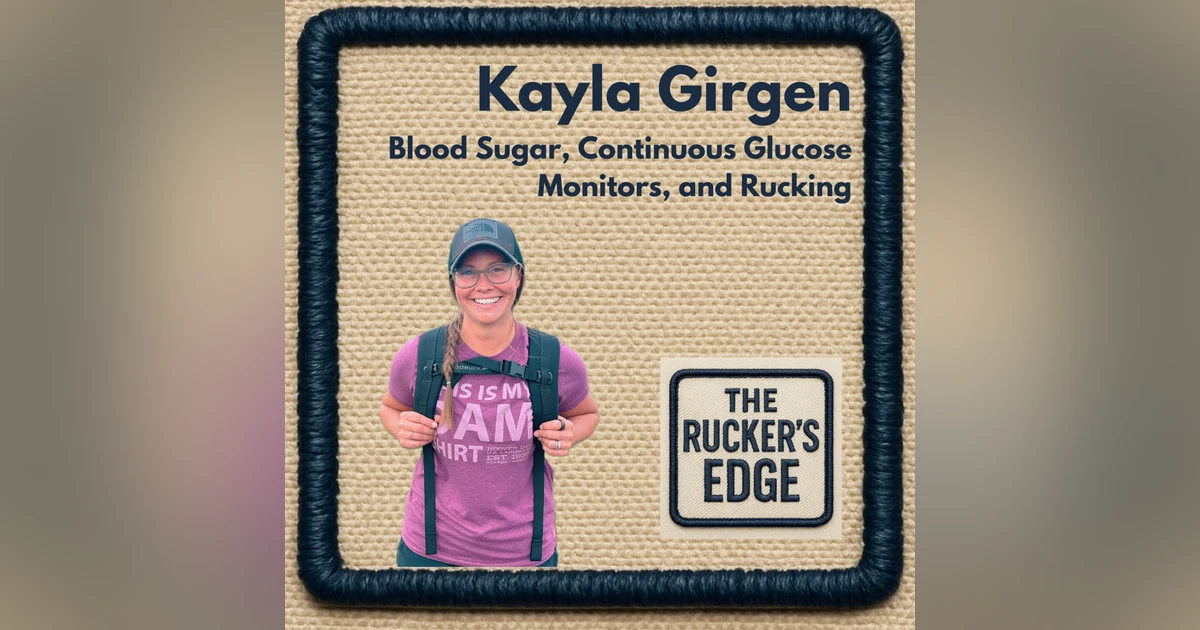


What does blood sugar actually mean for someone who rucks for fitness?
In this episode, registered dietitian and author Kayla Girgen joins The Rucker’s Edge to break down glucose, insulin, continuous glucose monitors (CGMs), and how movement directly improves metabolic health.
You’ll learn:
- What glucose really is and how your body uses it
- The role insulin plays in blood sugar regulation
- What insulin resistance actually means
- What CGMs measure — and who should consider using one
- Why post-meal movement dramatically improves blood sugar response
- How muscle mass impacts glucose disposal
- How rucking compares to walking, running, and strength training for metabolic health
Kayla explains how muscle acts like a sponge for circulating glucose and why building and preserving muscle is one of the most powerful long-term strategies for improving metabolic flexibility.
If you’ve ever wondered whether a CGM is worth trying or how rucking affects blood sugar, this episode gives you practical, actionable insight you can apply immediately.
LINKS & RESOURCES
- RUCK FIT on Amazon: https://amzn.to/4qlVYRS
- Free CGM Guide: https://cgmguide.gr8.com/
- Kayla's website: https://kaylagirgenrd.com/
- Kayla's Podcast: Sugar and Strength Podcast
- The Rucker's Edge – Official Website
- Follow The Rucker’s Edge on Instagram: @theruckersedgepod
NOTES
- Music Credit: “Play This Game” by Black Rhomb.
- I'm not a doctor, and this podcast is for informational and entertainment purposes only. Please consult with your physician before starting any new exercise or physical activity.
0:00 Have you ever wondered what your blood sugar is actually doing during your ruck and if it's something you should be paying closer attention to? Well, I'm here to say it matters more than most people realize. When you understand how glucose works, how insulin responds, and how muscle changes the equation, you gain control over your energy, recovery, appetite, and long -term health. But here's the good news. As a rucker, you're already doing your body a solid because moving your body gives you a direct lever to improve all of it. Today's episode takes you from confusion about glucose and continuous glucose monitors, also known as CGMs, to clarity about how to use movement and muscle to improve your metabolic health. You're listening to the Rutgers Edge podcast, a show all about rucking that is designed to help you improve your rucking routine, lose weight, and ultimately gain your strength and energy back. Each episode dives into the science, stories, and strategies behind rucking.
0:50 You'll learn from top ruckers, coaches, health experts, and performance specialists who break down what it takes to train smarter, recover faster, and stay ready for the next challenge. So whether you're new to rucking or an experienced rucker that's already logged hundreds of miles, this is the show for you. I'm your host, Spencer. Thanks for listening in. Today's guest is Kayla Gergen, a registered dietitian, certified personal trainer, and author of RuckFit. She specializes in metabolic health, blood sugar regulation, and strength training. And she helps clients use tools like continuous glucose monitors to improve insulin sensitivity and long -term health. Her expertise bridges nutrition science and practical strength training. making her uniquely positioned to explain how rucking fits into the metabolic health conversation. Before we dive into the conversation, I wanted to ask real quickly, if this show has helped in any way, it would be amazing if you could drop me a quick review on whatever app you're using to listen to this podcast right now. It helps me bring new episodes every week, and more importantly, more people looking to improve their fitness will be able to discover the podcast. Thanks so much. Okay, here's my conversation with Kayla Gergen. Kayla Gergen, thank you so much for being here on the Rutgers Edge podcast. I'm really honored to have you here. Thanks for joining me. I'm so excited to be here. I'm glad you reached out. Great. Yeah, I think this is going to be fun. You know, glucose has become a significant thing in my life recently.
2:15 I've learned quite a bit about it, and I'm really excited to have you here because I have a lot of questions. I feel like a lot of dumb questions and a lot of questions relating to your book, RecFit. So I kind of just want to start out by talking about what glucose is and what it does for our body. I remember when someone was diagnosed. With diabetes in my personal life, my initial and very naive thought was, oh, OK, so just like stop eating sugar and you're going to be healthy. Right. And I found out that's not the case. But I was hoping maybe you can briefly tell us and the listener what glucose is, what it does for our body and why it's important. Yes, I love this question because and there is no such thing as a stupid question, because especially when it comes to health and nutrition, I think there's a lot of ambiguity. And it's nice to have clarity and make sure we're all speaking the same language, too. Very good foundational things. Very good point. Thank you, Kayla. Yeah. And I think when I like think about the question, what is glucose?
3:15 What I think is circulating oftentimes is like you have to have carbs, which make. glucose, which give you energy. So I think a lot of times we connect glucose to carbs to energy, when in reality, like glucose is that energy currency for our body. Carbohydrates specifically, yes, they do break down into glucose, but your body can make glucose from other things, like other macronutrients, fat. and protein as well. So think of it more so like an energy currency. That is what is circulating through your bloodstream. That's what your cells are grabbing for energy as well and what helps keep us moving. But it doesn't necessarily mean carbohydrates are your only thing that's making glucose, if that makes sense. So let me know if I can clarify anything there. What happens if we were to completely ignore glucose? What if... that person in my life took my advice and said, stop eating carbs or, you know, stop limiting glucose that you take in? This is a good question. And I think a lot of times like carbohydrates aren't essential, meaning we don't have to have them in our diet.
4:24 So when it comes to protein, for example, we have essential. amino acids. So those are the things our body can't make on its own. We also have essential fats. So we have fats that essentially, if we don't eat them, we die, we have zero essential carbohydrates. So it's not something that we have to have. But if they were to remove something, depending on what their diet looked like before, if it was very carbohydrate heavy, it's probably going to be really uncomfortable, like they might get hangry, they might have some drastic blood sugar fluctuations. But eventually with time, they'll convert to using, you know, other fuel forms. So thinking about like the ketogenic diet, like a lot of times if you're not eating those carbohydrates, then your body's looking for alternative fuel sources. It's breaking down fat to generate ketones. So we have a couple different primary fuel sources for the body. We have glucose and then we also have ketones. And sometimes I've had like some clients where they get in the middle and they're eating like enough carbohydrates where they're not getting into ketosis. But then they're also like... not in ketosis. So when they have glucose spikes, like depending on their overall like metabolic health, they just kind of feel this, you know, maybe a little crappy.
5:36 So you can get into what another provider called like fuel purgatory, sometimes where you're not really leaning one way or the other. But one thing that's going to really drive that is what is your metabolic flexibility? Like what's your body's ability to snap back and forth between using those? A lot of times just with our modern diet, we're very sedentary, we let stress kind of take the wheel. A lot of those modern day stressors and how we eat can tamp down that metabolic flexibility. So we tend to maybe prefer carbohydrates and then we feel really bad when we don't have them. But there are alternative ways to get the fuel that you need. How do you know which fuel your body prefers? I would say it's probably different for person to person, like depending on preferences, like you meet those, I don't want to like, for lack of a better term, like keto freaks, they love the keto diet, they just feel really good on it. And we've seen like really promising things, especially people with maybe autoimmune conditions where they just feel like their joints feel so much better. So for someone like that, like maybe they prefer ketones. For the general public, I would say a lot of people are preferring, you know, more of a mixed diet because a ketogenic diet is very restrictive.
6:45 And I would say in either case, you know, one's not better than the other. I think the cliche is the best diet is the one that you can stick to. And I think that that is just so true. So I don't know that I have an answer. What is the preference from person to person? Cause I think that does vary, but I think most people prefer a mixed diet, but it's that underlying metabolic flexibility. Like how, how well can you essentially flip those switches on and off and metabolic health and kind of our topic today will help determine, you know, what. is the current condition of your metabolic flexibility. Okay. Okay. Appreciate that insight. I feel like we're really like going deep right into it. I know, like off the bat.
7:30 I'm sorry. That's just like how my brain works. I'm just insanely curious, specific about this stuff. Let's talk about diabetes. What is insulin's role in the body? I'm glad that you're bringing up insulin because this is the big thing that gets missed. I think a lot of times because looking at our like how we diagnose something like diabetes, for example, is very glucose centric. We're looking at what's your fasting glucose? What is your A1C? And that tells us what your blood sugar is doing. But what we really want to know is what is your insulin doing? And that's something that we. can't see unfortunately but essentially insulin is not inherently bad but it is the hormone that circulates that essentially unlocks the door to let glucose into your cells so without insulin we would just have glucose in circulation you'd have high sky high blood sugar 24 7 so we need insulin to get that blood sugar into the cell but oftentimes the problem is not that it's too much. It's that it's just not registering.
8:30 You've got maybe sticky keys, that door isn't opening like it used to. And that's what we would call like insulin resistance. And we have the insulin there, your body's just not picking up on it like it used to. So what's a good way to measure our health in terms of our glucose levels? Is it just straight up pricking fingers? checking glucose levels or is it cgm so we should we all just pop a cgm on and monitor our body for a week at a time weeks at a time and even when we're looking at cgm what we're trying to estimate is like behind the scenes what's insulin doing it's kind of like watching a play and you can't see what's behind that back curtain like all the backstage production that's your insulin all we can really see is like the play in front of the curtain what's going on that's our glucose essentially And we're really trying to infer like, what's my insulin? So if I see a spike, I'm just assuming insulin is high, but it could have been high even before you ate, for example.
9:30 So I personally love seeing like just what is somebody's fasting insulin? And that tells me at baseline, what have we got circulating? And that can be a really good indicator of insulin resistance. The way that we diagnose now by fasting glucose, for example, so that first morning blood sugar, or even like A1C. I see a lot of times where there's just no urgency. Like we start to kind of see that creep up and usually that's a yellow flag or maybe even red flag in some cases where we're starting to see those glucose numbers creep up, but it's a result of insulin. So if we can see what that fasting insulin is doing, then I think it helps prevent a lot of things because there's so many downstream effects of insulin resistance. It could be blood sugar.
10:15 Sometimes we see like high blood pressure. We also see high triglycerides. There's a multitude of factors downstream that tend to happen as a result of the elevated insulin. OK, now what you mentioned, like a baseline fasting glucose level, what should that be in like a normal, relatively healthy person? Or what's the ideal fasting glucose level? I would say the clinical terms like anything under 100. would be what we call like normal glucose tolerance. But then like prediabetes range would be 100 to 125. And then anything like for fasting glucose, that's over 125. I believe it's two diagnosis. That is what will or two occasions where you have your blood sugar over 125. That is going to be a type two diabetes diagnosis. Clinically speaking, anything under 100, I would say maybe even a little bit lower, like anything less than 95.
11:17 I think it can depend on the person when we're looking at fasting glucose, because I see it in some of my clients. And sometimes I see it myself where we start to have like this natural. rise in the morning, and that's just due to hormones like cortisol or anything else that might be coursing through. A1c is another measure, and that's what gives us a three -month average of what your blood sugar is doing at any given time. Okay. And this is where I love CGM, because it really helps us fill in the gaps, like what is happening? What's happening from, you know, 7am today till 7am tomorrow, it gives us that 24 hour stream of what is your blood sugar doing? Because I see a lot of times where somebody has a good fasting glucose, they have a good A1C.
12:02 But they feel awful. So they have really high highs. They have really low lows. It ends up looking really beautiful because their average looks nice, but they have a lot of variability. And that is what's key is like, what are you fluctuating from your baseline? And I think now we're even seeing we can really dial in on even. Like what I would call pre -pre -diabetes, people who have a lot of variability, a lot of going up, a lot of going down, big drastic swings essentially. And that is a precursor to pre -diabetes and then the eventual transition to type 2 diabetes. Okay. A couple of questions. But first, I think we need to introduce what CGMs are because we haven't actually talked about what they are.
12:43 Can you briefly describe what they are and how they work? Yes, CGM, continuous glucose monitor. This is a little sensor that sits on the back of your arm and it's translating to your phone what your blood sugar is doing in real time. So initially they were made for people with diabetes, so they didn't have to do the finger pricks like in the morning or before meals, after meals. Plus when you're doing finger pricks, you really miss what's going on in between. I see sometimes where it's like, okay, I'm checking my blood sugar an hour after meal, but we sometimes can miss some really beneficial data. on what happened between when you ate to that hour afterwards. Okay. And so with levels, talking about glucose levels, you mentioned variability. Is it safe to say you kind of want a consistent, stable level throughout the entire day and trying to avoid those spikes and crashes? more rolling hills like visually I like to see like nice like sloping hills what I want to avoid is mountain peaks so really sharp high or really sharp steep climbs and then the sharp drops there are some telltale signs there's one in particular thinking about insulin resistance if your blood sugar jumps up and then it stays high that is a pretty big red flag to me that we've got some insulin resistance. It can be situational, like if you have a really stressful day or maybe you didn't get great sleep the night before, that can show up. But if it's something that we're seeing trending with almost every meal, then that tells me that
14:13 maybe we have some bigger underlying issues. Okay. So I was fortunate enough to be able to use a CGM for the past four weeks now. And I have observed that My glucose levels are relatively stable, but I have seen on occasions I'll eat something. OK, let me back up. It's carnival season down here in Louisiana. So I've been having king cake like no other. It's I don't know if you're familiar with king cake, but it's basically like a cinnamon roll. I just learned about king cake last week. I had a client who was like, I like had king cake, been eating that all week. And I was like, what is king cake? Because don't you don't you find. Is there a baby in it? There's a baby in it. Yeah, like it's a whole thing.
14:54 That's like a whole other conversation. And there are every bakery during this time has a king cake and there's a lot of debate on who's the best. But I have been having a lot of king cake. And what I have been seeing is I will immediately spike like very quickly because it's a cinnamon roll or cinnamon bun and then immediately crash and then go back to. my normal like range where I usually am. What is a immediate spike and immediate crash mean as opposed to maybe just a spike and then going back to a normal baseline? That's what I would call reactive hypoglycemia. You get that sharp spike and then you get the drop below your baseline. So I'd be curious. It sounds like you're kind of hanging out, like say, let's just say like 90, for example, jump up to 200.
15:48 And then say when you come back down, you're dropping to like 70. So that when your blood sugar comes back down, you're dipping below that baseline. Is that what you're saying? Yeah. Yep. And that would be a case of reactive hypoglycemia. A lot of times it can happen an hour to three hours after eating. And that is essentially your body's kicking out too much insulin. So your body's trying to cover that extra blood sugar. It ends up kicking out too much. And then it really pulls too much sugar out of your bloodstream. OK, gotcha. Yeah, I'll go to like 140 and then like immediately turn around, go back down to like 70 before it comes back up to like 90. Do you feel like crap? Like do you feel symptoms? Like what do you feel? Oh, I just I feel like kind of thought maybe foggy and I feel like just off, like not necessarily that I'm low energy, but just like kind of not. Yeah, just not normal.
16:38 I don't know. Maybe because it happens so quickly. I'm not really that in tuned to it. But yeah, I just I feel off. But I also drink a lot of coffee. So that also has something to do with it. I would say it's the blood sugar. A lot of people feel that like shaky, fainty, intense hunger. It's almost like you're grabbing your desk, like just waiting for a crash landing. Yes. Yeah, that's exactly it. I have a fun experiment for you. Like one thing that would be really interesting, because the nice thing is it is preventable. You can still have your king cake and enjoy it too without the crash. But having some protein beforehand, having, I don't know. Greek yogurt. meat stick protein bar and then having your king cake okay if you do that experiment and then see what happens i bet that will fix the issue because then you have a little you have a little base versus having that all by itself okay thank you there's there's king cake in my near future and i will see if i can put some protein in my body before then yes protein and then yeah it's what i like to call cushioning your carbs you're basically cushioning your carbs with something and that a lot of times can help resolve the issue Someone gave me a tip. You learned recently that if you eat your fiber before your meal, it's supposed to help out with your glucose levels. Is that accurate? If we eat a salad before we have dinner or something like that? That's another strategy. Yep. Fiber is great because especially soluble fiber. I've had like some people they'll do or what I've heard some people doing is like shooting chia
18:08 seeds or like letting them soak. And when they get gels or psyllium husk, if you want to be extreme about it and not do like a green starter, like actual food. I haven't trialed this, but essentially that fiber creates a net. in your stomach. So it gels and things release a lot slower. So that can help buffer that a little bit. Fat is another one too. I would imagine there's probably some sort of fat source in there, but usually something like a protein, a fat fiber, or a combination of those. So like you had mentioned, maybe it's like a green salad with, you know, a vinaigrette. But that might not go good with king cake. I think king cake goes well without anything. But that's just me. OK, going back to CGMs, who should be wearing a CGM? Is it strictly just for people with diabetes or should any other area of the population be wearing one? I think that's the misconception is that CGMs are only with for people with diabetes. I even had mine on last summer and the neighbor girls were like, do you have diabetes? Like this was a nine year old, like they're associating a CGM with diabetes.
19:15 And I might be biased, but I think that we could. get a lot of preventative medicine from something like a CGM. Even if you only could use one or two, I feel like that would really change the way people eat a lot of times. I don't know if just having that data, like what you've experienced over the past four weeks, those first couple of sensors are going to be what you learn the most from. So I think anybody could benefit. I would say, especially if you maybe struggle with, if you feel like you're maybe weight loss resistant, if you feel like the scale is stuck, going back to the beginning of our conversation, that can help see like, okay, What are my trends looking like? It can give you an idea of like that metabolic flexibility and, you know, later signs of insulin resistance too. If you have something like prediabetes or you fall into that like 5 .7 to 6 .4 range for your A1C, that's the best time for prevention. And I see so often where it's like, oh, my doctor said, we'll just keep an eye on it. Like things are creeping up, but we'll keep an eye on it. And it's like, no, like that's a red. when things are trending up and now's a great time to make that change. So I might be biased, but I think everybody could benefit. These aren't prescribed, right? Anybody can just buy them. And if you're curious, you can pop one on and monitor it for a few weeks, right? Thankfully, the U .S. finally got on board up to, I think it was the summer of 2024, you had to have a prescription in the U .S. I think a lot of other countries, Canada, U .K., you could get them over -the -counter. Finally, we
20:45 have over -the -counter CGMs now. So the big ones, Dexcom, Stello, LibreLingo, those are the two that are available. And you can get a prescription through your doctor, too, even if you don't have prediabetes or diabetes. you have access to as well. I will say with the prescription ones, they have alarms. So if you have high highs or low lows, sometimes the alarms can be a little annoying for the general population. So I'm using the Dexcom Stello. Is that right? Is Stello the name of the company that makes it and Dexcom is the name of the product or I have it backwards? Dexcom is the company, like the manufacturer name. And then the Stello is the model. That's probably my personal favorite. That's what I use with all of my clients and my group programs.
21:30 It's pretty small. You stick it on the back of your arm and it doesn't bump into anything. It's a pretty decent spot for it. And I haven't taken it off yet, so I don't know how that's going to go. But we'll get to that when we get there. Sometimes that's the hardest part. I will say a little bit of alcohol on like a Q -tip or something if you need to work up the edges to get under that adhesive. Because sometimes, yeah, you might lose a little arm hair with that. Yeah, just a little bit. And I was surprised applying it. I barely even felt it. Like there's a fine needle in it and it goes into your interstitial fluid. Is that right? It's like it's not going into your bloodstream. It's kind of going into interstitial fluid, I guess is what it's called, right? You have done your research. I'm impressed. We've learned a lot over the past couple months. But yeah, I was expecting like to actually feel some sort of pain, but like I didn't feel anything.
22:21 You hear the click and you're like, oh, is it on? It's on there. And essentially it's just like a little filament. It looks like fishing. Five millimeters long, it sits right under your skin. And like you said, it reads from that fluid between cells or the interstitial fluid. So it does tend to lag like your true blood sugar reading. So I find sometimes for people who are checking like morning fasting glucose with a finger prick. Oftentimes there is a variance between your true blood sugar and your CGM. So that's one reason why I like to look at variability on your sensor because that accounts for any sort of like your sensor running high or low. More with Kayla in just a moment, including how rucking compares to strength training and walking to regulate blood glucose levels. But I want to take a quick break to say thanks for listening to the podcast.
23:11 Please text this episode with a fellow rucker that might find it interesting or a friend that could benefit from rucking. Sharing this episode would help the show grow and help more people improve their health and lives. Okay, back to it. We previously talked a little bit about diet in that if you have protein or maybe some fiber prior to consuming carbs, they could help with your numbers. But one of the biggest things has been And speaking in my own personal experience is movement. So if I'm moving before or after or around consuming a meal or consuming some carbs, my levels are significantly better. And it's crazy how much better they are when I'm moving versus being stagnant or not moving that much. How does that work? What's going on in the body where movement is improving our numbers as opposed to just sitting around? and having our numbers go haywire. Basically, when you move, it's pulling that blood sugar into your cells without insulin. So you don't need insulin. You kind of bypass that. You can open those doors to get into the cell through that muscle contraction.
24:20 And this is especially great for people with insulin resistance where they have insulin in circulation. It's just maybe not catching. And it's wild how fast your levels can drop. I've had a couple of cases where, you know, maybe a client with prediabetes or type 2 diabetes, like their blood sugar jumped after a meal. Maybe it was like higher fat or something where their blood sugar stayed really high for a long time. And then it's like, OK, just get out and go for a walk for 10 minutes. And then we see their blood sugar just plummet almost because you're just taking all of that in without the need for insulin. I mean, it's pretty miraculous. Like I just kind of I did a test and. It was almost it was immediate. It was within, you know, days of, you know, eating something, not moving, eating something, moving. And they were just drastic.
25:08 Granted, there could be some variables in what I ate, but it was it was enough to note. That's one of my favorite experiments is when you're doing. a meal, and then you have that same meal, and then you go for a walk or do something afterwards. On your CGM, it's so fun to see that. Maybe that's just me nerding out about it. I'm going to, no, I find it really interesting too. I'm going to replicate that, except this time I'm going to eat the same meal and then do it between two different days. How does, okay, this is the Rucker's Edge podcast, so we have to eventually start talking about rucking. How does rucking compare to walking, running, and lifting when it comes to glucose response? Thinking back to what we were just talking about, basically the movement, letting that blood sugar into your cells, you get that benefit. You're contracting those muscles.
25:56 What I would say that rucking also adds is you get some of those strength benefits too. So while you're holding onto that muscle mass or maybe somebody who's new to movement and new to rucking and you really start to maybe lean out a little bit or maybe put a little bit of muscle on, the more muscle you have, the greater you're going to see some of those benefits of movement. So after you eat a meal, go for a walk, for example, your muscle is responsible for 80 % of that glucose disposal. So I like to think of your muscles as sponges for that circulating glucose. So the more sponge you have, the better your glucose response. And with rucking, you get that. that muscle contraction, that endurance benefit, but then you also get the strength. So you're holding onto and maybe even building muscle. So you really get the best of both worlds. Yeah, that's awesome.
26:47 I hate to rank it, but it sounds like maybe strength training might be better than rucking. Rucking might be better than walking. Is that a safe assumption or not necessarily? I don't know. I always struggle because I think that one's better than the other, like the either or. It's like I always like a combination of both. And even with rucking, it's like, OK, well, maybe today is light and long or maybe it's a short and heavy ruck, like varying within the rucks. But I feel like we're probably biased, too. Like, I just yeah, I don't know. I love rucking and I feel like that it for me, it's primarily cardio. And then I don't feel bad if I, you know, maybe. don't get that extra strength training session in because I justify it by saying, oh, I had a heavier ruck this week or something. Yeah, I get that. So going back to muscle kind of pulling the weight in terms of glucose response, does carrying more load during a ruck improve your glucose levels just a little bit more? Well, in a couple scenarios. So I can see that. Like looking at immediately post meal. So you've eaten a meal, heavy ruck. I think there's a, you almost have to find a balance or a sweet spot where you're not impacting your digestion too. Because I can see where if you go really heavy, like this might be a case where you do something light or moderate post meal, just so you're not. you know, restricting the blood flow to your stomach, for example, going too hard after a meal, I can see where, okay, now I've got a stomach ache.
28:13 I'm not digesting my food well, because my body's demanding work to all of my other muscles. But aside from a meal, I would say rucking heavier is going to get more of that muscle benefit. And like you said, muscles really pulling the weight. You touched on timing there a little bit. Is there an optimal time to do movement post? consuming a meal if you can get it in like 10 20 minutes so if you're like eating dinner cleaning up and then heading out the door usually that's pretty good i want to say the benefit is like up to i'm trying to think it probably depends a little bit person to person like looking at your cgm data like where is that peak happening that's going to help you probably define like okay where is my benefit sloping off like when your blood sugar starts to come back down Maybe you've bypassed some of that benefit. So the closer to your meal, probably the better if you want to get max benefit versus rucking an hour after a meal, you might miss some of that, if that makes sense. You want to move while it's still climbing? Exactly. Gotcha. Okay, good deal.
29:21 And keeping in mind the CGM might lag a little bit. So a lot of times, for example, you said you're using the stello. I want to say that that's updating every 15 minutes. And because it's reading from the interstitial fluid, you might have some sort of a leg. Oh, I didn't even consider that. Yeah, you're right. I don't know why. Maybe in this world of immediate gratification, I just thought, oh, it's instantaneous. But yeah, it makes sense because you're not actually reading the blood. Yeah, there might be some transfer there between your... blood and your interstitial fluid, and then the delay of the technology, maybe. Is that what you're alluding to? Yes. And then the Stella itself, I want to say that pulls a reading every two, gosh, what is it? Two to five minutes, maybe. It's pulling a reading, but just to save your battery life, it's only sending the info every 15 minutes to your phone.
30:08 So especially when you're new to it, you're refreshing every 15 minutes trying to see that data. It's very addicting. I think when I looked at my phone pickups, when I first wore a CGM, I was like, oh my gosh. checked my app 36 times today or something. Yeah, for me, I experienced that. I'm like, wow, like I'm living in the future right now. I can see what my body's doing in real time on this device that I'm holding in my hand that's connected to my body. This is so weird. But yeah, yeah, you're right. Like when I popped it on, I was I was looking at it quite frequently. I got really into it. Like I was logging meals and everything. But since then, I've gotten a little lazy after I've sort of realized my number. It loses its appeal after the first couple of weeks. OK, it's not just me. That's, that's good to know. Yeah. It was kind of like a honeymoon phase. Exactly. I don't know if that sentence has ever been said before, but it just has. I have something that I can maybe add like appetite wise too. Sure. I would say a personal antidote or something that I've observed is I love rucking because it doesn't spike my appetite. And now that's just me, but I would say some exercises like HIIT training or something that's really intense, like a run.
31:16 Maybe I do find that some people's appetite is greatly affected, but I feel like rucking is something you can do for a prolonged period. You can really dial in that intensity, but I would say I... also just feel like it doesn't spike my appetite like a lot of things. I don't know if you've noticed this. Oh, yeah. I could totally see how that's, yeah, that's the case. When did you start rocking? When did you get into it? This was pandemic for me. I would say it was 2022, maybe. I actually heard Michael Easter talking about it on a podcast. And I was like, okay, this sounds pretty cool. Like I can burn fat, build muscle. and bone density all at once. And then it was the spending time in nature. And I would say the mental clarity and release that I got from rocking that really made a big difference. Yeah. Same. I, yeah, a buddy of mine got me hooked in rocking around that same timeframe during comfort crisis. I think Michael Easter was on. The Art of Manliness podcast talking about it. And yeah, I was hooked as well.
32:18 I wasn't as hooked as you, though, because you wrote a book about it, Ruck Fit. Talk to me about that. What was your inspiration for writing the book? My inspiration with the book was really to bring rucking to the average person because when you look at rucking and its roots in the military, it can be very intimidating. And before we even hit record, it's like, okay, you think of, do I have to ruck with my body weight on my back? And it's like, no, you don't. Like you can start with 10 pounds. Maybe you're working your way up. And I think there's so much to gain. It's a very low barrier to entry and it gets people outside. It gets people out of their head. You can use your ruck to strength train. So I go through talking about a lot of the benefits. I do a whole gear survey, like what's better, a weighted vest versus a ruck plate carrier versus a rucksack and maybe other equipment to consider, especially if you're in, you know, maybe different climates. I'm in Minnesota, so we ruck a lot in the cold for half of the year. And then I also include things like strength training exercises.
33:17 So how you can use your ruck essentially as your strength training buddy. And then I also have to talk about things like CGM and nutrition because I had to put my dietitian hat on for a little bit too. Right. Oh, absolutely. You're a registered dietitian. You have to squeeze that in. I get it. Who is it? Who is it for? Is it for someone new to rucking? Is that fair to say? It's best for new people, but I did put advanced plans, too, because I really wanted to offer something for everyone. So I have specific training plans, everything from a 5K if you're new. And then what I found just the longer I'm in, I think, the rucking community is there's a lot of people that want to start pushing themselves. Like, OK, I want to start rucking heavier, longer distances.
33:58 We're seeing, I think, more rucking races. Maybe I don't know if I'd say races, but challenges. wanted to give people a format for that. So I do have all the way up to like a half marathon or a 25k in there as well, especially I feel like we're seeing a lot like with Go Ruck, for example, I mean, they're notorious for having anything from a family event that's maybe super easy to selection where you're just the goal is to weed as many people out as possible. Yeah. So did you you drew off of your experience and knowledge being a certified personal trainer to put those plans together? I did. Yes. Where did you get your start being a personal trainer? It was my pivot out of corporate life. Essentially, it was a way to get away from my desk job. And I just found like on basically my free time, I was looking at things like bodybuilding .com and Women's Health Magazine. This was before we got all of our information from social media or podcasts. So those are my resources. And I just decided to turn it into a career. And that was my pivot out. And then essentially, when I was training to get my personal training certification, that's when I found out what a dietitian was.
35:05 And I was like, Actually, I think that's what I want. So then I ended up going back to school to get my RD as well. Hey, that's awesome. Wow. Good for you. I was the old lady in classes. Yeah. Oh, yeah. Oh, wow. That's so cool. But like there for a purpose, like you were there for business. Let's do this. Did you learn anything interesting while you were writing the book that kind of stuck in your mind? Anything surprising or anything like that? Some of the statistics were a little bit jarring. I think when we're looking at. kind of thinking about our conversation today, I share a little bit about like metabolic syndrome, which ties closely to things like insulin resistance and how muscle weaves into that picture.
35:46 So I think that was a little bit shocking to hear. Like I think 40 % of people are walking around with either metabolic syndrome or prediabetes and they don't even know it. Working on your muscle can be a big part of that. And that's why I love CGM and rucking. I feel like the two of those work really nicely. And also just how muscles are essentially an organ of their own. So when you're working out, you're releasing all of these anti -inflammatory molecules. And I think one article said it was like up to like a thousand different things that we just haven't discovered yet. So the more I learn about things, the more I'm really appreciative, I think, for the impact of what our muscle is doing and trying to help. People preserve that because when we do really strict diets, for example, it's like we're risking maybe losing some muscle mass.
36:36 And it's like, what can we do to help preserve muscle? Because that's going to help, one, your fitness, but then also how you metabolize your food, too. Gotcha. And you also have a new podcast, which I'm very excited about. It's called Sugar and Strength Podcast. Same question. What's the inspiration for the podcast? Imagine blood, sugar and strength. But I thought that maybe doesn't sound as nice. Like when you're talking like the blood, sugar and strength podcast. That could be a little. That could be a little jarring maybe on the first read. Exactly. So that was my goal. I know, you know, we kind of talked loosely about social media before this. And like, it's just, it's difficult to get your point across. I think sometimes in social media, and there's so much noise, my goal was to kind of take my expertise and put that filter on and help people sort through it. Because I don't think it's a shortage of information that we need. It's how do we filter out what matters to us and turn that into action.
37:32 I see a lot of people stuck into that perfect planning phase or procrastination. Like I just need to do this and then I can actually take action on the things I want. So my goal was to help turn that into tangible things, have more nuanced conversations. Instead of 90 second story on Instagram, essentially. I listened to the trailer that you have out for, or maybe it's episode one. And man, some of your vocabulary, the words that you've made up about procrastinating, procrastinate clean. What was the other one? Procrasti -snacking. That's my favorite. Procrasti -snacking, yeah. I'm going to start weaving that into my personal life because I like that. I like that a lot. I find it really entertaining.
38:17 I also, in the trailer, you mentioned something about doing AMA episodes, which is such a cool idea. I will definitely be submitting quite a few more questions for you because I bombarded you in this first quarter, a quarter or a half of this episode with questions. I have so many more, but I don't want to take up too much more of your time. But I will definitely be submitting some more questions via AMA. What are you looking forward to the most with the podcast? I'm looking forward to setting the foundation for people, first of all, like, okay, what is my nutrition philosophy, and then having a platform for more nuanced conversations, because I think there is no one size fits all. So if I can give people more tools, and then they have that in their toolbox, they can pick and choose when to use them. Because I find a lot of times something might not be relevant now, but you might think back or, you know, six months from now, it'll be like, oh, I remember this. I'm going to go back and, you know. maybe take more of that to heart. So giving people more tools, whether it's nutrition, CGM, rucking, that they can use in their real life. Because, you know, as much as we want to overhaul everything overnight, I feel like that just sets us up for failure in the long run. And as unsexy as it is to just like make small changes over time, I feel like that's what really kind of gets things turning in the right direction. I feel like that's an excellent purpose. Well, thanks for sharing that, Kayla.
39:47 And I have one last fun question for you. But before we get to that, I just want to say I had a lot of fun during this conversation. I really appreciate you coming on, sharing your knowledge and your expertise. And I wish you the best of luck with RuckFit and your new podcast. And so for the last fun question, I've been asking the last couple of guests just because I think it's kind of fun just to see other people, how creative they can be. If you could create a bumper sticker about rucking, what would it be? Ooh, I'm a sucker for puns. So wherever you can put the F word, like you can put ruck. Yeah. But I feel like that's been overdone a lot. One thing that I want to put on a t -shirt, which would probably be appropriate for a bumper sticker, is ruck around and find out. Yeah, I like that. Like R -A -F -O. Yeah, that's really good. Well, Kayla, really, I said it before, I really appreciate you coming on. Thanks for sharing your expertise with us. Yes. Thanks for having me. All right.
40:43 That wraps up my conversation with Kayla Gergen. Check out her book, Ruck Fit. It's available pretty much everywhere, but I included a link in the show notes for your convenience. You can connect with Kayla at her website, KaylaGergenRD .com. That's K -A -Y -L -A -G -I -R -G -E -N -R -D .com. Also check out her new podcast called the Sugar and Strength Podcast. I've listened to the first couple episodes. She's really onto something there. I'm really enjoying them. You might find them interesting too. And lastly, Kayla's been pretty generous and is sharing a free CGM guide if you're curious. I included a link in the show notes. If you want to reach out to me, head on over to theruckersedge .com or on Instagram at theruckersedgepod. If you enjoyed today's episode, make sure to go ahead and follow or subscribe to the show in your favorite podcast app so you're notified of the new episodes.
41:30 All right, that's it for today. Thanks again to Kayla for sharing all of her expertise. And thank you very much for listening to this week's episode of The Rucker's Edge.