Rucking Nutrition 101: Fueling Before and During Your Miles with Kyle Kamp (Part 1)

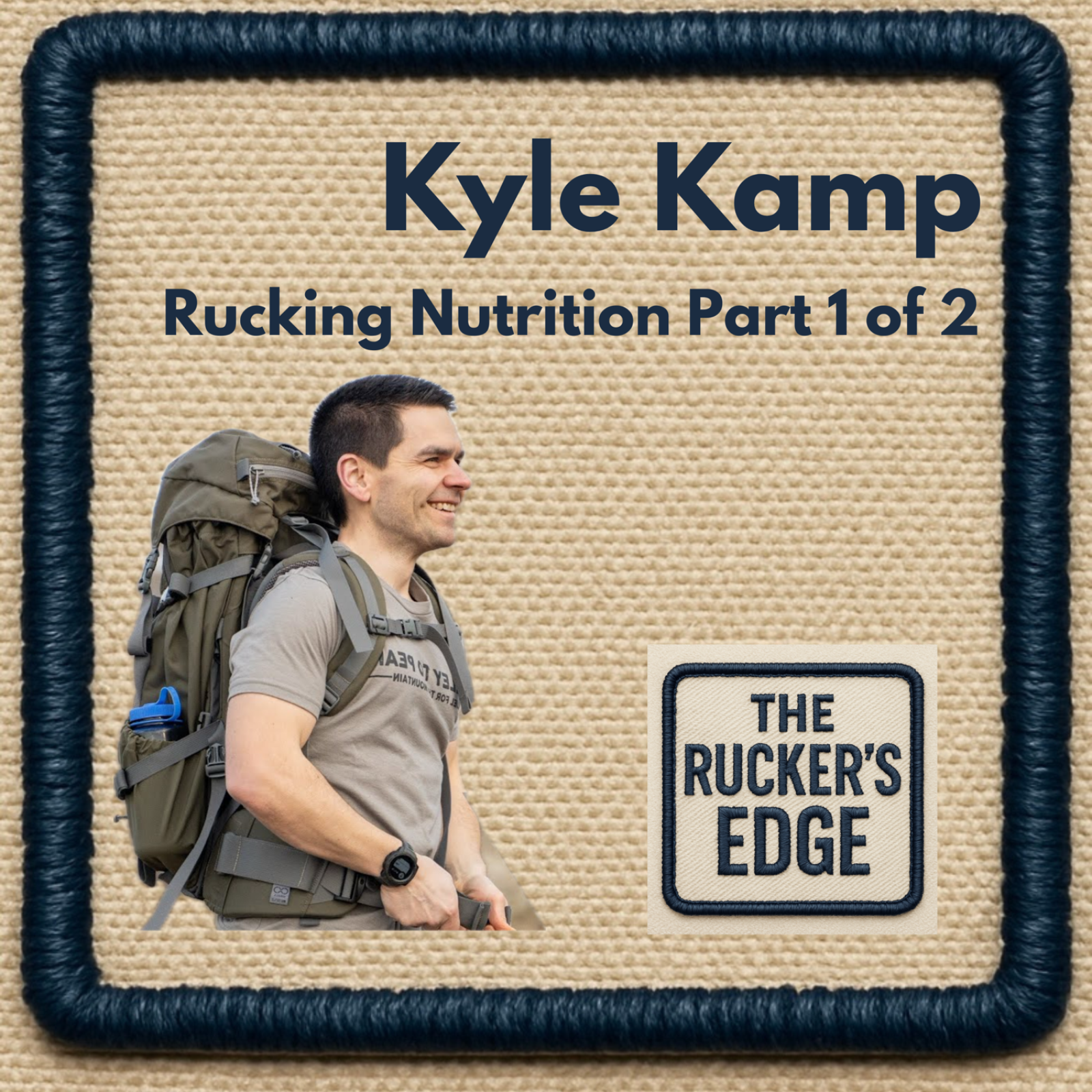


Today’s episode is Part 1 of my conversation with registered dietitian Kyle Kamp from Valley to Peak Nutrition, and we’re breaking down the fundamentals of rucking nutrition. Whether you’re prepping for your first 5-mile ruck or training for a 12-hour endurance event, fueling matters — and Kyle makes it simple.
In this episode we cover:
- Why overall nutrition matters more than your pre-ruck meal
- When carb loading actually helps (and when it does nothing)
- How caffeine boosts alertness but doesn’t provide true energy
- What to eat during longer rucks — including quick carbs that digest easily
- Why protein does not fuel your rucks
- How to personalize your fueling strategy to match your intensity, terrain, and environment
- Practical hydration advice: electrolytes, sodium, and how much water you really need
If you’ve ever been confused by nutrition advice, overwhelmed by supplement claims, or unsure what to eat before and during your rucks, this episode will finally give you the clarity you’ve been looking for.
Links & Resources
- Valley to Peak Nutrition: https://www.v2pnutrition.com
- V2P Podcast: https://www.v2pnutrition.com/podcast
- Follow Kyle on Instagram: https://www.instagram.com/v2pnutrition
- Follow The Rucker’s Edge on Instagram: https://www.instagram.com/theruckersedgepod
Notes:
Music Credit: "Play This Game" by Black Rhomb.
I'm not a doctor, and this podcast is for informational and entertainment purposes only. Please consult with your physician before starting any new exercise or physical activity.
0:00 Have you ever started a ruck feeling great only to realize halfway through that your energy is dropping, your legs feel heavy, or your brain starts checking out? Yeah, most people assume that means they need a better pre -ruck meal. But today's guest is here to tell you that's not the whole story. This is part one of two from my conversation with registered dietitian Kyle Kamp. Kyle is the owner of Valley to Peak Nutrition, an online nutrition coaching service for outdoor enthusiasts and the host of the super informative Valley to Peak Nutrition podcast. During our conversation, Kyle breaks down the fundamentals of fueling for rucking, but without the complicated science, conflicting advice, or overhyped supplement talk. In this episode, you're going to learn why most ruckers are focused on the wrong meal, the truth about carb loading, how caffeine really affects your performance, and exactly when you do or do not need to fuel during your miles. You're listening to the Rutgers Edge podcast, a show all about rucking that is designed to help you improve your rucking routine, lose weight and ultimately gain your strength and energy back. Each episode dives into the science, stories and strategies behind rucking.
1:05 You'll learn from top ruckers, coaches, nutrition experts and performance specialists who break down what it takes to train smarter, recover faster and stay ready for the next challenge. So whether you're new to rucking or an experienced rucker that's already logged hundreds of miles, this is the show for you. I'm your host, Spencer. Thanks so much for listening today. Please enjoy part one of my conversation with Kyle Kamp. Kyle, thanks so much for joining me today on the Rutgers Edge podcast. It's really good to have you here. Yeah, it's awesome to be here. I appreciate you inviting me, Spencer. I'm excited. Looking forward to it. Absolutely. Same here. I'm looking forward to getting some of the valuable information that you have for us with your extensive background being a registered dietitian. And I have a lot of questions that I've had over the years, and they've also transitioned or translated to me rucking that I'm hoping that you can clarify for myself and the audience. But I kind of want to start out with. how I should be preparing my body for a ruck. Let's just say maybe the day before or right before a ruck. I know that balancing protein, fats, and carbs is pretty essential or key. What does that balance look like when you're preparing for a long ruck? I would take a step back and look even at a broader perspective of a person's overall nutrition.
2:25 And I mean that in this sense, one meal prior to a rock is not going to have any impact on that performance for the most part. Now I'm going to come back to that statement here in a minute. Okay. If you are genuinely looking to make the most out of that rock, like let's not even talk about weight loss or body composition or anything of that nature. Let's just talk about energy in that rock. That is going to come in the meals preceding that rock by potentially days, right? So nutrition is largely driven by consistently doing something long enough to where you notice that impact. So for example, If a guy has an atrocious nutrition regimen, maybe he has none at all, gives no thought to it whatsoever, and then we have this conversation about, oh, how do I maximize the meal right beforehand? He will never feel the effects of that meal, even if it's quote -unquote optimal before the rock, because his nutrition preceding that is so...
3:35 you know, let's, let's just use the word atrocious. Sure. So atrocious that, that, that meal is not going to have any impact on it whatsoever. So I think taking a step back from that in a broader sense and having people look at your overall nutrition level. So let's start there and then we'll kind of lead into this, this, this question that you're really asking about. What about right before? Sure. For the most part, like, as I use the word atrocious, what I mean is not even that you're eating quote unquote. what people would label as their typical quote unquote bad foods. There are three main macronutrients that we get what we feel from. So you have carbohydrates, which main job is to provide energy to the muscle.
4:17 You have protein, which is the main job to try to recover, grow, or retain the muscle. And then you have dietary fat, which the main job there is to transport hormones and to have optimal health, transport nutrients, et cetera. So when I say atrocious nutrition, if you have a guy who is not having a mixture of those different nutrients, he is probably going to lack in one of those areas, be energy, be it muscle retention or growth, or be optimal health. So when you're talking about like general nutrition, you want to try to have a mix of those nutrients as a part of each meal throughout the course of the day so that you can get each of those benefits from said nutrients. Now, if a person's doing that, then you can... start to have that conversation about what should I eat right beforehand? And we would funnel this under the category of meal timing, right? So like, is there any benefit in trying to have something one hour before my RUC? And I know we're going to talk about some post -RUC nutrition, but as a part of that, do I need protein immediately after I get done with the RUC or I lose out from the benefit of that RUC? We would funnel all of those under the category of meal timing. okay and what we find is this if you have pretty good nutrition habits in your daily routine you really don't have to pay attention
5:49 to or focus on pre -ruck nutrition you don't have to focus on this category of timing because our bodies are so great at being able to adapt based on what we've already had and what we need in the moment it can It is like a pendulum. It can switch and begin to tap into some of those nutrient stores to where you may not need anything before the rock. I definitely understood the fact that, yeah, you need to eat healthy all the time, not just right before. But I am curious. So for someone that does maintain somewhat of a pretty decent nutritional balance, what's the ideal timing before like a good breakfast before going out on a rock? Is it sort of like swimming, like you eat and you wait 30 minutes? Or is it more maybe have a small snack and then get going a few minutes later? It's going to depend on the composition of what you're eating. And here's what I mean by that. If you eat a mixed meal, if you eat a meal that is substantial and has a mix of the different macronutrients, carbohydrates, proteins, fats, and I'll give you an example of that here in a little bit. It's going to take longer for that meal to process than if you were to eat something light and predominantly only carbohydrate based, right? And so the process of a meal from the point in which you eat it to the point of where you get the nutrients from that meal to where it has an impact on your ruck,
7:19 to where that meal is actually affecting whether or not you're able to get through your ruck strong or weak. is a period of time of hours. So you may not even be getting the benefits of that meal until you're back. So if you eat that meal and you go on a rock and it's a meal that takes a long time to break down, you're not even, probably not even getting the benefits of that until you are back home. An example of that would be like for breakfast, let's say it's a... bowl of oatmeal with some fruit and a couple of eggs you have a cut you have a you have a mixed composition there of proteins carbohydrates and fats whereas if you were to take something in like a piece of fruit or a box of raisins or even a handful of breakfast cereal or glass of juice or a handful of grapes those are all examples of straight carbohydrate and relatively easy to break down carbohydrate so now you go from a period of processing that could take hours down to potentially minutes and you don't have to wait and you are getting the effects of that nutrition on the rock so a lot of being able to answer that question of okay well what's a good you know what should we eat before rock the answer there really depends on well how long do you plan to have between consumption of that meal and the beginning time of your rock. If you have a while, maybe a good solid mixed composition breakfast is a good option.
8:47 You have a long time to break that down. If you don't have that much time, then maybe now you're looking at something that is lighter, mainly carbohydrate and easy to break down. Okay. I see what you're saying. And when I was, I used to be a runner a couple of decades ago at this point, and I was always told to, to, to carbo load before, before your runs. And we would do a lot of pasta the night before, I guess, is that the theory that if you eat like a lot of carbs that, that much or that many amount of carbs beforehand, you kind of need enough time for your body to process it before, before your run. So you'd go heavy on a pasta meal the night before. Well, it's not so much about the pasta and the carbohydrates the night before and that needing a long time to break down as much as it is the total composition and the introduction of proteins and fats because protein and fat slow the digestion of carbohydrate, right? So now you go from a period of potentially minutes, like I said, to hours because it takes a while for... the gut to break those nutrients down so if you eat carbs with proteins and fats there's going to be a prolonged period of breakdown between consumption and actually an actual delivery of energy to that muscle but the like what you're talking about with runners in carb loading which is a phrase that a lot of people are familiar with especially in the running space and community that has to do with my comments earlier on your general meal habits. Because the theory there
10:19 is that if you eat carbohydrates, a large portion of carbohydrates the evening before, while you're sleeping, your body is taking that carbohydrate and depositing it into the stores of your muscle. So that when you go to that race the following day and you begin depleting your current stores, there is a resource or a hub to now tap into that is full. right and so if you didn't do that and that hub was also dry now you're now what right and that's the wall that's the wall that people describe in running or rucking or any any type of performance pursuit that they hit is they they're they're depleted from energy either because they don't have good nutrition habits in general or they didn't you know quote carb load and carb loading like conventional conventional recommendations or historically we've always said, you know, you eat a big bowl of pasta the night before. And in all reality, a good carb load is the reduction in training met with an increase in carb intake over the period of several days. Okay. Right. So like one meal the night before is not going to make or break you. And I'll throw this in there too, just so people who are listening, don't get confused.
11:31 You, you know, you do not need to carb load before a rock to make the most out of that rock. Most rocks, um, are not, are not that long, right? You don't have people out there rocking three, four or five hours. Now they will on a weekend event or an occasion or something like that. But most training rocks, most daily rocks that people are doing are not what we would throw into the category of an endurance event. Thanks for clearing that up for me. I was a little confused on that. Now that you've covered how to approach the different macros that we consume, what about these supplements, specifically caffeine? I love drinking coffee. I need coffee in the morning.
12:13 Should we avoid caffeine before rucking? I don't think you need to avoid it. However, I am also not going to recommend it to the way that you will read most supplement companies pushing it because what we find in research is There is some data to suggest a significant increase in performance, whatever you describe that as, with an athlete who takes caffeine. Now, when you read that actual research, what you find is mostly a cognitive benefit. In other words, there's a perception of increased energy, so therefore the person can now push harder, right? And to me, depending on the intensity of a person's exercise, I don't love mixing things that already tax the heart more than what it's already being taxed in the physical sense. So if you take someone who is a sprinter in which the intensity is very high, if you go adding an additional aid that then makes that heart rate even higher, I don't love the tax on the heart in that example. Now, if you take a person who throws a 45 -pound rock on, and walks on flat ground and they're, you know, relatively familiar with doing so. It's not a new endeavor to them. They're probably not taxing the heart that bad. And so, but they also may not need caffeine. So, you know, I'm
13:46 not going to say that you need to avoid it, but I'm also not in the camp that believes that it's a make or break type of supplement. Sure. And in the world of supplements, you know, that to me is the point in which you should you should you should look at and decide whether or not you want to take them and that is it with this supplement do i notice this significant change in my ability to do x y or z and if my answer to that is no then the the potential benefit that i was taking it for now becomes theory right and if i can't feel it and it's theory do i want to spend my money on that do i want to spend my time and brain power trying to remember to take that in a certain cadence as recommended by the supplement company and you know you just don't find too many supplements where the answer to that is like oh yeah that that pain is worth doing so i'll do it yeah and i think i always had a misconception about what caffeine actually does i always thought caffeine gives you energy but correct me if i'm wrong recently found out that's not necessarily the case caffeine just prevents you from being tired does that sound accurate to you that's 100 accurate right so you caffeine does not that's a great that's a great separation of terms from you and to recognize that because caffeine does not provide you energy it can make you alert right and that's what you find in the research is you know people who take
15:18 this they improve performance because they are more alert but the second thing you've got to look at in in that research too is the dose and the dose is so high that now you're now you're asking you know like the question a phrase that we use a lot with our our folks is optimal versus practical you know you've got all these optimal recommendations but those aren't often those are very rarely are those practical for a person to implement Right. And so, yeah, I suppose that you could take mega doses of caffeine and become more alert. But is that practical for you to be drinking, you know, the equivalent of five cups of coffee before a rock every single morning?
15:58 Right. And, you know, is there a downside to that because you've got a history of cardiac issues? Right. So now it's like, yeah, well, now all of the risks outweigh the benefits. So I don't know that it's a supplement for that person in that scenario. Gotcha. No, I'm going to keep drinking my coffee because at this point, it's just it's more of a ritual than than anything on the weekends. I need coffee during the work week to keep me alert at my desk job. But when I'm when I'm up and moving around and excited about getting a workout and I don't I don't need that that extra aid that caffeine provides to me during the work beat. But it's yeah, it's just part of my ritual in the morning. Okay, so now that we've talked pre -ruck nutrition, let's talk about mid -ruck, where maybe we're more than halfway or we are halfway into the ruck. What should we be eating or when should we be eating? Should we not wait till we feel like we need some energy or what are your thoughts on that? Yeah, so the answer to that is going to come down to really two things. The total time that you plan to be on your feed. and the intensity in which you plan to be approaching the ruck with so for the for the timing portion of things you don't need anything if that ruck is not longer than 60 to 90 minutes right and even if you are even if even if you are finishing on the 60 and 90 minute mark you very likely do not need anything on that ruck and that goes back to my points earlier on we are assuming you pay decent attention to your nutrition through the week because again your body is going to
17:30 tap into the resources that it already has and you don't need more than what than what's available there whenever rocks or really any any type of physical training goes beyond or i'm sorry it goes under 60 to 90 minutes right now you have to look at the other variable of intensity and this changes things a little bit and this way you can you can you can put a broad A broad statement over it that says this, the greater the intensity, the more that you are using fuel in that workout. And so now there is a greater need for replacement during that. And so if the intensity of that rock is high, you may now need something at 60 minutes rather than waiting until minute 90.
18:14 But if the intensity is relatively low, call it a scale, call it like a two on a scale of one to five. in terms of difficulty with one being pretty low key and five being like, holy smokes, I don't know how long I can do this for. So if you're at a one or a two, you may be able to go 90 to 100, 120 minutes with no fuel at all because your body is not metabolizing the fuel that you've already got fast enough to justify needing more. And I would argue that you could take more, but you probably won't feel the effects of that. But let's assume that the intensity is high. And let's assume that you're out for one of those big weekend three -hour johns. Now the goal becomes totals and timing. You want 60 grams or about 250 calories worth of carbohydrates every 60 minutes on the 60 -minute mark until you stop. So that would be like at minute 60, minute 120, minute 180, so on and so forth. Now, there's some... there's some variation there.
19:20 Like you could take it anywhere between 45 and 60 minutes, but you don't, you definitely don't want to extend beyond 60 minutes. So if the intensity is high or the duration is long, you want fast acting carbohydrate about once every 45 to 60 minutes from the point that you begin until the point that you end. But the cutoff there again is like 60 to 90 minutes. So if you're going you know, if your rocks less than 90 minutes, probably don't need anything. If you're venturing, you know, into these longer ones where you're planning on them going between two, three plus hours, then you're going to want to plan for that totals and timing, which again is about 60 grams of carbs every 60 minutes. Or for people who find calorie conversions easier, that'd be about 250 or 300 calories worth of carbohydrate every hour or so until you finish. Fast acting carbohydrates. Is that basically straight up sugar? What are some examples? Okay. Yeah, it can be. I mean, you know, your average electrolyte drink, we've kind of grown synonymous with using gummy bears. You could use, you know, just about anything you want. You'll have people who now are, you know, for whatever personal reason, they don't like the idea of consuming sugar.
20:35 they may want to consume something more quote -unquote natural so they could do dried fruit or they could do figs or they could do honey sticks or they could do maple syrup or they could you know a variety of these different things but the point is is that you want something that's going to be into the muscle pretty quick right you don't want that two and three hour delay like we talked about earlier you want something that's going to hit you within a handful of minutes because you have now exhausted the fuel reservoir. And if we don't refill that, you are on approaching the face of hitting the wall or bonking or whatever phrase people are familiar with. So you need something that's going to process fairly fast.
21:18 I would say one of the greatest misconceptions that exists here is that protein is that. Protein gives you energy. Protein does not give you energy. Protein rebuilds and maintains muscle. It is not a nutrient that you want to give energy. Now, the body can make energy out of protein, but it most certainly is not its most preferred fuel source in an event where you're taxing the muscle a lot because as you are taxing the muscle, the body is pushing blood to that muscle for recovery. It is not giving it to the digestive system. So you want something that the stomach's going to be able to process relatively easy.
21:58 And so that fast acting carbohydrate with whatever source you would prefer is a great way, a great way to do that. You have some pretty extensive knowledge hiking into the backcountry on some of your hunts. I'm curious, what's your go -to snack to keep you fueled? That's a great question. I have several. You know, if it's, if it's, if it's hunting where you go between periods of intensity, climbing up to a ridge and periods of sitting and period, you know, just these like different, different levels, man, there is nothing better to me than your humble peanut butter and jelly sandwich. Okay. I love that. We do an event every year with some good friends of ours through a backpacking company called XO Mountain Gear.
22:47 And that, that event is called a death hike. And the idea of the death hike and the heart behind it is that you, you know, you commit to doing something that kind of scares you on the rucking front. Right. And so that's ranged from, you know, we did a big back country trip through Alaska and 35 miles and like 36 hours or something. We've done Grand Canyon, uh, rim to rim to rim. We've done the Grand Canyon R5. We've done a lot of different things on something like that, where you are pushing very, very hard. like a peanut butter and jelly has a fair amount of fat in it, has a fair amount of slow processing carbohydrates in it. So it doesn't sit as well with me on those. I might do something more of like a. an electrolyte powder that has carbs in it or i might do honey or i might do sour patch watermelon kids or i might do gummy bears or i might do you know there's a variety of things like that or fruit if i you know if i if i can stomach it but you know that's one point to make is when you're you know for a lot of very good reasons there is a magnifying glass on all things sugar right now. And so even the mention of it can carry a negative connotation. And, you know, people will say like, how can you be a dietician and recommend sugar? Because in certain scenarios, and that is a very important takeaway for anyone who does listen to this, there are case use scenarios
24:17 for every piece of nutrition and a case use for things that are easy for the gut to digest are when intensity. grows and so you know let's use these death hikes as an example my appetite goes into the gutter you're working so hard you're moving the whole time you're you know you've got a pack strapped around your hips so you're already cutting blood flow off to the gut you have all of these these variables stacking against you and you often feel like you want to throw up and so even the ability to get anything down because you're moving for you know 20 hours a day sometimes The ability to get anything down alone can be a feat. And about the only thing that I can get down to keep moving in those situations tend to be more high -carb, sugar -based things.
25:08 On a daily basis, I don't eat any of that. But in that scenario, it's the only thing that I can eat to keep moving, right? And so that's a very important thing. And I'll put kind of an overarching â theme or mantra or banner or whatever over the top of this to say that if if anyone who hears this has a certain food that sits well with them and they violate all the principles that i'm talking about they should still keep eating it because the number one thing you should do is what works for you and what exists in the world of nutrition i mean for and and fits that category is as broad as the internet is search engines right it's like i mean there could be i could have 100 people in the room And you could have a hundred different responses on what sits well with them and what sits well with one guy. You'll have another guy down that line of a hundred say, oh, I throw up if I even look at that, but I normally like eating it at home. And you'll have another guy say like, oh, I'm allergic to that. So I'm giving general examples, but definitely I would advocate and encourage anyone. if you know something that works for you and it violates every principle that i'm saying that is exactly what you should keep eating because it works for you and at the end of the day that's all you're chasing you are chasing and trying to find what's going to work the best for you so that you can keep doing something
26:38 that you love you know and and taking on whatever challenges that you're you're uh you're willing to take on so yeah there's um You know, that's what's tough with nutrition and even with our own podcast is people will write in and they'll ask a question. There are no yes and no black and white answers. The number one preface to every nutrition question for anybody who teaches nutrition and is worth an ounce of what they are teaching. It should be, it depends. That should be the number one preface to any nutrition question because to give a good answer, you've got to know the variables surrounding that question and then you can really give a good one. And that's going to vary, you know, just person to person. More with Kyle in just a moment, including his thoughts on drinking electrolytes. But I want to take a quick break to say thanks for listening to the podcast. Please text this episode with a fellow rucker that might find it interesting or a friend that could benefit from rucking.
27:38 Sharing this episode would help the show grow and help more people improve their health and lives. Okay, back to it. You previously mentioned sports drinks. I kind of want to jump into hydration strategies and electrolytes now. When is the best time to consume? Let me back up. Should we be drinking electrolyte mixes on every ruck? No, no. So again, it depends. And the variables that it depends on are Number one, your environment, right? And so if you are in an environment and it's hot where you live and you have a propensity to sweat a lot and to sweat really easy, then yes, now you have a reason to at least ask the question, should I be taking these? If you don't, then there is nothing to suggest that you're going to gain anything by doing so if you don't.
28:36 If you don't already. Right. So I think that that, that first and foremost is the question I'd be asking. Now, again, you got to go back to the question of, well, what's the intensity of your planned rock? What is the duration of your planned rock? If they're long, like for example, maybe the intensity is low, but the duration is long. Well, you drinking water during all of that and you peeing the whole time without taking in any salt, for example. you're going to lose some sodium so you know in that scenario i would either be eating salty food or i would have some sort of an electrolyte powder that has salt in it simply so i don't dilute my sodium levels from drinking only water and that's only because i'm going to be doing it for so long but you know again and you may be able to answer this better than i can your average person engaged in a rucking activity doesn't have much more than an hour if that per day to give towards it right and so you know if you use that as sort of your example person in these scenarios then you know the answer is probably no you don't need fuel while you're rocking you don't necessarily need a supplement you don't necessarily need any sort of an electrolyte drink for something like that just a good solid daily nutrition regimen is going to get you as close as humanly possible to the performance that you want okay let's say
30:07 let's say 100 degrees outside like 50 60 humidity crazy hot you're sweating you're going at a pretty good pace you are basically the the hardest you can go what are the more important electrolytes or are certain electrolytes more important than the others period yeah um and then if is there a ratio that people need to be looking at in terms of like magnesium potassium sodium yeah that's a good question yeah that's a great question so in that in that scenario i'm gonna say um we actually just did a podcast slash it was a youtube video for green belly who makes these meal to go's if anybody's familiar with that for like backpacking food okay and it was all about electrolytes so they asked they asked a lot of these questions too By choosing one is almost like saying choose your favorite kid.
31:00 But for the sake of conversation, I would say that sodium is probably the one to pay the most attention to for two reasons. Number one, it's the one that we need in greatest quantity. And number two, it is also the one with the greatest concentration lost in sweat of all the electrolytes. the one, the, the electrolyte that's lost the most in sweat is generally going to be sodium. So that's going to be the one you want to pay attention to most. Now we live in a day and age where like before you had Gatorade or make your own. And now, gosh, I mean, it seems like everyone in every state has a different electrolyte powder that range from 200 milligrams of sodium and some, which would be like Gatorade to north of a thousand in element, right? Depending on the concentration that you, you you mix it at so the the number one question that you need to ask yourself though in that environment of 100 degrees let's say you and i were to go for a rock we get back you have a huge salt ring around your shirt and in the bill of your hat and i have nothing right i mean we're both sweating about the same but i've got absolutely nothing you would be categorized uh what we would categorize as a quote salty sweater that means your your your sweat contains a fairly large portion of salt in it because we can see it it doesn't mean that mine doesn't have any but not the concentration that yours does so in in that case then i would
32:31 say yeah you probably would benefit from having something whereas i may not by no other reason than the concentration of sweat now they make nowadays they have um at home sweat rate kits that you can pick up that will literally tell you the amount of sodium that you're losing in a given time. Oh, interesting. And then we, we have standards that we can recommend, um, replacement for. So like sometimes the standard can be 400 to 800 milligrams of sodium per hour for an athlete doing an, a endurance event. But again, you can't say everybody needs that because it depends on that person and whether or not they're losing that amount to see whether or not they should supplement with it. Now, to your question about ratios and scenarios and concentrations and all that, that has become more apparent lately as certain companies have made us think that we need these ratios. Now, you've got to think that.
33:31 The folks that are promoting this and selling these products, they've got to have some reason to make you think they're the best, right? We've got the concentration and here's the ratio and here's what you need it in. And I would say that in the medical and in the academic world, yes, there are books and concentrations in which we need some of that stuff. But for your average person, I would say it does not matter. I would say for your average person, it does not matter. And I would again go back to and defer to you are the litmus test. Which one do you like the best? Which one are you most likely to take? Which one can you afford? Because these things are not cheap, right? I mean, you get like a box of six of liquid IV and you're talking $17 sometimes. That's not even a week's worth of that. And now all of a sudden you've got an $80 a month, you know. electrolyte habit. And so I think that when you look across the board, if you find and you check all the boxes that suggest, yeah, I might in the summer months benefit from taking some of this in. Now you've got to just find the one that's going to sit the best with you. So I'll give you an example. Even if I sweat a lot, I can personally hardly stomach the element powders. It is so much salt and such a high concentration that I can, I mean, it's
35:02 a struggle for me to get one down. And so you can talk to other guys who say like, that's my favorite one. But again, that's where it goes back to practical versus optimal. And you just have to find the solution that's going to be the best for you. All right. That wraps up the first half of my conversation with Kyle. You can connect with him over at v2pnutrition .com. That's the number two in V2P Nutrition. Or at v2pnutrition on Instagram. If you want to reach out to me, head on over to theruckersedge .com or on Instagram at theruckersedgepod. If you enjoyed today's episode, make sure to follow or subscribe to the show so that you're notified of new episodes. All right, that's it for today.
35:42 Thanks again for listening to this week's episode of The Rucker's Edge.