Rucking Nutrition 101: Hydration, Protein, Creatine, & Collagen with Kyle Kamp (Part 2)

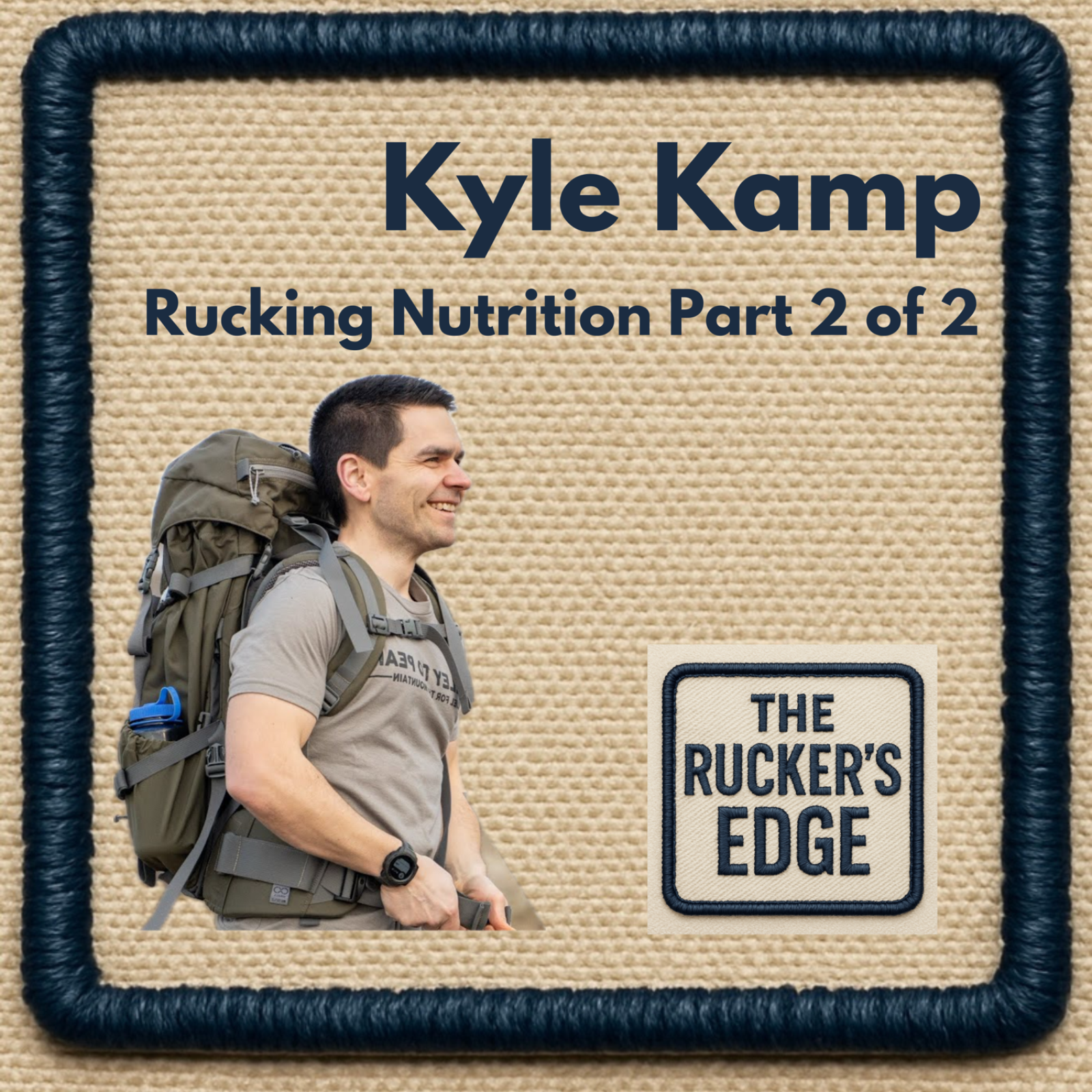


In Part 2 of our conversation with registered dietitian Kyle Kamp from Valley to Peak Nutrition, we discuss hydration, supplements, protein timing, and recovery strategies tailored specifically for ruckers.
In this episode we cover:
- Why consistent hydration matters more than exact formulas
- Whether post-ruck protein shakes are necessary
- The difference between animal vs. plant protein
- Creatine: who it helps, who it doesn’t, and why
- Why rucking is an effective tool for improving insulin sensitivity
Links & Resources
- Valley to Peak Nutrition: https://www.v2pnutrition.com
- Follow Kyle on Instagram: @v2pnutrition
- Follow The Rucker’s Edge on Instagram: https://www.instagram.com/theruckersedgepod
Notes
- Music Credit: "Play This Game" by Black Rhomb.
- I'm not a doctor, and this podcast is for informational and entertainment purposes only. Please consult with your physician before starting any new exercise or physical activity.
0:00 Have you ever wondered if you should drink a protein shake after one of your long rucks? Well, our guest today, Kyle Camp, goes into detail when you should and shouldn't consider it. This episode is a continuation of my conversation with Kyle Camp from Valley to Peak Nutrition and the Valley to Peak Nutrition podcast. I recommend you go back and listen to episode 19, which is part one of our conversation, because in part one we covered the fundamentals of fueling your rucks. But today, we're taking it a step further. In addition to talking about post -ruck protein consumption, Kyle cuts through the noise on supplements, hydration myths, and post -ruck nutrition so you can stop guessing and start fueling your training with confidence. You're listening to the Rucker's Edge podcast, a show all about rucking that is designed to help you improve your rucking routine, lose weight, and ultimately gain your strength and energy back. Each episode dives into the science, stories, and strategies behind rucking. You'll learn from top ruckers, coaches, nutrition experts, and performance specialists who break down what it takes to train smarter, recover faster, and stay ready for the next challenge.
0:59 So whether you're new to rucking or it's already logged hundreds of miles, this is the show for you. I'm your host, Spencer. Thanks for listening in. Please enjoy the second half of my conversation with Kyle Camp. I want to talk about just drinking water. You know, ruckers, typically we put water in these bladders. We stick them in the ruck along with our weight plates. Is it best to drink smaller sips more often or large quantities less often? Or it doesn't matter. I don't think it does, again, because if we're taking your average person with a busy life who has a lot of responsibilities and is simply trying to do something to be active, to play with their kids and hang out, they're not trying to be some physical specimen and big endurance athlete, right? They, for the most part, are not probably... going to notice a significant difference between small sips and big gulps so long as the net the net volume is matched for their need right now let's say that you've got a big i i know a couple of folks in our own program who have been in big ruck groups and they'll plan once per quarter and all day rock right into the into the mountains into the hills or whatever Now, the idea is, is that you want to be getting a specific amount of water in per hour per every other hour. But the main reason
2:33 for that is so you don't get too far behind on the day. So again, what's better? Is it big gulps or little sips? And I don't know that it matters, but we do find people tend to hit that total per day mark easier if they're taking small sips. I think too, just from a practical standpoint, my observation working with people, the biggest barrier is just remembering to drink at all. You have people who maybe they run out of water and they don't feel like taking their ruck off and filling their bladder back up, or maybe they're doing a water bottle instead of a... And they don't feel like stopping and pulling it out of the bag or the water pocket sleeve if they're carrying, you know, a different pack. Or they don't feel like stopping to pee so they don't drink at all. Or, you know, name your reason for not drinking. We tend to find that leads to more problems than someone being under a specific mark, right? Like if that specific mark is, oh, you need. You know, 2 .8 liters on this rock to maintain optimal performance. And this guy gets 2 .4. We don't find him falling apart at the finish line because he missed 0 .4 liters.
3:45 We find the guy who's got 2 .4 liters left and he didn't drink anything falling apart because he didn't want to stop and pee. So, you know, that's I think the bigger thing, again, is just like don't get in all of nutrition. Don't get too spun up on the nuances. find the basics, become an absolute master of them and do them with relentless consistency. And I would venture to guess that most people would see a dramatic improvement in whatever outcome it is that they want, be it performance or weight or body composition or whatever. Mastering the basics always does it. Okay, let's move into post -rucking. So after the ruck, we did our cool down, we threw the rucksack down. Should we consume a... protein shake after we rock because I know previously you mentioned proteins good for rebuilding muscle should Rutgers actually be drinking protein shakes I'm gonna rephrase that and say do Rutgers have to drink a protein shake the answer is no and I'm gonna Break that down in two ways. Number one, we are assuming again, your daily nutrition habits are good. And if your daily nutrition habits are good, you are probably getting a distribution of protein across the day, right? So therefore, whenever you stop rucking, there is probably already some protein in your bloodstream for your muscle to draw from and begin the rebuilding process. And you're probably going to be eating breakfast, lunch, or dinner, depending on what
5:16 time of day you rock, sometime within the next couple hours of you finishing. Which means before the current protein in your bloodstream is ever gone, you're going to be replenishing again. So that's number one. Number two, if you are consuming... decent protein throughout the course of the day especially from whole foods there is no need to then go add more in so like a phrase we love to use here is water does not get more boiled the longer it sits on the stove once it's already boiling so if you've already met your daily protein threshold through your good habits and good food there's nothing that would suggest going even above and beyond that's going to get you anything more which is Which is exactly why I tried to spend some time early on in the podcast saying, look, if you have generally good nutrition habits on your day -to -day basis, it takes care of everything. All these nuances, all these little things, none of that stuff matters. If you have a good and decent composition of general and daily good nutrition habits, it kind of takes care of everything else. And so you don't necessarily need an additional. protein supplement now this gets better about the worst thing that you can do is have prolonged periods of time between meals right so now this fits the group of like people who like to fast whether it's like intentional or unintentional because of their their job let's
6:46 say if if you finish your rock and there is a prolonged period of time between your meals let's say that you eat at 7 p .m and you rock at 8 let's say you rock at 10 p .m because it's the only time that you can get it in and you don't plan to then eat again until 7 a .m or 10 a .m the next day i would in that scenario have a protein drink or a protein rich meal somewhere in there just to make sure that there's some protein still in the bloodstream for my muscle to repair from Right. So, again, goes back to if you have general, you know, decent nutrition habits, it really reduces the need for all the nuance. But if for some reason you don't, then, you know, just having a protein rich meal anywhere in there can help fill the gap. For those moments when you need to take in some protein, I've recently seen orgain. I think it's a plant based protein.
7:43 Do you need to take more of that as opposed to a whey protein? That's a good question. There are plant -based proteins and there are animal -based proteins. For the most part, animal -based proteins are going to be absorbed better and they're also going to have a higher percentage of individual muscle building blocks in the ratios your muscle needs them than plant -based proteins of any kind. Say peas, for example. Peas have protein, but They don't necessarily have that ratio that we need to rebuild a muscle. And the absorption of those are less, which would suggest, and it is true, for someone who is on a plant -based diet, they tend to need a higher daily protein intake because we know those are not going to be absorbed as well as animal -based products. Now, it gets a little more complicated when you talk about supplements because those organe products and soy -based... protein shakes do have the concentration of building blocks and are fairly well absorbed. And so in the case specifically of non -animal based, like a whey, because whey is derived from dairy, and a non -animal based supplement like orgain, I would say they're fairly even because of where it's derived from and the processing that takes place with those orgain shakes. Okay. So, yeah, you
9:14 could do, you know, you could do either. I think, again, it just comes down to preference. You mentioned the supplements there just briefly. I do want to talk about a few supplements because one of them, creatine, has been like a hot topic, I guess, in the world of nutrition. And I think you just did a podcast episode about it, actually. Should we be including that in our protein shakes as Rutgers? Yeah, we did. We just did a big kind of deep dive summary on that because, you know, creatine. Has been around for a long time. I can remember in high school, guys, in my high school, which was a long time ago, taking that and, you know, hitting the weight room. And basically from that period up until about two to three years ago, the recommended dose was five grams or so. And, you know, the thinking on that was, number one, we see the most like the place that we see it being potentially the most effective.
10:09 is in short burst activities. So think of a sprinter or think of an Olympic weightlifter who does a lot of what we call Olympic weightlifting that are compound movements that you're not doing a whole lot of, but they require a large burst of energy in short periods of time. So we've seen creatine be affected there. And part of that is because it replaces the energy system involved with movements like that short burst of activity. Now, Outside of that, we've never really seen any potential benefits for it unless someone does not have an external intake of it. And so meat naturally contains some creatine.
10:52 And so you'll see some research that say like there's a 50 % chance that a person is even a quote unquote responder. And a great example of people who are responders are people who don't have an external source of creatine for meat intake. So vegetarians, right? So you get a vegetarian who doesn't have an external source of creatine intake, start to take creatine. They may notice some benefits. Recently though, like the recommended doses climbed from five grams to 20 grams. And there are some complications that come up with 20 grams because some people can't hardly stomach that much of it. And so I would say it boils down to this. You know, I, because rucking is, does not fall into that category of short burst type of activities. I wouldn't say that a person needs it. However, it is really, really, really well studied. And we don't find many downsides to taking it in terms of it causing you a problem or affecting your health at all. So if a person wanted to try it and see if they can feel and notice a tangible difference when they do it, they most certainly could. We don't find that to be the case. And even in the case where people are now suggesting to take 20 grams per day, which is a pile of creatine, a lot of that is in... um, you know, is showing quote unquote, showing improvement in cognitive benefits. Now
12:25 I say quote unquote, because the studies are very, very limited. And even of the studies that we have, the sample size is really, really small. And so when you, when you look at supplements, you, you have to, I think, ask yourself two things. One, what does the research say? Two, do I notice it being a benefit? And what I mean by that is before I took it, I didn't get a benefit that I actually noticed after I started to take it, right? And in the research side of things, I can find you an article to... to read whatever you want it to read in. I can find you an article for every supplement on the planet that says there's a benefit. And I can find you an article for every supplement on the planet that says that same supplement that showed benefit isn't effective, right? So here you have to ask yourself this. You have to say, you have to look at everything with nutrition and research and say, Has this been done in lots and lots and lots of people to the point of where we could say that it's been seen a certain outcome has been seen so many times among all of these people that we can now isolate it and say it's that thing that we are studying that makes the difference. Yeah.
13:50 And if that's the case. then yeah, I might have some interest in looking at that. But in the topic of, you know, creatine in these huge doses and cognitive benefits and all this stuff that you hear on all of these, you know, I won't call them out specifically, but new podcasts, we don't, it's brand new research. It's not done among huge groups of people. And it's, you know, very like, I would encourage people to go listen to this podcast we just did. There's an article linked in there too. And basically when we started saying, oh, yeah, 20 grams is the dose, there was a research study among a small group of people. And I would encourage them to go read that article because it's a small sample size. And I think it's wasn't done well, not done, not done well enough for me to say, like, that's what we should take. I should I should say. Sure. Like, that's not the science we should be basing all of our decisions off. I'm glad you brought that up.
14:44 Yeah, you can do a lot with. Sample size variations and different statistical analyses. You can kind of create any narrative you want to almost. Yeah, I mean, you know that just in your profession, right? I mean, you can, I can, I'll give you a great example. So let's say that, for example, years ago, green tea extract was like big in terms of it increases your metabolism and aids in weight loss. But when you would go to read this particular article. The headline would say green tea extract increases metabolism and aids in weight loss. But when you read the actual research, you find that the group who took green tea extract did have a higher calorie burn per day. And that calorie burn was three more calories per day than the sample group. So you can technically say, yeah, it increased their metabolism, which would lead to weight loss. But will three calories burned per day mean more weight loss and a different life for me? No, no way. And that's the problem is you have a lot of these podcasts and you have a lot of social media and you have a lot of Instagram memes saying, oh, this product or this thing or this dietary approach leads to this outcome.
16:06 And yes, but is that outcome actually going to be noticed by the person? No, not three calories, not 20 grams of creatine, not whatever, right? Right now, I think there's â and that's what I would say. we find your average person is really confused by is it's like, I hear all of this over here. I hear other people saying, no, that's not true. And I just have no idea what to believe. And that's what's tough about nutrition right now is, you know, people have never had more access to information and knowledge and never been more confused. And that's, that's what's tough. Yeah. One of my favorite misuses of science or decision making based on science is getting causation and correlation mixed up. I see it way too frequently. I can't tell you how frustrating that is. More with Kyle in just a moment, including his take on another popular supplement on the market. But I want to take a quick break to say thanks for listening to the podcast. Please text this episode with a fellow Rucker that might find it interesting or a friend that could benefit from Rucking. Sharing this episode would help the show grow and help more people improve their health and their lives. Okay, back to it. Moving on to the next supplement, we're big on smoothies in our households, and I've got a lot of joint pain, so I've been using collagen supplements, but I've seen some conflicting conclusions, and I wanted to get your professional opinion on it. Are they effective? Because I've read that they're supposed to help lubricate your joints,
17:38 but some of the data doesn't necessarily indicate so. I was just kind of curious what your thoughts were. Yeah, this is one that kind of goes back and forth as well, and I would say... We kind of find exactly what you're describing. Number one, it's hard to determine people who do report an improved outcome. Is that because they just simply increased their protein intake to where now they're meeting the minimum threshold? And if it had been from something other than collagen, they would have seen the same effect, right? Because we do know that protein is responsible for the improvement of. Hair growth, it's responsible for the repair and retention of muscle, prevention of muscle loss, etc. The one thing that is hard to completely write collagen off for is every protein has a different composition of amino acids. And amino acids are the main building blocks that are to make up or be responsible for rebuilding a muscle. It is believed that the amino acids mainly responsible for joint health have a higher percentage in collagen than in other proteins, right? And that is the one thing that would convince me that, yes, there is some reason to take collagen if the goal is joint health. But like you were saying, and you were right, We also have enough studies that
19:09 say, yeah, it really doesn't matter what type of protein you consume. So long as you're meeting your daily need, you're going to get the benefit out of it. And just isolating collagen protein does not necessarily mean that you're going to get better, stronger joints, et cetera. And honestly, I just think that the data is too conflicting and the arguments. for collagen being pro collagen, being those certain amino acids that are responsible for joint health. Like that's just, uh, that's believable to be Frank. And, and I don't, we, I don't think that we've got enough on either side to completely write either of them off. And even in, you know, even in our own, even in our own profession, there's some butting of the heads where you've got. really, really reputable people, really, really reputable scientists saying, you know, who have no affiliation with collagen companies at all saying, no, they're like, we think there is something to this. And then you've got other scientists who have studied and they're like, we don't find that. And so again, I think that's, this is one of those ones where I would say, have a person take it and you'll have people take it and they will, they will report. they can subjectively feel their joints don't hurt anymore. And in that case, whether placebo or not, take it, right? But if you take it and it's an added expense and it's a burden to be on your routine every morning and you can't make heads
20:40 or tails as to whether or not it's doing anything, I would put my focus and concentration on just trying to meet my daily protein needs. Gotcha. Yeah, I appreciate that explanation. I have this one. I don't know what you're, Kyle, I don't know if you have a hard stop at this time. We've gone a little over. I'm good to keep going for a few more minutes if you are. Yeah, yeah, let's keep going. Insulin resistance and diabetes has become a significant problem in the United States and it's getting worse. These questions are more exercise physiology. So if this is not within your wheelhouse, please let me know if you don't want to answer that. But I am curious, how does rucking affect blood glucose and insulin sensitivity compared to like other forms of exercise like running and strength training? I know that's not necessarily a dietary question, but it's sort of adjacent. It is. I mean, it somewhat is. And you're right. It is adjacent to the field.
21:34 And I would say. I would say this. Any exercise is going to help with that. It's going to help with insulin sensitivity. It's going to help with glucose levels and all of that in one big way. When we move and when we are active, your cells are now more receptive to carbohydrate. And that is going to help put those into the muscle instead of leaving them in the blood, which is where a lot of the complications with increased glucose levels come from in diabetes forms, etc. What rucking has that some of the others you mentioned doesn't have is accessibility.
22:17 Nearly everyone can do it. And it's fairly low impact. You can make it as hard or as easy as you want it to be just by sliding a weight in or out of your pack, right? And that is the number one thing with nutrition and fitness is you have to give people something that's practical. The world and the internet is full of how to optimize. commit to optimization and you know five hours zone two workouts every single day I don't have the time to commit to optimization writing these really technical programs but I can put on a backpack with a little weight in it and go move and so what you start to have is you have approachability which means because there's no barrier to entry to people for rucking, they're more likely to do it. And because they feel like they can do it, that's going to feel like a win to them.
23:21 And that's going to build consistency. And so with all of these things, nutrition or fitness related, you don't get the health benefits from them or the performance benefits from them without consistency. Doing any of this stuff one time is not going to do anything for you. But if you do these things, every day for, or, you know, five days a week for six months, that's a different person. Right. And so that's, that's the main, that's what I would say is that any exercise or activity is going to aid in any improvement of health outcomes. What rucking has that long distance running does not have that heavy lifting does not have that some of these other things do not have is a barrier to entry for most people.
24:08 Right. It's very approachable. Yeah. And because of that, people are more likely to engage in it. And if you can get them to consistently engage, they get the health outcome. Totally agree. And what I found, it's sort of like a gateway exercise to once you once you start rucking, you start to see improvements in your health. You kind of want to start exploring other exercise forms and maybe you're going to start lifting weights. Maybe you're going to start running. Who knows? But thanks for that. I appreciate that. And then lastly, my last question related to this is what's what would be some of the best ways to prevent? post -exercise hypoglycemia after a long intense rock like a a weekend you know eight ten miler yeah i would i would loop in most of our conversation to this point and say number one and this this may not need to be said, but number one, if a person isn't symptomatic to that, I wouldn't then put that in their head. They're going to become that, right? It's not like every person becomes hypoglycemic after they do any sort of a physical activity. And again, for people who are listening, hypoglycemic means you get low blood sugar levels and then the effects of that.
25:17 However, if you're doing nine or 10 miles, it goes back to our totals and timing conversation. The prevention of hypoglycemia after you get done rucking starts in the two to three hours it takes you to get done with the ruck. Are you fueling on that ruck? Are you taking in the right type of fuel? Are you taking in the right amount of fuel? And if the answer to all of those things are yes, yes, and yes, there is no hypoglycemia to be had at the end of that ruck, if that makes sense. Absolutely. You can get delayed hypoglycemia, which is if the RUC was really challenging for you, when you stop, the muscle will immediately begin trying to recover and it will use the fuel that you've taken in to try to begin that recovery.
26:03 So if you have a significant period of time where you haven't eaten anything, it will totally deplete what you've got there and you will feel low blood sugar and shaky hours after the RUC. Because it's already used the fuel and it needs more. And in that case, again, it goes back to our original conversation of, are your daily nutrition habits good? Do you have a good composition of the meals? Are you eating with semi -regularity? And if the answer to those things are yes, you avoid most problems and you avoid most nuances like we talked about earlier with needing supplements or having to worry about timing and pounding protein shakes after you get done and all those other things. Excellent. Thanks for that, Kyle.
26:47 This has been a fantastic conversation. I'm really appreciative of your time. You've provided so much valuable information for our audience. Thanks so much. Before we go, if listeners are curious about the services that you provide through Value at a Peak Nutrition, where can they reach out to you? Yeah, we have a website. It's v2pnutrition .com, and the 2 is the number 2, not T -O, so v2pnutrition .com. We have a host of stuff on there, Spencer, from free information. We've got a couple of different courses that we have created on there if people want to learn more about nutrition and walk through those. We have a coaching program for people with bigger goals or longer goals or they want some personalized direction or what have you. We have a podcast as well that we put out biweekly episodes on and different guests and we cover rucking in there. We do a lot of backcountry hiking and hunting. you know, all sorts of stuff like that, that, you know, might be of interest to your audience, but everything's under Valley to Peak or v2pnutrition .com. Excellent. Yeah, I definitely recommend checking out the podcast, especially the one on creatine. It was packed with really good, useful information. Well, Kyle, thanks again, man. Really appreciate your time. Thanks for coming on today. Yeah, my pleasure. I appreciate you having me. All right. That wraps up my conversation with Kyle Camp. You can connect with him at v2pnutrition .com. That's the number two. in V2P Nutrition or at V2PNutrition on Instagram. If you want to reach out to me, head on over to TheRucker'sEdge
28:18 .com or on Instagram at TheRucker'sEdgePod. If you enjoyed today's episode, make sure to follow or subscribe to the show so you're notified when new episodes are released. Okay, that's it for today. Thanks again for listening to this episode of The Rucker's Edge.