The 1,000-Mile Ruck: Pain, Purpose, and Project Grit
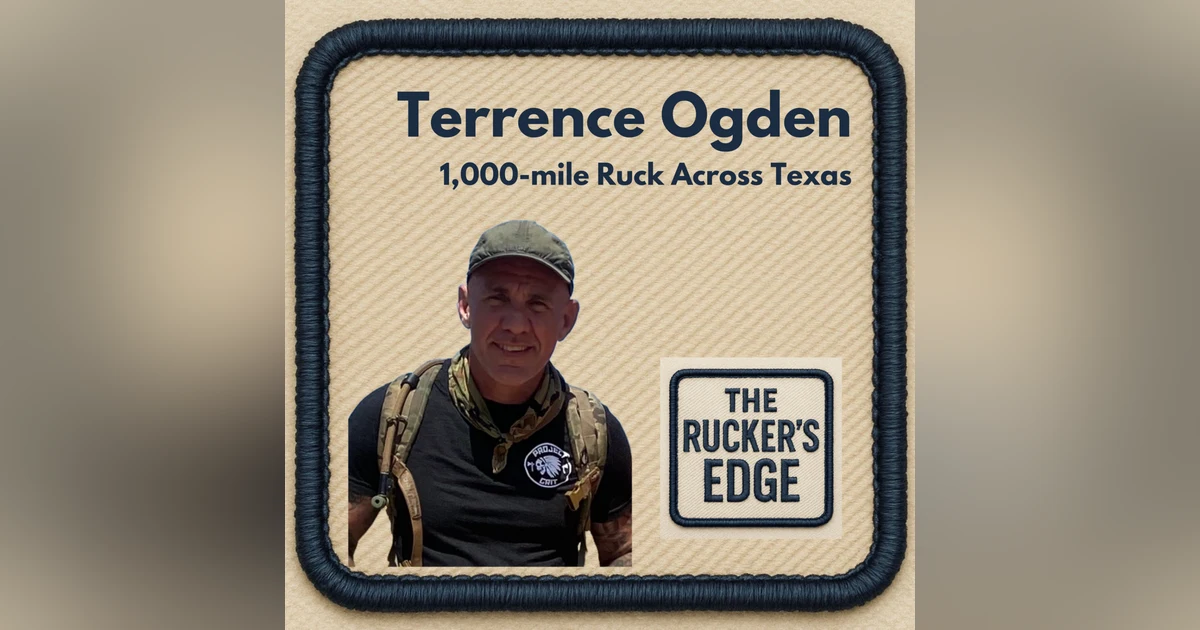


What does it take to ruck 1,000 miles across Texas?
In this episode of The Rucker’s Edge, Spencer sits down with Terrence to break down one of the most extreme rucking challenges ever attempted—crossing Texas on foot with 40 pounds on his back.
But this conversation goes far beyond mileage.
Terrence shares how his journey from addiction to purpose shaped this challenge, the physical and mental battles he faced along the way, and how rucking became a tool for transformation. From brutal heat and dehydration to loneliness and emotional highs and lows, this episode reveals what really happens when you push yourself to the edge.
You’ll also learn about Project Grit, the mission Terrence built to help others overcome adversity through shared struggle, and why community might be the most powerful performance tool of all.
Links and Resources:
Terrence Ogden on Instagram: @OfficialProjectGrit
The Rucker's Edge – Official Site
Follow The Rucker’s Edge on Instagram: @theruckersedgepod
Notes:
- Music Credit: “Play This Game” by Black Rhomb.
- I'm not a doctor, and this podcast is for informational and entertainment purposes only. Please consult with your physician before starting any new exercise or physical activity.
0:00 What's the longest ruck you've ever done? 10 miles, 20, 50, maybe 100? Well, my guest today, Terrence Ogden, the founder of Official Project Grit, completed a 1 ,000 -mile ruck across the state of Texas. That's averaging 25 miles a day for 40 days straight. But this isn't just a story about distance. This is a story about Terrence's transformation. But before we even get to the miles, let me tell you where he started. Terrence's story doesn't begin on the trail. It begins at rock bottom. We're talking addiction, homelessness, jail time, the kind of things that most people don't escape, and the kind of things that most people are too ashamed to talk about. Terrence talks about them openly, though, because he knows that's exactly where his power comes from. Fast forward 20 years and this man isn't just sober, he's leading a movement. He founded Official Project Grit, a Texas -based community that uses rucking as a vehicle for discipline, redemption, and transformation. I actually featured Terrence back in episode 16 when he was just about halfway through his journey. Now he's on the other side of it and today you're going to hear what it takes to prepare your body and mind for something this big. Terrence also teaches us... What breaks down along the way, physically, mentally, emotionally, and how community, purpose, and sheer grit can carry you further than you ever thought possible.
1:25 You're listening to the Rucker's Edge podcast, a show all about rucking that is designed to help you improve your rucking routine, lose weight, and ultimately gain your strength and energy back. Each episode dives into the science, stories, and strategies behind rucking. You'll learn from top ruckers, coaches, health experts, and performance specialists who break down what it takes to train smarter, recover faster, and stay ready for the next challenge. So whether you're new to rucking or an experienced rucker that's already logged hundreds of miles, or in Terrence's case, a thousand miles, this is the show for you. I'm your host, Spencer. Thanks for listening in. Before we get going today, I want to take a quick second to ask for a favor. If this show has helped you in any way, it would be amazing if you could drop a quick review on whatever app you're using to listen to the podcast right now. It helps me bring new episodes every week, and more importantly, more people looking to improve their fitness.
2:13 We'll be able to discover the podcast so you can help someone else start or improve their rucking. Thanks so much. Terrence, thanks so much for joining me today. I really appreciate you coming on. I've shared your 1 ,000 -mile ruck previously on an episode. I think it was episode 16, and I'm very honored to have you here today. Thanks for taking the time to have a chat with me. Hey, thank you for the opportunity, man. I'm stoked to be here. I'd like to start out with the idea for the 1 ,000 -mile ruck. Was there a single moment or a specific place or conversation that kind of spurred the idea for you to go on this 1 ,000 -mile journey? The 1 ,000 -mile or what spurred that whole idea was, seven years ago, I started a ruck. It's always on or around Texas Independence Day, and it's the Immortal 32 ruck, which is a 75 -mile nonstop ruck from Gonzales, Texas, to the Alamo, honoring the Immortal 32. which were 32 individuals that answered the call to Travis's reinforcements letter. And they intercepted the letter, took it to their leader, George Kimball, and asked him what we should do. And he said, there's no question. We go to the Alamo, gather as many men as you can. They gathered 32 and they knew that it was highly likely that they weren't going to come home and they went anyways. When I started that ruck, it was like, I felt like that was a big piece of history that just kind of got
3:45 forgotten about. And I wanted to like really tell their story. And after doing it for seven years, at that point, it was six years rather, November of 24, I was, I like to push myself and I like to find new hearts. And November of 24, I was sitting around. thinking about you know i was getting ready to start talking about the immortal 32 for the next year which is in march and i was like man i kind of need a new hard what is something that i i'm 50 50 if i could pull off and i happened to be messing around on the internet and uh ran across some stuff about people going across the state of texas and so i Did a little search, has anybody ever rucked across Texas? And to the best of my research, I found that nobody had. And I was like, that'd be awesome. I don't know if I could pull that off. And most people that do it, it's 850 miles from Louisiana to El Paso. And I was like, man, that's epic. What would make that a little more epic? That was like a thousand miles. It'd be really cool. And at that point, I knew I knew I could do, you know, 75 miles. I knew I could do 100 miles. I knew I could lead a group of people along those same routes. And I just knew
5:17 that I had I had to come up with something to push it to see what I could do and started developing the route. And I started. 17 miles south of Port Arthur at the Sabine Pass, where Louisiana, Texas, and the Gulf meet. And traveled across the state, one foot in front of the other, with 40 pounds strapped to my back. So that was Port Arthur, I think? Is that what you said, Port Arthur, Texas? Yeah, just south of Port Arthur. When I read that you were going to be starting there, the thought came across my mind, I wonder if he's going to run into any gators. And I think, like, day one, you posted something on Instagram of a gator on the side of the road. I was like, yep. He's definitely in the elements right now.
5:58 Yeah, right from the get -go. I drank a big coffee when we started, and I was walking, and there was some tall grass, and I had to take a leak. And I was like, eh, maybe I should take a leak right there. And I BS you not, dude. All of a sudden, there was this low growl. It was a gator. And I was like, oh, OK, maybe not yet. Not yet. I'll go a few steps further down. Speaking of starting in Port Arthur, I mentioned this previously on episode 16, but the symbolism of your route starting from essentially Texas' lowest point and going across the state, gradually ascending up to Mount Cristo Rey. Did you think about that prior to starting your route? Because you've talked about your journey through addiction and living a hard or rough life previously and trying to... you know, prove that you're working through changes through this thousand mile rock. Did you plan that? Or is that just a coincidental, I guess? So when I thought about it, you know, I was like going from the bottom of Texas and, and then I was like, I think it was more divine inspiration, you know? I mean, it was like, I thought it'd really be a cool way to, to tell my story. In the route, you know, I mean, going from the bottom and, you know, I mean, no offense to Port Arthur in that area, but it's dirty down there. It's flat. It's not real hospitable, you know. And it reminds me of where I started on this journey that I've been taking in life. And
7:28 going from that to the highest point of Texas, you know, it kind of represented being elevated. And then coming off of Guadalupe Peak and heading due west to El Paso to the top of Mount Cristo Rey, it was very significant because it was going from the bottom, being lifted up, and then giving it all to something bigger than myself. So it kind of just like fell in my lap that way, just one little idea after another, and it fits so perfect. Since you mentioned a little bit of your backstory, do you mind talking about that a little bit? I don't want to put a timeline on it, but when you look back at that version of your previous self going through addiction and those hardships, what do you think that person or that version of yourself needed to get out of that? So at that time in my life, you know, I spent a lot of years just lone wolfing it, you know. At that point in my life, it was like the pain had to become greater than the fear of accepting help. And the hardest thing for me to do was to ask another person to help me out. You know, the way I was brought up. in texas my grandfather pretty much raised me and you know that john wayne mentality you know be a man be tough get get shit done you know and which is all great great stuff and i'm not knocking that by any means because it made me the man
8:58 i am today but that's only good to a certain point and there's a point where We need each other. Like it or not, we are tribe -like. And I know for men, it gets real uncomfortable with some of that stuff, talking to another man about things that aren't comfortable to talk about. And I spent a lot of years like that. And once again, you know, I feel like it was not to beat this horse, but it was a divine thing that the right person showed up at the right time. It was a perfect stew of things. I was in a bad place. scared. And this person showed up. And the thing that really stuck out to me is he stuck his hand out and asked me to come back. And at that point in my life, not a lot of people wanted me around. I was a completely different person than I am today. My life has 180. And having someone just say, hey, man, you're all right, dude, come back and keep hanging out. And we started to develop a bond and a friendship and he mentored me and helped, he essentially pulled me out of the gutter and showed me another way to live. And I think that that was a, I don't think, I know that was one of the hugest things that changed my life because had that situation not happened, I would have very easily just become another statistic, you know? So extremely grateful for that. Who is this person? How did you come to know them? So this guy was Kenny Baker, and I had just got out of detox, and they sent me
10:33 to a 30 -day inpatient rehab. And I lasted about two weeks there, and I was like, the hell with this, and I took off. And all I had to my name was a backpack and a bunch of bad habits. And I left there, started hitchhiking into town, didn't know where I was going to go. I was going down the road. This girl pulls over. She's got a cooler full of beer and she was looking to score. So I was like, oh, this is perfect. You know, in my mind at that time, I was going to rip her off for some money and get what I wanted out of the thing and move on. And we were driving.
11:13 It was hot and the windows were down. And I remember I was like, I felt like I was at a fork road. It was a classic, you know, angel and devil on the shoulder. One saying, if you do this, you're going to end up being screwed again. The other one's like, nah, do it, do it, do it. And something happened. I just grabbed my bag. We're sitting at a stoplight. I grabbed my bag and jumped out of the car and started walking. And I didn't know where to go. And there was a AA meeting right there. And I felt like that'd be a safe place for me to figure out what to do. Went in there and this guy showed up and he's covered in prison tattoos. He had try me tattooed across the front of his neck. First, I thought he was some clown, some joker. And he shared some really deep stuff. And he came up to me and shook my name, asked who I was and asked me to come back.
12:05 And that changed everything. And that was Kenny Baker. Kenny Baker was a Marine. He got strung out on heroin, robbed some banks, did some time. got out and while he was in there, changed his life. And I knew that that guy was just as screwed up, if not more than I was. And I could see something was working in his life. So it was like, if I knew if I hung with him, maybe I could get what he got and changed everything. Wow. Thanks for sharing that, Terrence. Kenny sounds like a really outstanding person. You mentioned he's a Marine. I'm seeing there's a commonality between all the Marines that I come across. They don't leave anybody behind. They're going to take care of everyone they come across. It's really phenomenal.
12:50 I'm really happy that you came across him. I'm really happy that he stuck out and invited you back. That's really, really cool. I'm glad you listened to the right side of your shoulder, too. For sure. So you mentioned you were doing some hitchhiking. Was that the very beginning of your rucking experience? I guess technically, yeah. It's kind of ironic that when I left that rehab, all I had was a backpack. And here I am today, and I just trekked across the whole state of Texas with nothing but a backpack. So it's kind of ironic, but yeah, it's pretty fitting. When did you start rucking, actually intentionally throwing weight on your back? So I found rucking probably in 2013. And I was doing a bunch of ultra marathons and running a lot. And I would do, I found rucking and I started using it to supplement like my off days. And I developed a knee issue and I never liked to run. That's a whole nother story. But I fell in love with rucking. I found it to be. a good way for me to like get the cardio, get a little bit of weight training at the same time. And I also found it to be extremely helpful because I'm real big on ditching the headphones when I get out there on the trails because number one, situational awareness. Number two is like in that time when
14:20 it's just me and my thoughts, I work out most of my problems. And on the other side of that coin is I also come up with some of the most creative stuff. When you're able to just drown out all the BS noise that's going on between yours and just be. it's amazing what happens, you know? And I think in this world that we live in today, we're so connected that we're extremely disconnected. And I think getting back out and, and going and being in nature and doing something that's hard really brings out the best in us, you know? And I also found rucking to be a great equalizer. Like if me and you wanted to go for a run and you're doing six minute miles and I'm doing 10 minute miles, we ain't gonna be able to work out together. Work out. I'm gonna feel like I got. smoked you know and we're rucking i call it the equalizer you know either person could strap on more or less weight and and have conversations you know you're not having to make eye contact so a lot of times it's easier for men to speak to each other when they're just going and focusing on putting one foot in front of the other so yeah that's how i found rucking and i and i found it to be a great thing and it's helped me out tremendously in life Yeah, that's great. I'm also an advocate for taking the headphones out during a rec. It's just something about the repetitive nature, being out in nature, being outside, that clears your mind so you can focus on any problem that you need to solve.
15:47 Yeah, it's phenomenal. First time that I experienced that, I was hooked. I was like, yeah, I need to keep doing this. All right, so let's go back to the 1 ,000 -mile rec. Let's talk about your preparation. What did your training look like? I'm guessing you set a goal like this. There are months leading up to it that you're probably training for it. What did that look like? Did you build some sort of structure into your training or did you do some sort of like traditional training? Was it rucking, running combination? If you don't mind just talking about that for a little bit. Sure. So a long time ago, I kind of adopted the mentality of. not getting ready just staying ready so i pretty much the way i live my life is like you could call me up tomorrow and say hey we're gonna go do this thing and i'm probably 90 close to being able to go do that so i've developed that mentality but a thousand miles is a little bit different you know because there's a lot that goes into there's days where it's like you don't want to get up and move you know i mean i averaged a little over 26 miles a day for 40 days and a lot of those nights i was only getting like four hours of sleep and training for it you know i i have all different a bunch of different techniques like one of the things i do is i'll go out and do a four to ten mile
17:17 ruck in the evening come home set the alarm for four hours and four hours get up and go another do another four or five miles and what that does is that gets you with uh all right get off your ass and let's get after it that also teaches you how to move when you're tired and not wanting to do it you know and i would do a lot of hill repeats we have a nice little hill out here that is about 250 feet of elevation gain over about 200 yards so a lot of hill repeats and putting in miles you know and i would i was probably averaging probably 60 miles a week towards the end but that being not really because when i started this deal it was just i was gonna go do it and then i was approached like you need to document this thing and then the next thing i know we're shooting a documentary on it And that changed like a lot of the time thing. And towards the latter part of it, I started getting some overuse issues of the training process.
18:25 And so I dialed back my training quite a bit by the last two months. And A, I didn't have a whole lot of time. And B, I didn't want to go into the thing with an injury. So I was in good shape, but I hadn't. I had to kind of bail on my training plan to a certain degree. That being said, I was still going to the gym. I was still doing all my community rucks that I put on and that stuff. There was tons of logistics stuff to figure out. You know, with a thousand miles across so many diverse terrains, a lot of people don't realize Texas is not flat, number one. Texas is not all the same. There's pretty much six different regions of Texas that you have to deal with. So it was a lot of logistics that went into it. There was a lot of places where I wasn't able to do resupplies. So I made a bunch of food caches and then decided where I was going to place those food caches. And then before I went and did the ruck, I went and placed them all and buried them all. Throughout the route, each food cache had a gallon of water and three freeze -dried meals. And it was clutched.
19:51 for those to be there so you know it's like when when when i place a food cache i mark it i mark the ground with some spray paint and i always found a sign that is specific you can't just say see a stop ahead sign and put it next to that because there's 50 million stop ahead so i would find like mile markers or road signs And I would photograph, mark it in GPS, also have it in my phone. Then I'd also had a written paper with everything. So if I lose my phone, if I lose my GPS, you know, I still can find my food cache. Because they were, especially out in the desert, they were essential for survival to pull this thing off. So always have backups for your backups. Yeah. All of that. Did you ever? Did you find all of your food caches? Yes, I did, actually. They were all there. And I actually, by accident, bypassed one of them. You had to go back. Well, that's a whole story in itself.
21:02 That was in between Guadalupe Peak and El Paso. And we can talk more about this later. But when you're out there by yourself. You, like I alluded to earlier, we're tribe -like, like it or not, that you start to like miss conversations. You start to miss face -to -face contact and all of that. And I was out there and I ran into a road crew working and I'm a blue collar guy. They're blue collar guys. So went and started talking to them. And, you know, we had this great conversation. It lasted about 30 minutes. And I walked off and I kept going. And then I realized, oh, my God, there was a food cache like right there that I needed to get. And I was already four miles past it in a world of pain. So I had to make a decision. Do I turn around and go back and get it? And that's going to be eight miles to get right back to the point that I'm standing right now. Or do I go for it? And I had like a quart of water and I'm in the desert and I went for it. Some pretty remarkable stuff happened after that, but it's another story. Yeah, I want to get into that in a little bit. I do have a few other questions about your prep work because you mentioned that you had some overuse issues.
22:23 I'm guessing you kind of felt something in your knee or your ankles, maybe some tendonitis or something. What did you do with your feet in your prep work to get them ready for this? Anything in particular? time spent on them like you mentioned yeah i mean i i have a sock system i use when i do long rocks and i have some preventative stuff i use i also have some products that i use and you know i mean you're when you're on your feet For that long and that many days, there's going to be problems. You want to mitigate it the best you can, but there's definitely going to be some problems. And they all showed up. I'm not really one to blister, but I definitely got a lot of blisters out there. I definitely got some overuse issues. I think my left ankle kind of seized up on me at about mile 600. So I spent a lot of time heel striking after that.
23:22 You know, it really boiled down to the discipline, you know, I mean, because there wasn't a day that I woke up that I was motivated to go do it. And it wasn't, oh, this is what I want to do today or this is what I think I'm going to do. And I was like, no, this is what we're doing. Get up, get after it and get out there. But the feet thing, that was that was a real thing. You know, my sock system was pretty good and it did. Everything that I expected it to, I knew blisters would arise. I knew there would be overuse issues. And it's just kind of like what my grandfather taught me. Be tough, man up, and keep moving.
24:03 Get through it. Yeah. Is there anything that you thought you were ready for, but maybe was exposed during your ruck? Was there a gap in your preparation? Absolutely. So a long time ago, a man taught me most people fill their bags full of insecurities. And that's a metaphor that can be used for a lot of stuff. And it's true. And when I started the Ruck, you know, I thought I had it pretty dialed in. And I started running into issues right from the get go. And I wasn't prepared for it to be as hot as it was. October, I thought it'd start cooling down. It was still in 100 degrees. And East Texas is humid. You're in Louisiana, so you know about humidity. And it just sucks it out of you. So I kept running into issues with running out of water. And that's a scary thing when you're out there sweating the way you are and you keep running out of water.
25:03 So I learned real quick that some of the gear, I started having to strip luxuries. And I had to look at everything from a different angle. Is this thing multipurposeful? Is this just some luxury that I want to have to escape or something like that? Or is this just some comfort that I'm trying to hold on to? So I had to start stripping everything down and looking at it from a logistic and practical angle. I had to ditch a lot of stuff that I was hoping to have, like a stove. Ditched my jet boil, ditched my tarp, ditched my rain gear. Pretty much had it broke down to just one set of clothes. I had a shirt, a pair of pants, five pairs of socks, and some lawn johns, some wool lawn johns for West Texas where it dropped down into the 30s. And that was pretty much all the gear I had for the whole thing.
26:01 Yeah. So there was a lot, I mean, pretty much every section of Texas gave me a whole new beast to deal with. I was looking forward to getting to a certain spot. Then I'd get to that spot and it's like, okay, you're not dealing with that, but now you're dealing with this. And it pretty much went that way all the way through the whole thing. What kind of pack did you, did you bring along with you? Was it Everly stock? Was that what it was? No. Uh, so go rock sponsored me on this deal and it's a prototype for a hiking bag that they got. And so I had the honor and the privilege to be the first one to test that out. And, uh, the name's not confirmed yet, but there's, they're still trying to hammer that out, but it was a great bag. I don't think I could have done it in like a regular go ruck sack, you know, but. that bag was, was clutch to get it all done and, uh, worked out great.
26:58 It fit proper. The weight was just distributed very well. So that one, uh, that, that was a game changer for sure. That's great. Uh, I'm so curious in the prototype. If you can talk about, I don't know if you signed an NDA or anything like that, but is there a way to slide in, uh, weights like in all their other, like the Rucker? no there's not there is a there is a a sleeve in the back for your water bladder but this one is more designed towards hikers and people that want to get into the back country so essentially your gear would be your weight for that matter uh the rucker they just came out with the well i don't know if it's out yet but the rucker 5 .0 should be coming out soon or the rucker 4 .0 those are great and if you want if you want the actual pocket for the weights More with Terrence in just a moment, including the surprising impact the community rucks had on Terrence's psyche.
28:07 But I want to take a quick break to say thanks for listening to the podcast. Please text this episode with a fellow rucker that might find it interesting or a friend that could benefit from rucking. Sharing this episode would help the show grow and help more people improve their health and lives. Okay, back to it. So you just mentioned Go Ruck. And one of the things I wanted to ask you about is, man, you spent so much time solo, but you did strategically host community rucks along the way. I believe some of them were Go Ruck sponsors. Some of them were with local ruck clubs. What was it like going from solo miles to suddenly being surrounded by a community?
28:48 So, yeah, we did six community events along the way. And those were. they were like a bittersweet thing and uh i didn't want this thousand mile rut just to be about some idiot you know walking across texas i wanted to try to bring community into it because community is what really saved my life you know and having other people so i thought that was a big part of it and i think it'd be a really cool thing for people to come and join me along the way That being said, it changed the dynamic of the ruck because now I have to be somewhere and I have to be presentable.
29:30 I have to be able to converse and deal with that. And so it was a burden, but an honor to be able to do. And it was also, and there was, there was. quite a few people that did come and do like a day or two with me friends of mine throughout the whole thing but all of those times was it was tough you know i mean i spent some time locked up and that was the the closest thing i could relate that to is like when you have visitation coming up you know it's coming and you're kind of excited about it you get to see your people And it comes and it's short lived. It lasts for just a small window. And then you go right back into the hell that you just walked out of. And so I would have these extreme highs of having that one on one with people and having people around me. And then I'd go straight back into.
30:33 The being alone by myself with your thoughts. And so those were like these real emotional highs followed quickly by an emotional low. So that was that was definitely a challenge. And I knew they were coming. And, you know, once again, just write it out. This too shall pass. And, you know, and but all in all, those times spent with other people was huge for me out there. Big. I could imagine. Oh, yeah, absolutely. I think I sent you a message before you started wishing you well. You gave me a heads up that there was going to be a community event in Houston. I really wanted to attend that, but I couldn't. But I was thinking if I was spending so much time solo and I came across a big group or a big community, it would be like a 180 in terms of, oh, I'm energized again. I'm motivated to keep going, but I didn't think about it. When you leave that group, you're back in at, okay, embrace the suck again sort of situation. You mentioned that you had some friends come out and join you. I think I saw Daniel Carlton. I guess he goes by Three Quarter Cowboy. He joined you for, I think it was like a day or two days or something like that. That was really, really cool to see. It was towards the end, I think, of the ruck, if I remember correctly. Yeah, it was about three quarters of the way through.
31:57 It was out in the middle of the desert. Yeah, which has to be probably the hardest part because you're at the end and there's nothing around you and you're in solitude. So, yeah, any any other person that joined you, I could imagine would be would be just tremendously helpful. Speaking of other people you came across, you also came across Matthew Johnson, the runner that ran across the state of Texas. Was that planned? No, that was not planned at all. And it was just it was kind of. funny how it worked out because they had to do a route change due to mud or something like that and my wife called me and she was like hey it looks like matt johnson's gonna be going through fredersburg at the same time as you and so we we coordinated it after that i was like hey this this is too ironic that somebody rucking across the state of texas east to west and somebody running from North to South Texas, that their paths are right here next to each other, that this has to be a handshake moment.
32:58 And it worked out. We met up at 6 a .m. in the morning and shook each other's hands and said a few words and solid dude. And we both continued on our journeys. That's crazy. How does that happen? That, I mean, Texas is so big throughout the entire year. Y 'all somehow ended up on the same day in the same spot in this big ass state. You know what I mean? It's, you know, it's all something bigger than us, man. That's cool. Did you come across somebody else that was rucking on your journey? It's kind of funny. We were in the middle. My buddy Carson Tinker came out and spent two days with me. He did about 50, 60 miles with me. And we woke up in the morning and every day I would shoot a video for a recap of the day before. And we were shooting this video. You know, I hadn't seen anybody other than Carson for days. And we're talking about how alone it is out here. Then all of a sudden in the background, somebody comes walking by and I was like. what the heck was that and we stopped and talked to the guy and he started i want to say in 22 0 22 or 23 he started up at the arctic circle came down followed the canadian border all the way to I think, Maine. Then he went down to Florida, made his way to Nashville,
34:31 and then he's in the middle of the desert. That's another crazy thing. Like, what are the chances that two people pass cross at the same time? And his name is Marcus Johnson, and he's trying to make it to San Diego. His deal's a lot different than mine, but he's been doing it for, I think, four years now, three or four years now. living out of a bag and putting one foot in front of the other. Wow, that's amazing. I'm going to have to go Google his name and hear about his story because I'm sure there's something to unpack there. That's wild. What are the chances you run into two people on parallel paths, I guess.
35:14 Going back to logistics, I am curious. We did talk about... But was there any logistical surprise that you encountered, something that you didn't anticipate maybe? Like you mentioned like missing one of the food cache because you were having a conversation on the side of the road. Was there any other like logistical item that maybe you would have improved if you were to do it again or something you wish you would have done? I would say that. The biggest things that I wasn't, I was pretty, pretty dialed in and pretty prepared.
35:55 And the things that I wasn't prepared for was usually stuff outside of anything I had control over, which was weather, which was the thorns. The thorns out in the desert was something that I did not even think about. But it was like, I probably, probably the last. 10 to 15 days. Every day I spent probably at least 45 minutes pulling thorns out of my shoes. And the heat, the wind, it was all elements like that. But pretty much everything on paper, I had pretty dialed in. And things I would have done different, I probably would have put more water out there for me because there was a lot of times I had to ration pretty, you know, I had to be on top.
36:46 of it so there's a fine line that i mean and i did get dehydrated out there but there's a fine line and you know staying on top of those things because it could really it could kill the whole deal so i probably would have put more food more water out there had i done a different also more little treats for myself little morale boosters and uh so i didn't have any of that stuff out there which would go a long way you know a little something to just Give you a little bit of a sugar rush or a, you know, something to make you feel better for a second would always be a treat, you know. I'm thinking back on one specific day. You were in a crunch for time.
37:28 I think you needed to do laundry, but you also had to get to your food cache. Do you remember that day? I think the laundromat was like closed or something. Yeah, so that was in Brenham. And I think I was 10 days into it. I'd been sweating my butt off. all the way through East Texas. And it was a funny story. And all I wanted to do was get to Brenham and get to a laundromat, wash my clothes, and then get a hot meal. And there was a CrossFit gym there. Brenham CrossFit was going to let me crash in their gym that night. And then we were doing a community ruck out of there in the morning. And I was asking the guys, hey, where's the laundromat? Oh, there's one right over here. So I'm just whooped. I'm in pain, dirty. All I could think about was food and getting clean and get to the laundromat.
38:23 Sweet, they were closing in an hour or something. So I was like, sweet, I have just enough time to wash clothes. So I didn't have a whole lot of clothes. So I pretty much stripped down to a pair of gym shorts that I had at that time. And so no shirt, no socks, no underwear. I'm just wearing a pair of shorts and emptied my bag. So my bag spread out on the folding tables, get everything loaded into the washing machine. And I go over to the coin machine to get coins. And I was trying to shove money into the machine and it wouldn't take it. And I look, there's a red light and it said out of service. I'm like, get out of here. So I had to go get dressed, repack my bag, and I was feeling pretty defeated.
39:07 And I looked at the only other laundromat in town, and it was two miles in the opposite direction of the gym I was going to stay at. And so I started feeling really sorry for myself, and I was pissed off and just sitting on the curb. And I was like, dude, just quit feeling sorry for yourself. Get off your ass. Go wash your clothes. Step one, get clean. Went to that laundromat and shoved all my stuff into the laundry machine. And I had just enough time because I started looking on places to eat and I found a burger joint that closed in 45 minutes. So I was like, all right, I have just enough time to wash and dry my clothes.
39:52 Run them through the wash. I go to open up the washing machine and the spin cycle thing didn't go. So they're soaking wet. And I'm like, oh, there's no way. dry in 15 minutes shove it on the dryer get it dried as best i can pull them out they're still wet wet socks on blistered feet and it's like i got i think i had it was two miles and i think i had like 30 minutes to get there and i was like typically that wouldn't be that big of a deal but i'm you gotta remember i'm hammered my feet hurt and uh blistered up and uh i had taken my bandages off and uh So I think I made it to that. I think it was a Sonic.
40:33 I think I made it there in like 20 minutes. So it was like I had enough time to get the burger and all that. So, yeah, that was a that was a whole little. That's wild. I mean, you're averaging, what, 20 something a day. The smallest little hiccup adds. Two miles, four miles. That's just, yeah, that's hard. That's hard to stomach. It doesn't seem like much, but if you really think about it, I mean, it adds up, you know, I mean, you figure every, every mile is typically about 20 minutes. So, you know, it starts stacking up, especially when you get beat up, those 20 minute miles aren't always there. Yeah. Take me to the last push of Mount Cristo Ray on Veterans Day. What were you thinking? Did that feeling match what you thought you would experience?
41:23 So rolling into El Paso, I mean, I was beat up pretty bad. And I wasn't moving fast. And it was just a slow go. Every step was extremely painful. And we got down to the Rio Grande and where the border wall is. And I made this turn and I could see Mount Cristo Rey. And that was a moment. I had to sit down. You know, I got a little emotional. I was like, holy shit, there it is. You know, this is the end of the journey, you know. And I just sat down and looked at the Statue of Christ on top of that mountain. And it was monumental. I still had another five miles to go because the way the river goes, you got to go around it. And that last stretch, I mean, it was a fight. Every step was a fight. But every step was also like this weight being lifted off.
42:25 And we got to the Rio Grande and there's a bridge that goes over the Rio Grande. And once you cross the Rio Grande, you're in New Mexico. And I remember I got to the middle of the bridge in the middle of the river and I just stood and I was like, holy shit. I just walked across the whole state of Texas, and it was surreal. You know, it seemed like the whole way I'd never get to that point, but I had gotten to that point. So it was just this moment that just, I can't really explain it in words. I was still in a lot of pain. You know, none of that stuff just went away. And then, you know, a little bit down the road, there's the turnoff to go to the base where the parking lot is, the base of Mount Cristo Rey is. And it's a pretty good little hill right there. And I started up that hill and just fighting it.
43:21 You know, I mean, I knew that this is the end and everything hurt. And I got past this one point and I looked up and. I could see all my people up there. And my daughter had made this sign, you know, that said, like, congratulations. And I forgot all what was on there. I was pretty much a wreck at that point. And then I remember just like, you know, walk with purpose. Got to the top and greeted them, and it worked out perfect because we were doing a community event there at 3 o 'clock, and I pulled in at 2. So, you know, everything just worked exactly the way it was figured to go. And had I screwed around another two hours earlier, I wouldn't have made it there in time. They went and got me some food, and I was able to get some food in me and hang out with my friends, my wife, my son, my daughter.
44:23 And people started showing up. And I mean, I knew just a hand. There was a whole handful of people that showed up from from my area. But there was a lot of people that I've never met that had followed that journey. And it was just it was surreal. And it was just, you know, I went and met and shook everybody's hand. And then we started up Mount Cristo Rey. And it was when we started, man, I still had all that pain. But it just like everything kind of just lifted off. and i started just hammering it out you know and i started like putting a gap between me and everybody else and then the next thing i know there was all these little kids around me and because there was a bunch of people that brought their kids and i'm surrounded by like a bunch of kids and they're like so excited you know to be part of this and i was just like how freaking cool you know and Looking down at those kids and just seeing the excitement and just talking to them, telling them stories. And then we got to the top and then we did a patch ceremony up there and giving those kids those patches, you know, was was huge for me. It was like I kind of felt like things had gone full circle, you know, because I didn't have the best childhood coming up. Being able to show those kids that, you know, we can do more than we think we can and to go out there and try to be the best version of ourselves. It was just, it was just changed my life. That whole event just really, truly
45:55 changed my life. I 100 % was not the same person that started it on October 2nd and finishing it 40 days later. It was a, it was a big transformation and a lot of what I think, how I feel and all of that. So, yeah. That's amazing. Thanks for sharing that, Terrence. Transformation, that's a really good way to put it. That's truly phenomenal. Now, we haven't talked about it yet, but Official Project Grit, for the audience member just learning about it now through this episode, do you mind giving us a little bit of a description of the mission statement and what y 'all do? So, Official Project Grit started... It started on the middle of a road, and it started on the very first Immortal 32 ruck, and we were 45 miles into a 75 -mile ruck. It was 2 a .m., and I started to pull away from my partner. It was just me and one other guy, and super fit dude, and we were hammering it out. He kept falling back, and I remember looking back and getting angry and getting frustrated.
47:03 I looked back and saw the faint glow of his headlamp. And I was like, you know what? He's a grown man. He can figure this out, dude. I'm going to push on. He's making this harder on me. And I was ready to leave him in the dark. And then something bigger had me turn around and walk back to him. And the whole way back to him, I'm cussing him in my head. I was just real frustrated. I was in a world of pain. I was in a tough spot. And when I got to him, I looked down on him and he looked up to me and said, I'm done. I can't go on. And when I looked down, I saw the version of myself. I saw the version of myself when I was ready to just give up on life. And I thought of Kenny and how Kenny stuck that hand out for me. So I don't know exactly what the words are that I told him, but it was. Pretty much, you know, hey, let's get up. I'm not going to ditch you. We're going to finish this thing side by side. He stood up and we continued and we finished that 75 miler. And that was the moment that Project Grit was formed. And it's not about going and doing something extremely hard. It's not about going and doing some, you know, extremely long distance. It's about one person helping another person out when they're in the lowest point.
48:25 And from that, we two years later, we brought it out for the public to do. And I started seeing other people, ironically, pretty much in that same spot, start getting outside of themselves and helping another person get through that tough spot. All of my ruts are group ruts. So we travel as a team. There's no like it's not a race. It's it's about one person helping the other person get through it. I have multiple events that I do throughout the year, and it's about getting out there and doing that. And it's more than just that. It's the stuff that Kenny had taught me that changed my life. It's about doing the hard thing. That was one big thing that he was always adamant about is the things in life. that i'm trying to avoid the things in life that i i'm afraid to go do the things in life that that i keep running from are usually the things that i need to go and address you don't have to like it but go figure out what it is and and find out what's on the other side of that and that's that's where it started for me so project grid is all about you know it's Changing your life, you know, and I got to a point in my life where, you know, I'm 24 years clean and sober. And I'd got to this point in my life that I was, what I wanted was a family. I wanted a home and I wanted to get out of that situation. I'd gotten to this point in life where it's like I achieved
49:57 those goals and I felt like something was still missing. And I felt like mediocrity had set in. And Project Grit is set up to, you know, get over that mediocrity. Do challenging things and find the power of teamwork. You know, I mean, that's pretty much what we're all about and going and doing the thing that you don't want to do. And it changed my life. It helped me find my purpose. And that's what we do, man. What an excellent way to pay it forward. If someone is curious about getting involved or, you know, joining you on a ruck, where can they go to learn more? Where can they go to sign up for anything?
50:40 So I have a website, officialprojectgrit .com. And on that website, it shows my events. It shows what we do. I have a newsletter that comes out twice a week. There's one that comes out on Tuesdays. It's a little more philosophical about kind of some of the teachings that Kenny gave me. And on Saturday mornings, it's about obscure people that you probably never heard of that I call it the legends of grit. persevered in life by pushing through and getting gritty and getting things done. So that also, another way is I'm on Instagram. That's more of my day -to -day stuff at official project grit. And you can see more, more of my daily content on that. So those are the best ways to get in touch with me. Excellent.
51:27 And I'm so curious, what's next? You mentioned a documentary. Is that in the works still? What's going on there? So documentary is in post -production. We're looking at it being completed in July. Then we're going to push it out to some film festivals, which will be private showings while it's going through all that. Once it's through the festivals, it'll be open to the public. I have a book that I'm about ready to send to an editor that is about everything before. the thousand mile rock i will have a book too that is on the thousand mile rock and uh the next big event that we got going on that i'm about to release is the gritty 50 and that is going to be a 50 mile rock in 1908 theater theodore roosevelt issued executive order 989 And it was that all Marine Corps officers had to complete 50 miles in 20 hours to keep their commission. Fast forward to the 60s, JFK reinstated that executive order.
52:37 He had a big speech about fitness. And it kind of like that there was like a civilian craze of people trying to do 50 miles in 20 hours. The Gritty 50 is Project Grit's version to. bring that standard back. And it will be a 50 -mile with a 20 -hour cutoff to make the standard, a 24 -hour cutoff to just be a finisher. So that's coming out in the fall. The first one will be in Georgetown, Texas, Lake Georgetown on the Goodwater Loop. But my idea with this event is to take it through multiple cities throughout the United States. Wow. I'll look up when it's in Louisiana. I'll join you on that one. Terrence, thank you so much for joining me today. I really, really appreciate you offering your time. Thanks.
53:28 Yeah. Thank you for the opportunity. And, uh, yeah, it was a great conversation. All right. That wraps up my conversation with Terrence. You can connect with him on Instagram at official project grit. I'll drop the link in the show notes. If you want to reach out to me, head on over to the records edge .com or on Instagram at the records edge pod. If you enjoyed today's episode, make sure to follow or subscribe to the show in your favorite podcast app so you're notified of new episodes. Before I go, I want to give you a quick heads up. I'm going to be taking a short break over the next three weeks, but mark your calendar. I'll be back on May 6th with a brand new episode featuring Jessica Flores, co -founder of Triton Ruck Club out of San Diego. Okay, that's it for today. Thanks again for listening to this episode of The Rucker's Edge.