Why Lifters Should Be Rucking: Strength, Recovery, and Longevity with Ashley the Amazing
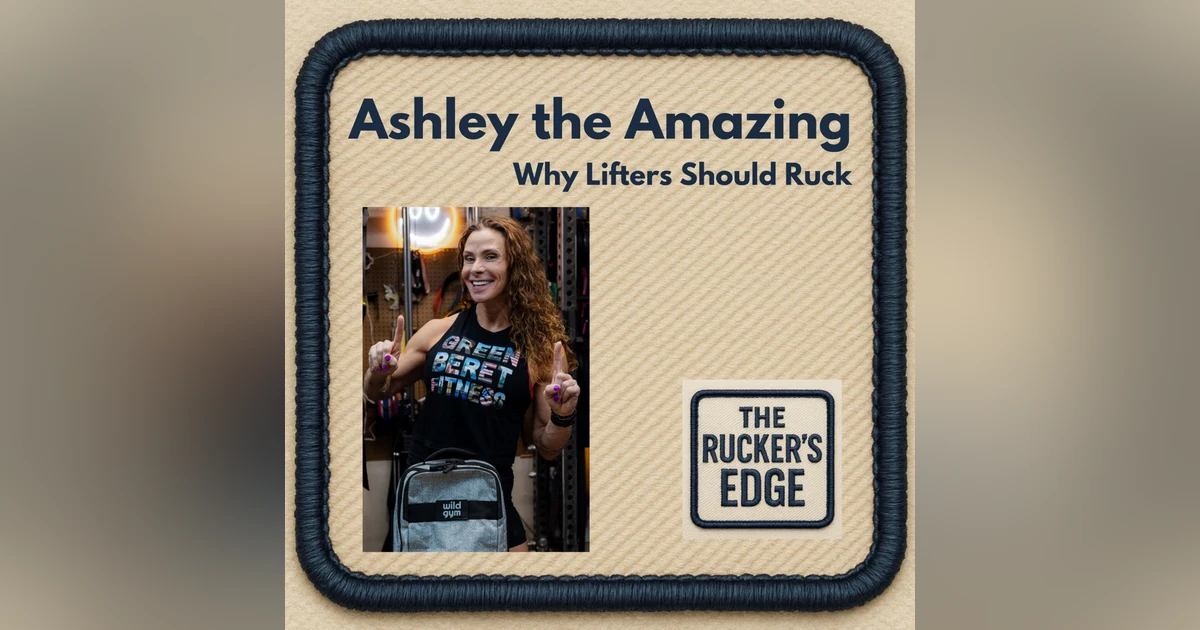


Many strength athletes avoid cardio because they worry it will interfere with muscle growth and strength gains. But what if the right kind of conditioning could actually make you a better lifter?
In this episode of The Rucker's Edge, Spencer sits down with Ashley the Amazing, Army veteran, former professional bodybuilder, endurance athlete, Olympic weightlifting coach, and kinesiology professor, to explore why rucking may be one of the most overlooked tools in a strength athlete's training program.
Ashley explains how rucking can improve recovery, cardiovascular fitness, tendon health, bone density, work capacity, and longevity while helping athletes avoid common mistakes that can lead to overtraining or loss of performance.
They also discuss how lifters can safely add rucking into their weekly training routine, common misconceptions about rucking, and why this simple activity can benefit everyone from competitive strength athletes to beginners just looking to improve their health.
Whether your goal is building strength, improving conditioning, or staying active for decades to come, this episode will help you understand where rucking fits into the bigger picture.
What You'll Learn:
- How rucking supports strength and hypertrophy goals
- The relationship between cardiovascular fitness and recovery
- How rucking improves tendon health and bone density
- Why rucking can help improve longevity and overall health
- Common misconceptions lifters have about rucking
- How to add rucking to a strength training program
- Why women and youth are often overlooked in the rucking community
- The interference effect explained
- Practical recommendations for getting started safely
Links & Resources:
- The Rucker's Edge – Official Site
- Follow The Rucker's Edge on Instagram: @theruckersedgepod
- Follow Ashley the Amazing on Instagram: @Ashley__The__Amazing__
Notes:
- Music Credit: "Play This Game" by Black Rhomb.
- Disclaimer: The information presented in this episode is for educational purposes only and should not be considered medical advice. Always consult a qualified healthcare professional before beginning any exercise program or making changes to your health, fitness, or nutrition routine.
0:00 Many lifters or strength athletes treat cardio like the enemy. They fear that spending too much time doing endurance work will cause them to lose strength, lose muscle, and undo all the hard work they put into the gym. But what if the opposite is true? What if the right type of conditioning could actually help strength athletes recover faster, improve work capacity, joints and connective tissue, and even help them lift more effectively over the long term? Today's guest believes that's exactly what rucking can do. Ashley the Amazing is an Army veteran, former professional bodybuilder, endurance athlete, Olympic weightlifting coach, kinesiology professor, and current doctoral student in exercise science.
0:40 She has spent years competing, coaching, and studying human performance across multiple disciplines, giving her a very unique perspective on how strength and endurance can work together. You're listening to the Rucker's Edge podcast, a show all about rucking that is designed to help you improve your rucking routine, lose weight, and ultimately gain your strength and energy back. Each episode dives into the science, stories, and strategies behind rucking. You learn from top ruckers, coaches, health experts, and performance specialists who break down what it takes to train smarter, recover faster, and stay ready for the next challenge. So whether you're new to rucking or an experienced rucker that's already logged hundreds of miles, this is the show for you. I'm your host, Spencer. Thanks for listening in. Please enjoy my conversation with Ashley the Amazing. Ashley the Amazing, thank you so much for joining me here on the Rucker's Edge podcast. Been following you for a while. You put out some really cool content, and I'm really excited to talk to you today about why lifters are people that strength train should be rucking. So thanks for joining me today. Thank you, Spencer, for having me and reaching out and putting this together. I'm excited to be here. So you have quite the extensive history when it comes to fitness. I'm just doing some research on you because I've only known you through social media. But when I started doing some research prior to this podcast, I saw that you can. competed in bodybuilding at a pro level. You've run marathons.
2:02 You've done CrossFit, High Rocks events. You served in the Army for several years. And you also teach kinesiology. So when someone approaches you or asks you to describe yourself in terms of where you fit in the fitness world, what do you tell them? Where do you even start to explain your background or your history? I just tell them that I am a land animal. So anything that has to do with fitness on land. is my jam. I can swim. I just, I'm not, I'm not a water animal. So I should tell them, hey, if it has to do with things that we can move our bodies on land, I'm all about trying it. That's awesome. And so, yeah, you're also, not only do you compete in all these different events, but you also teach people about kinesiology. What's that like being a professor and, you know, giving knowledge to people that are eager to learn? Is that, that's got to be gratifying, I'd imagine. It is. It is. Before I even graduated from George Mason with my master's in kinesiology, they reached out to me my last semester like, hey, we want to offer you a job. And I never thought of myself as being a professor in teaching. And then I said, you know what, I'll try it for a semester.
3:09 And I loved it. So this is my third year being an adjunct professor of kinesiology at George Mason University. And I loved it so much that now I'm back in school working on my doctorate so that I can teach at a higher level. and just have more knowledge to share with people who are interested in learning. So fitness is obviously kind of a big part of your life, it sounds like. It's a massive part of my life. So what does your training look like these days? What are you doing on like a daily basis or a weekly basis? What are you doing? Right now, I'm a little bit into everything. I still do some hypertrophy training, some bodybuilding things. I've been really into Olympic weightlifting the last two years, and I'm also now coaching. I do Olympic weightlifting coaching at a local CrossFit gym here in the area. So I'm teaching others Olympic weightlifting. And I'm also like running, cycling, rucking, everything really. I just like to try it all and just, I don't know, it keeps me entertained and keeps me in the best shape of my life. Even more than when I was competing as a professional bodybuilder. I feel like I have never been in better shape or just felt better. Cool. And that's great. Yeah, and I saw you recently had a knee injury. How's the recovery going? And is rucking entering the equation for any recovery with that?
4:31 Yeah, I just had knee surgery two weeks ago yesterday. Recovery's going great. Every day I get a little bit better, a little bit stronger. I'm not able to ruck. It'll probably be another two weeks. It'll probably take me about four weeks at a minimum, six weeks maximum, the doctor said, before I can get back into rucking. Hopefully it'll allow me to ruck at a higher capacity than I have been because of the knee injury that was existing that needed corrected. Gotcha. Yeah. Well, I hope the recovery goes well. I hope you get under the ruck again soon. I don't know how important that is in your life. And speaking of rucking, so I mentioned this earlier, you're a veteran. I think you served in Army Airborne. Is that where rucking started for you or were you rucking before then? Talk to me a little bit about your history. Yeah, introduced to rucking before then. I mean, I joined, I signed up for the military when I was 17, a senior in high school. And then as soon as I graduated, I left.
5:24 So I didn't have any exposure to rucking until I joined the military. Gotcha. So rucking in the military, I work with a lot of vets. I have family members and friends that are veterans and speaking to them about rucking. I have. Come across the opinion that rucking is not fun. It's grueling. It's terrible. Why would anybody want to do that? Was that your experience in the Army? I mean, clearly you're still rucking, so you're enjoying it and it's benefiting your fitness. But was that how the approach was when you're active duty? Well, yes, because the military doesn't. automatically say, hey, we're going to start with 10 pounds and walk for two miles.
6:04 They just throw 85 to 100 and some pounds on you and say, hey, we're going to go do a six mile and build up to a 12 mile. So, of course, it's going to be grueling and suffering. I loved it. I was actually one of the best ruckers in my units. where I served, especially at JCSE, like it kind of preceded me. I remember I was at this brief with an incoming company commander and in his welcome speech to the unit, he was like, I've heard about this Sergeant Romniak who is an unbelievable rucker. And that just kind of just motivated me more. Just I, even though it was uncomfortable, I absolutely loved it. And then once I served my time, I did nine years. I continue, I just continue to rock. Cool.
6:46 Oh, that's awesome. Yeah. Built to carry. Ashley, you have extensive knowledge in the strength training community. You are competing at a pro level. You've had coaching services where you're training lifters. I'm curious, when you bring up anything that looks like cardio to a dedicated weightlifter, is there a typical reaction? From my experience, I have seen that there's been some reluctant to do cardio work. Has that been your experience as well? Absolutely, there is reluctance. And I think that's just because of... old mindset or an older way of thinking that cardiovascular work is going to interfere with the strength training or hypertrophy gains that they're trying to go for, which is clearly not the case anymore if programmed right. I gotcha.
7:32 Yeah, that has been my experience too when speaking with weightlifters. It's like, no, why would I want to do anything that's not weightlifting? It's going to get in my way of, you know, putting on muscle. So thanks for clarifying that. I don't mean to cut you off, but I want to say that it will actually make them a better lifter. When we talk about recovery and body adaptations, right, a lot of those lifters, like the biggest guy doesn't mean they're the healthiest in the room. We have many facets of fitness, right? We have mobility and flexibility and strength and anaerobic and aerobic fitness. And so we have all these facets and they just focus on strength training. They're missing out on so many other variables, which. cardio or conditioning is such a fundamental and foundational platform for them so if they would just incorporate a little bit of cardio or weighted walking or we would call it rocking they would have better recovery between sets they would have better cardiovascular circulation like better um you know lymphatic drainage they would be able to let me just say it this way if we have a lifter and he's doing a heavy set of three to five back squats And he has no levels like zone two cardio conditioning under his belt. And then we have another athlete who has a great solid. He does rocking, you know, two days a week for 30 minutes.
8:50 The lifter A, who has no cardio, it's going to take him that full five minutes to recover in between sets. And he still might not have all the ATP, all the energy back in his body to do another max set and like a full effort. Whereas athlete B, who's trained, his heart rate has dropped back down. His nervous system has calmed down and he's going to be 100 % ready to tackle that next set to make better progress. So, I mean, it just builds on to you want to be a better lifter. You have to incorporate some zone two, some light. cardiovascular work. Yeah. Let's get into that. Let's get into the meat of this episode on why lifters should be should be rucking or doing some sort of cardio. Like when you look at a dedicated weightlifters like training program, have you seen like gaps or something that's like obvious that they really should be doing? I mean, I'm rucking, I think would fill those gaps. But is it common that there's just like no cardio being done? Oh, yeah. And from my experience in this. fitness community for over 20 years now, a lot of the lifters don't do any cardiovascular work. And it really does hurt them. It hurts their blood pressure, their cognitive function.
10:00 It hurts their rest and recovery. They could be getting so much more. And some of them are just diehard strength athletes. And all they want to do is progress in strength, progress their muscle, progress their muscle size or strength. And they're leaving some gains on the table by not walking, by not getting that heart rate up. For example, if you have a resting heart rate of 90 beats per minute, and I have a resting heart rate of 60 beats per minute, and we time that per minute, per hours per day over the week, your heart rate, your heart is doing 30 beats more per minute than mine. And if we multiply that by minutes, by hours, by days, by weeks, that's thousands of heartbeats more that your heart is doing more work than mine. And because I do the cardio, I'm saving years off my life.
10:47 So it's going to make you more efficient. It's going to make your engine just work clean and help support everything else you do in your life. Yeah, no, totally agree. I mean, I've seen that in my own personal experience, just from doing nothing to getting out there and actually, you know, rucking again. I used to be an avid runner and, you know, never really thought about trying to maintain a certain body weight or a certain level of health. But like after years of not being able to do any cardio and getting back into rucking, I'm like, oh, yeah, this is how I'm supposed to feel. But beyond cardiovascular adaption, what does rucking... From your experience and your education, what does rucking do for like joint health and connective tissue, I guess, and even maybe like load bearing capacity that weightlifters should understand or learn themselves?
11:35 So let's, we're going to take this kind of back a few steps into looking at humans. So what are humans really good at doing? We're really good at walking, right? We're ambulatory, but we're great at that. And we're great at carrying loads. What other mammal out there can pick up a heavy load for an extended period of time? They've done studies even with apes that they cannot carry loads like we can as efficiently. And there's no other mammal out there that can out -endurance us. So that's why when we look at past like hunter -gatherers and even tribes that are still hunting today, they're able to pursue their prey on foot, right? They're running or they're running this animal down to hunt it. And the thing is that we are adapted, that we don't have fur, and we have physiological adaptations that allow us to sweat, that allow us to cool our bodies, that allow us to stay with producing energy efficiently.
12:31 over a long period of time where other mammals don't have that. So that's why we succeed when we hunt is because we run that animal to exhaustion because they have fur. If you think of dogs and things like that, right, they don't sweat. They're going to tire out before us. So we're really good at those things. So we need to do more of those things. So given that we're really good at long distance and we're good at carrying loads, right, because once you hunt the animal down, you have to put it in your backpack and carry it out, right? You have to carry it back to the tribe. There are adaptations that are innate to these things that we're supposed to do, right? So if I take a Chevy Dually and a race car and I take them both to the racetrack, that race car is going to be really, really good at doing what it's supposed to do. And the Dually is not going to do that. But if I take them both to a heavy hauling, the Dually is going to be really good at that. So we need to go towards what we're...
13:20 made to do, what we're really good at doing. So endurance and packing things. And then with those comes these adaptations, like we build better bone density, which has been shown for rucking in women that it helps with bone density, which we're going to prevent osteoporosis, right? The over time when we fall and break a hip. Tendon health, that is one of the biggest bonuses of rucking. So when we think about tendons. We want stiff tendons. We want the stiff tendons because we want the force to transfer from the bone to the tendon to the muscle. If we have weak tendons that are kind of like jello -y, think about trying to, if you have a tight rubber band, there's more elastic, so you can transfer more force better than if it was elastic. So by us being with load on our back while rocking, we are producing gains in our tendons, which is going to make us better with strength. because you want that force to transfer from the bone to the tendon to the muscle more efficiently. So that's one of the biggest takeaways from rucking that people don't even think about is, wow, it's going to make your tendon stronger, you know, and there's a lot of strength athletes who tear their pecs, tear their biceps because the tendons aren't as strong as the muscle. So rucking allows us to strengthen those tendons so in the gym we don't have to worry about so many injuries. Yeah, that's... Excellent points. Everything that you touched on just there kind of leans into how to improve your longevity. You mentioned breaking a hip. That's a huge thing. After you break a hip, I forgot the stat, but that's X amount of
14:52 months before you're back in the hospital or even worse. But as people age, you know, I'm thinking like, you know, maybe in their senior years, I have learned that resistance training becomes increasingly popular. Okay. So when we're talking about longevity. We think of VO2 max or how efficient your body is at using oxygen. And rucking is a great way to improve your VO2 max, which is an indicator of longevity of health over the lifespan. And that's because rucking is a whole body activity. If you think of cycling, right, you're just using your legs. When we're rucking, there is so much more going on because we now have a force behind us, which is going to make our body have to alter its biomechanics to offset that load. We have to worry about stability, postural muscle. We're going to burn more calories.
15:39 There's so many good things about rucking because we're made to do it that are going to help transfer us to have that. longer life especially if you think about it when you're rucking maybe not in your neighborhood but out in the woods that uneven terrain you're working stabilizer muscles like you said proprioception you're kind of having to be more aware of your body in space which that unilateral like step step step it's going to transfer over to when you're older and you're trying to put your pants on one leg without having to sit down or you're just balanced in general there's so many positives that people just don't realize because they just think oh rucking that's the military thing where Everybody complains that, oh, you know, the military rucking annihilated me and broke me and that's why I can't do anything.
16:19 Well, they didn't do it right. But if you do it right, there's the benefits are stacked. Right. Yeah. And speaking of those benefits, like when a weightlifter starts rucking, have you noticed based off of maybe some of your athletes or your own experience, like what are some of the physical changes that might pop up first or that they might start noticing first? Noticing first, they just, they feel better. And I think that's because they get, most of the time we're getting outside, it's very seldom you see someone rocking on the treadmill. And then when you get outside, right, you're getting that sunlight, you're getting your vitamin D, you're getting some fresh air. And you're probably doing it with a community, right? You can do it with your family, your friends, in a group. So you're getting this like psychological boost of serotonin and all these things of like, wow, I'm doing it with friends, I'm getting sunlight, I'm getting fresh air. I'm not stuck inside looking at my computer screen or my phone screen. I completely agree with you on the, uh, ran rucking on a treadmill.
17:15 One of the reasons I chose rucking as one of my primary forms of staying, you know, fit was just, I tried these different other things and like, I just got bored. Like I can't, can't sit on the rower and row for that long that at that consistency that I needed to, or yeah, the treadmill is just awful. I'm not a big treadmill user. But yeah, I think you're absolutely right. Getting outside, hitting on those, yeah, as you said, walking in uneven ground and improving your proprioception, like you mentioned before, excellent points there. More with Ashley in just a moment, including her recommendations on how strength athletes could add rucking to their workout schedule without sacrificing gains. But first, do you have any friends or family members that exclusively lift?
17:57 If so, do them a favor and share this episode with them. It might inspire them to start rucking. Sharing this episode would not only help them, it will also help this show grow, which will then help even more people improve their health and lives. Okay, back to it. I'm curious to see how you would maybe coach an athlete or maybe drawing from your experience doing that with some of the services you used to offer. How should people start? implementing rucking into their routine, say they're at the gym five days a week, where does rucking fit in for a weightlifter? So rucking would fit in for somebody who's serious into strength or hypertrophy on active rest days, a light upper body day, or even a rest day. I would say any day but leg day. There's this thing called the interference effect where if you're doing, let's say, your leg day immediately followed by... hardcore rucking, your body isn't going to know whether it's going to go for anabolic and muscle building or if it's going to go for like fat oxidation and endurance. And those are different kinds of muscle fibers. So you don't want to put the rucking on the same day as leg day or any other kind of really intense training day because you want everything that you have, all your fuel, all your recovery in your body to go towards feeding those gains of strength.
19:20 and adaptations there. So the rucking is going to fit in great on, like I said, the recovery day, active recovery, like a mobility day, upper body day, because that way you don't have to really worry so much about that interference effect in your body, not knowing which pathway to take and then it freaking out and then you just waste everything because you're not getting strength and you're not getting endurance. Your body's just all over the place. So yeah. And then also to tell somebody, I would say start slow and slow. So for females, 5, 10 pounds, 15 pounds. For males, you could start with 15, 20 pounds. It depends on the person's fitness level and where their cardiovascular fitness is on a spectrum if they've never done it before versus they've done it a lot. They can start a little bit heavier, go longer. Less is more, though, when you start because if someone goes out there like they did in the military and they think they can do 40 pounds for five miles. they're going to get hurt. They're going to increase their injury risk. So start low and slow and then gradually increase the intensity with, you could do hills, you could go from your flat, you know, hometown going around the block to going to the park. You can add load, you can add time. So there's a lot of different variables that you can add to start progressing someone.
20:30 So for me, I would say if it's a strength athlete, one to two days a week. 30 minutes at a conversational pace. So if we're talking about RPE, or rate of preserved exertion, you know, something between four and six. They should carry on a conversation. It should be their heart rate's elevated, but they're not at like a zone three effort where they're in the red, they're dying. It's awful, right? And then every two weeks you can progress by adding five minutes, by adding five pounds, by adding a different terrain, adding a hill. Those are easy progressions. And then once you work out to maybe three days per week for 30 minutes for strength athlete, that's a good place to be. I wouldn't recommend them doing any more than maybe 40 minutes unless they're trying to like lean out. So if you're talking about using rucking for maybe hypertrophy or bodybuilders.
21:17 We can get into why that eccentric loading would be really good for conditioning their legs. That's a whole little piece that we can get into, which would bring in like this nice hard look on their muscles. But for strength athletes, their goal is to increase their strength, you know, percent rep max three days a week, 30 minutes. There you go. Like it's not that complicated. It's not that hard. And the next I will say, a lot of people say you can start with. Any kind of backpack, which you can. If your kids have a backpack, they could load books. But it's not necessarily you need to invest all this money initially into a good ruck because it can get expensive. But if you're serious about rucking, it is worth the investment because those comforts of a pack that's adjustable to your shoulders, to your back, having a hip. belt to help support some of the weight so it's not all on your shoulders will keep you interested. It will keep you going because if you come back and everything's sore and it wasn't comfortable for you, you're not going to continue it. If you come back, you're like, man, I couldn't stand up for a week. My traps are like just wrecked. People aren't going to because they're like they don't want to they don't want to have that level of discomfort.
22:27 A lot of people aren't. So if you invest in a nice ruck, it will help you stay. consistent because you'll be comfortable, you'll feel good, and you'll keep doing it if you like it. Yeah, that's so excellent points there, Ashley. That was really well summarized. Two things I wanted to hit on there. You did mention about maybe not rucking on leg days. I had also had that thought. It's like, okay, yeah, you're working out your legs. You may not want to work them out even more because you're probably exerting your muscles and your legs. You need to let them rest. Is it advisable to not even ruck the next day after? A leg day? Or what are your thoughts on that? How long is long enough to give your legs a rest before rucking? If your legs, the day after leg day, are completely wrecked and sore, I would say don't ruck, do light cycle.
23:19 So with rucking, there's this eccentric loading. So when we... If you think about, we talk about treadmills or step mills, you think of like the athlete having to step and push off, step and push off. So there's a sync eccentric loading. So we're having to break. We're putting load under the lengthening portion of our leg, which actually induces more muscle fatigue and muscle damage than the bike. So the bike or elliptical doesn't have any of that eccentric because your feet are just staying there and you're using your muscles. So eccentric loading is going to be a lot more difficult on your body to recover. So if your legs. are super sore, I would say light bike to get that lymphatic drainage, increase circulation. If you did legs and they aren't sore, then you can rock the next day as long as you are well fed, well hydrated, and well rested. As I mentioned earlier, there's this phenomenon in the body called the interference effect. And I'll deep dive into this for a short moment. So there's two pathways we think about that our body takes when we're training. And we're talking about fitness. There's the mTOR pathway and the AMPK pathway. The AMPK pathway is, let's say that we train fasted or we do cardio fasted or we're an endurance athlete. It's great for fat oxidation. So you're going to use a lot of fuel. But your body is in this state of survival mode. So whatever you have. fuel wise and stuff in you, it's going to just hold, like keep it where it is to sustain this low intensity effort.
24:44 And you're not going to have anabolic signaling. You're not going to have muscle protein synthesis. Whereas if you're well fed and you're well recovered, like you have, you've met your adequate protein and carbohydrates, you could do rucking the next day because your body, the mTOR pathway, that's, that's, that's, it's. The light switch is flipped on when your body's like, we're recovered. We have plenty of carbs. We have plenty of protein. We can go into muscle protein synthesis. We can build. We can start that anabolic process. So as long as you meet those requirements and you go to RUC, you're going to be fine because then you're going to be able to use more energy to do your endurance, to train your cardiovascular system. Because they are different muscle fiber types. You think about strength training and you think of strength athletes, they have like the big muscles because those muscle fibers they're building are, if you look under my scope, they're nice and big. And that's why endurance athletes are long and lean because their muscles transition to a long lean look. So if you don't time it right and you, let's say you repeatedly do leg day and then rucking. and let's say you do that four times a week, you're going to see your muscles slowly get smaller because they're transitioning to a longer fiber type that is more dense with mitochondria because they want more oxygen. And then you're going to be like, wow, I'm losing all my gains. It's because you haven't allowed your body to recover and get the food and stuff it needs. You do need to separate the two and you can separate them. Let's say you don't have all the time in the world. You can do legs in the morning. And then if they're not wrecked, you can go on. a rock in the afternoon, or you
26:15 can do it the next day. It just depends on how sore you are and how much food you have available in your system. Wow. Yeah. Thank you so much for that explanation. And like, as an endurance athlete, you know, I grew up running and had historically issues putting muscle on, like frustrating issues. That makes sense. Like your muscle, I guess, configuration or shape is just going to be different than someone specifically just only focused on. on building muscle mass. So I think you just helped me out there, Ashley. I'm putting, ticking that box off in the back of my head. Thanks for that. You're welcome, Spencer. There is this really cool part about rucking though, is that it, because of the ability to have load on us, it does give us the option for progressive overload and we can build strength with rucking.
27:04 So there was a really small study done with these, these. um backwoods hunters i'm actually reading this book right now on cameron hayes who's a like yeah who's an endurance athlete and he does strength training he does bow hunting anyway so there's a study done and they had those massive packs right because they're out in the wilderness doing these hunts and um they they actually lost body fat and gained some muscle during the couple of weeks or the months they were out in the wilderness versus if you were have someone just do cardio that typically they lose both muscle and fat so having that little bit of load actually will help you burn fat better than just walking or running and it will help you maintain if maintain and at and at least maintain if not actually put on So there is some benefits for strength athletes to also get muscle building from rucking.
28:00 Excellent. Excellent. Thank you for that. I appreciate that. The other thing that I was going to hit on after you summarize, you know, all the benefits from rucking and how to implement, specifically how to implement rucking into a routine, is the purpose -built rucksack is a game changer. It's great. I mean, I mentioned this all the time on the podcast. I just want people to start rucking, and it's great to start with what you have. I have a whole episode about that. If you want to listen to that, you can go back and listen to it. It's great to start with what you have, but it really, really helps to have something dedicated to hold these specific rucking weight plates high and tight on your back. It's, yeah, that is a great note. It's always worth mentioning. Get something purpose -built because it really is a game changer. How you wear it and where you put the load are going to make or break your ruck. Absolutely. If you're using just a regular backpack and the load is all the way in the bottom of the backpack because you've never done rucking before, you don't know about it, it's going to pull your shoulders so much that you're going to be uncomfortable. Why are people doing this?
29:01 Whereas if, let's say, you are new to rucking, you have just a standard backpack, put towels in the bottom to fill the first half, and then you can put your bags of rice or your cans of canned good or whatever you have around the house for weight. You want the weight to be high and tight. And then I always say anything over 20 pounds, invest in a hip belt because that's going to shift a majority of the weight from the shoulders to rest on your hip bones, which makes it so much more comfortable so that you can have a enjoyable experience. Enjoyable, right? I mean, it's still going to be some level, but. Uncomfortable being or comfortable being uncomfortable, I guess. Yeah, exactly. Can we move into some misconceptions some weightlifters might have about rocking?
29:44 So I in preparation for this episode, I went on to some online forums just to kind of see the pulse of what people are saying in terms of like weightlifting and and rocking. And I saw a few few items that I suspect might be misconceptions. I'm curious to see what your take is on it. But some people have said like rocking is going to destroy your knees. How do you feel about that? Well, if if we're looking at that as a blank statement. We need context. So is it going to destroy your knees next to running? Running is going to be way worse on your knees because of the force. If you're running, your force is going to be like eight times your body weight on the ground, where rucking, even with a load, is going to be maybe three times your body weight. So the force on your joints is going to be significantly less with rucking. So no, it's not going to destroy your knees. The only thing I will say that...
30:35 With my background and my knowledge, if you already have weak ankle mobility and bad hips, maybe your mobility or flexibility in your ankle and your hips are bad, then it's going to hurt your knees. Most of the time, knee pain is not because of the knee joint itself. It's because of the two joints above or below it, right? The hip or the ankle. So no, it's not going to damage your knees. It's actually going to be beneficial. I mean, we're literally made to walk. So we're walking with weight. It's phenomenal. And it's going to, like I said, it's going to help build your tendons. It's going to help strengthen those stabilizers. So there's, I would say that misconception is apparently that person either had bad knees, bad ankle mobility, bad hips, or just bad posture in general. Yeah. Good, good notes. Another one, you kind of already touched on this, but like I'll lose muscle if I add rucking to my lifting program. So we did touch on that, but that's absolutely probably one of the biggest ones I hear is, oh, I don't want to lose my muscle.
31:31 Well, then eat and recover. And you will not, literally, you won't have to worry. That isn't even a physiological option as long as you have food in your system and you're recovered. Yeah. I'm looking through the rest of these. It looks like we already hit on all these other ones or debunked them. In our pre -call, you mentioned one thing that was important. for you to communicate here today was that rucking is for everyone. I know that I was going to ask you this, like, what does that mean to you? And who specifically do you think gets overlooked in the rucking conversation? And the rucking conversation that who gets overlooked is youth and females. I led some Go Ruck events in 2020, in 2025. And I did a lot of takeovers, which is Go Ruck's kind of introduction to rucking.
32:20 So you do like a little workout and maybe like a 5K ruck. And I will say in the community, I was the first female to lead in the Go Ruck community. And I had more females show up and say that like, hey. man, this is so much nicer to be led by a female or to see there's other females out there rucking. I do believe that females are a little bit intimidating about getting involved in this kind of sport because if you Google rucking, the first thing you see is just all this hardcore military, like, oh, we're going out. And then women are like, oh, that's not for me. But absolutely, it's for you, right? They have rucks now, like Frontline Athletic has a ruck specifically designed to fit a woman's body way more comfortably. on their shoulders and on their chest. So I would say that, you know, women are overlooked and that definitely it's for them because it's going to, like I said, with their bone density and just overall better biomechanics and just getting them out and active. And then youth, youth can do it. If you think about kids are already carrying their weighted backpacks to school. So why not get them incorporated on the evening walks with the family and the dog and just have them, right?
33:23 We don't, childhood obesity is on the rise. So rucking is an awesome outlet for them too. And it's. It's low cost relatively right there. I have a backpack and it's just something you can just literally go outside and do. You don't have to say, oh, I have to sit in traffic and drive to the gym just so I can get this done. No, you literally just step out your door or drive to the park and it's free. Yeah. Yeah. It's interesting you bring up youth rucking. I'm curious to see your take on this. But like I know with with weight training, kids need a certain development. I think from what I remember years ago and that it may not be the best idea to strength train at a young age. Any cautions that maybe youngsters should be aware of if they wanted to start rucking?
34:04 No. So actually kind of the newer research and stuff we're seeing right now is as long as youth are supervised when it comes to rate training or rucking and they have the proper guidance for form and kind of fit, they can do it. Even at the Go Ruck events that I led, we had youth. I mean, small kids, maybe like seven years old, come out and do this with us all the way up to like 15. And as long as they are given the proper training and guidance and understood that especially youth, right, when they go through puberty, their bodies are going to change a little bit and they're going to have to kind of learn their bodies again as they adapt and they grow. But man, it's absolutely amazing for them. And it helps with their bones. It helps with their proprioception and their own awareness in their body. Awesome. Yeah, I appreciate your expertise on that. Thanks. Yeah, I haven't kept up with that research in quite some time. So I appreciate you getting me up to date on that. Yeah, you're welcome. So coming to the end of this episode, if a lifter wants to start rucking, what's what's one takeaway that you would want them to remember after listening to this episode? I would say the goal isn't to survive the ruck and kill yourself. The goal is to adapt to the ruck. Yeah, good point. I like that. I like that a lot. So, Ashley, this is really. helpful for me. And I'm hoping I'm sure it is going to be helpful for the audience.
35:21 And I had a lot of fun talking to you today. I wanted to ask you if someone wanted to follow you or keep up with your work, where would you where would you send them? I am on social media. I'm pretty active on Instagram and YouTube. And YouTube is where I do a lot of my equipment reviews, including different reviews of rocks. And you can just find me under Ashley the amazing if you just type that in. And that that's pretty much my social media and what people know me as is actually the amazing. Awesome. Well, Ashley, appreciate your time here. Thanks so much for sharing your expertise. Thanks for giving me your time to have this conversation today. I really appreciate it. You know, thank you, Spencer. It was such a gift to be able to talk to you and share some of my knowledge about rocking.
36:02 So hopefully one person out there is motivated to get outside and go on a walk. All right. That wraps up my conversation with Ashley the Amazing. You can connect with her on Instagram at Ashley the Amazing, and I'll drop that link into the show notes. If you enjoyed today's episode, make sure to follow or subscribe to the show in your favorite podcast app so you're notified of new episodes. In next week's episode, I talk to Philip Pape from the Wits and Weights podcast. We talk about weighted vest and rucking through the lens of science. Okay, that's it for today. Thanks again for listening to this episode of The Rucker's Ed.