World Record Ruck and Veteran Support with Mark Jones

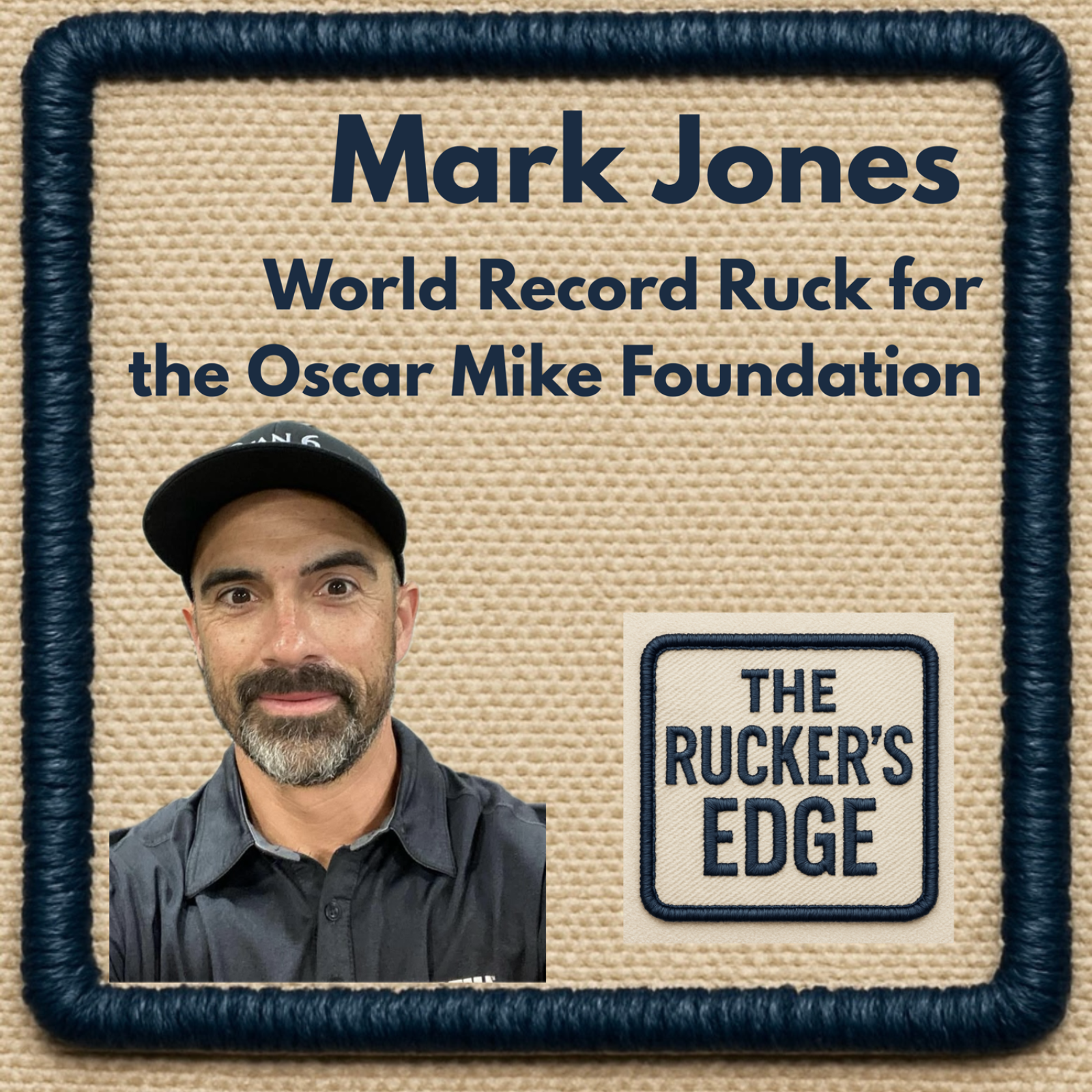


In this episode of The Rucker’s Edge, Mark Jones shares his mission-driven journey toward a world record ruck for the Oscar Mike Foundation, an organization dedicated to empowering injured veterans through sports and community.
Mark’s story begins with his first half marathon in 2006 and builds through a decade of testing his limits — from GORUCK Selection Finisher to multiple Death Race completions. Now, he’s taking on an 80-mile (with a 100-mile bonus) ruck while carrying 40 pounds, all to raise awareness and support for the Oscar Mike Foundation’s work with injured veterans.
Mark opens up about working with a coach for the first time and the mindset required to keep going when every step hurts. He also shares his philosophy on competition and the importance of supporting fellow athletes along the way.
If you’re training for your own event, building your rucking endurance, or simply need inspiration to push beyond your limits, this conversation will help you find purpose in the pain and motivation in the mission.
Links & Resources
- Learn more about the Oscar Mike Foundation: oscarmike.org
- Connect with Mark on Instagram @rucking100
- Follow The Rucker’s Edge on Instagram: @theruckersedgepod
Notes
- Music Credit: "Play This Game" by Black Rhomb.
- I'm not a doctor, and this podcast is for informational and entertainment purposes only. Please consult with your physician before starting any new exercise or physical activity.
0:09 What does it take to carry 40 pounds on your back for 80 miles and do it for something bigger than yourself? Today on The Record's Edge, I'm talking with Mark Jones, a Marine, a Go Rucks selection finisher, death race competitor, and now a man on a mission to set a world record to raise awareness and support for the Oscar Mike Foundation, which helps injured veterans stay active and unstoppable. He's attempting the world record this Thursday, November 6th, and the live stream will be available on oscarmike .org. In this episode, Mark breaks down how he's training for his 24 -hour 80 -mile event, what it's like to work with a coach for the first time, and how he's built the mental toughness to push through fatigue. You'll hear his philosophy on competition, recovery, and purpose, and how you can apply these same mindsets to your own training and life. This one's about endurance, service, and what it really means to stay Oscar Mike on the move. You're listening to the Rutgers Edge podcast, a show all about rucking that is designed to help you develop a rucking routine, lose weight, and ultimately gain your strength and energy back. Whether you're an office worker with lower back pain, a fitness first -timer, or a new parent trying to get back to your pre -kid's weight, this show is for you. I'm your host, Spencer. Thanks for listening in. I'm excited to share this one with you today. But just a real quick sidebar, my apologies for the audio.
1:25 I had a mishap during the editing process. I'm going to fix it for next time. But anyway, here's my conversation with Mark Jones. Mark, thanks for joining me today on the Rutgers Edge podcast. It's really good to have you here. Hey, thanks for having me. Happy Halloween. Yeah, happy Halloween. We're recording this on Halloween. Got some trick -or -treating later today, some more fun activities. So 100 miles, 24 hours, 40 pounds, five days from now. How are you feeling about it? You know, it's been a wild ride. But I want to eliminate the 100 miles because we're chopping this up. Obviously, this is a fundraising event for Oscar Mike. The number one goal is to break the record, which is currently 79 miles, which means we need 80. We're looking at the 100 as the bonus piece.
2:07 Everything after 80 is all bonus. 100 is a high bar, but if you know me, there's nothing we would not do to pursue the 100 in the first place. Yeah, feeling really good. That makes total sense. And it's really good to hear that you're feeling good about it. And I want to talk a lot more about the world record attempt and especially Oscar Mike, the foundation you're doing this for. But I want to back up a little bit and talk about your entry into endurance competitions and your journey, if that's okay. Your endurance competition resume is one of the strongest out there from what I can see. And if my research serves me well, I think you started with a half marathon as one of your first endurance races. What drove you to the world of endurance races or competition in the first place? man you went you went deep that's 2006 okay so i mean the story if people have listened to me in the past they hear the same story but i love to i love to preach it because it was just there's no way i could recreate this uh you know the the feeling of coming down the stairs uh you know heavily overweight hung over it's two in the afternoon uh my pockets are empty i'm wondering what the hell i did last night And I opened the door and the sun hits me dead in my eye. And there's a half marathon flyer sitting at my doorstep, the Harrisburg, Pennsylvania half marathon. And I just was like, what the hell is this? And, you know, ego kicked in and something told me I needed to change my life and jump into this. And that's what I did a few weeks later. And man, I was sick for days, but it was, there was something
3:38 about that heat down that really just wanted me to search for more. Yeah, it's such a cool story. So many people wouldn't even read what was on that flyer or pamphlet. It would just keep moving. So I'm glad whatever it was caught your eye and you dove into this world because your resume is just so impressive. I went back and took a look at some of the events you've done and completed. First of all, GORUCK Selection Finisher at the top. That was certainly an eye -catcher. Two -time GORUCK. rucking world champ five -time death race finisher insane um and then most recently and i'm missing a lot of events mark but most recently here in april the big bad ruck and then congrats on your top 10 finish on the inaugural ruck race league regular season finish by the way you know you've done all these events but what was your first rucking competition or competitive event my first it was called a hump in the marines so in the united states rink or you uh it's called a hump and My first reaction was, what the hell is a hump? What are we doing?
4:28 You're a six, 17 -year -old Mayan wanderer when you hear that word. When you start packing all this stuff up and you have no idea how to do it, you don't know. I've never really put anything on besides a dance board in my life coming out of high school. Now you have this Alice pack at the time and your stuff and all the crap they tell you to put into it. All of a sudden, you're just marching down the road and you just know you have to keep moving. That right there. Because so many people are jumping into it with, obviously, your show is an insider scoop of how to get better at this or to take those first steps. But for me, I had absolutely no clue what the heck I was doing. And what I realized real quick is that there was this pain just from carrying some weight. But the weight that I was carrying was obviously practical and useful to the mission that was coming up right at hand. So that's what I kind of fell in love with is the practical side of it that I always like to preach to towards everybody today, like why I do this. I'm kind of curious, how much weight do you think you were carrying? You know, I would say probably in the beginning, I'm just starting off probably like 40 pounds or so. And it doesn't sound like a lot, but when you get into it and you start carrying like real stuff, it's not the same kind of load that the equivalent 40 -pound plate would be. You know, it's bulkier, it shifts. It's just a different style, right? Yeah. And I would definitely easily say, just in boot camp, we were carrying loads up to 100, no problem. And that was definitely
6:00 towards the end. And, you know, that all varies, too. When you get into what they call the fleet, you're carrying different weapon systems that get shifted around all over the place. So you can have a 50 -pound pack, and then all of a sudden it becomes 100 or more, depending on what else you're carrying. But, you know, that's the whole game. Share the weight. I'm curious, of all the events in your history of rucking, which one are you the most proud of? Man, that's a really tough question. There's different moments and different times in my life that, you know, because we're always facing that finish line for something. Not, you know, I don't know, at least for me, it's not the award, the pass, money. There's something going on in my life that it brings an event to surface into my life, just like the half marathon. That wasn't placed on my doorstep by somebody. That was blown around in a little tornado and just landed on my doorstep.
6:56 It was crumbled. It wasn't perfect. That landed there for a reason. And I feel like events always call to me for a reason. And so whenever I'm having something difficult go on in my life and an event pops up that I want to pursue, and that becomes a great achievement at the end because of all the hard work. the time that I reflected on how I got better and how I trained for it and then how I succeeded. So those are all especially unique moments. And it could be from a 5K to a multi -day step race or another event that might have the same shared feelings. But one I have to say that sticks out the most is the selection, just because it is one of my only stories I can really truly display and speak of. how resilience played a huge part to that success. That wasn't something I just went and did and succeeded. It took a few times. And humbly saying, I quit a few times. And finally, when I put 100 % focus on it, I was able to just get it done. And when I got it done, I put the tools needed to get it done into my pack and carried that weight literally. it wasn't as bad as it was for all those times that I just second, I gave it, I gave it like that, that B race mentality.
8:17 It said that 100%, this is all I'm going for this year. And when I did that, I made it, it made it that much easier, you know? Yeah. So I would say, I would say that's definitely up there as, as top three, top five for sure. Yeah, definitely. I can totally understand that. And yeah, congrats to you. That is a phenomenal feat and a tremendous amount of respect for your first. Did you attempt it more than once? I thought I just saw you attempt it the year before and then you came back the next year. Was it two years later? No. So I had no idea what I was getting myself into. A buddy was just like, you should go do this. And it was way back when you had to do a challenge to kind of like get into it. So I went into the challenge and then was able to, I guess, get approved for selection.
9:00 And, you know, I was like, okay, I can do anything, you know, mentality and got to like 36 hours and just quit. I was pissed off. And then I jumped right back into it. You know, again, ego kicking in saying, oh man, that was a fluke. You got it next time, you know what to do. And then it was a shorter timeframe. And then it was a legit bed drop where I just passed out on the beach and I woke up and I said, you're done. So, you know, those three times, I think in two years, I was told by Jason, the CEO, like, hey, you need to take two years off, focus. I see you can do this. You just need to focus. So that's what I did and took his advice and came back. That's awesome. Wow. Thanks for sharing that.
9:41 I didn't realize that. I have a tremendous amount of respect for you for your previous attempts and then coming back, taking the time off and achieving your goal. That's just wild. And so few people have achieved that. That's quite the accomplishment. And I know you don't do it for the medals. There are more greater reasons for your why. But yeah, it's a huge accomplishment. And going back to the world record attempt, you're doing it for Oscar Mike Foundation, which again, I want to talk about a little further. Yeah, 24 hours, 40 pounds. Yeah, the current record is 79 miles. That's a little over a 14 -minute mile pace. What's your strategy going into this? So we had a roller coaster to get to where we're at now. So anybody trying to think about maybe pursuing a Guinness World Record, you'll get into that world where there are a lot of unknown answers until you pay a lot of money to get.
10:36 some answers. And that's what we've been doing for the better part of a year. So I won't talk about the ridiculous amounts they charge for an in -person adjudicator, but that's what Oscar Mike wanted because they have this big red tie event the next day on Red Friday, and they wanted a big presentation. So no pressure to me. We start on Thursday, it goes to Friday, and then at night the presentation will happen. So the format that I ended up creating, because Parks and Rec's in Chicago, where we were going to have it initially, was just such a pain to deal with. And they didn't really answer any of our questions. And time was ticking down. This is what I'm talking about. Maybe a month ago, we just finally got the thumbs up. But it wasn't from Chicago. It was from a venue in Belvedere, Illinois, which is about two hours west of Chicago.
11:26 And this was just spotted on me looking on Google Earth. And I see a track. We had a big open space. So it's just a bunch of soccer fields in the middle. And then it has an asphalt track around. And I was playing around with the distances and just found that a rectangle around basically the entire facility is 1 .4 miles to the T. And I was like, no way. 1 .4 times three is 4 .2. And that's equivalent to a backyard ultra. So this is something manageable where we could say every three loops. In under an hour, we're at the backyard, maintain 4 .2 an hour, and we're on pace. Perfect, yeah. We don't have to wait for a bell every hour. We can go whenever we need. Yeah. So that's going to be the exciting piece. If you're into that stuff that we're going to have on the live stream, that you can really kind of battle track where I'm at. You have to have a camera on you the whole time and then a camera on the clock. So it's going to probably be a split screen of just things going on the entire 24 hours. That's really cool that it's going to be live streamed. Wow. Is it typical that you have a coach help you? I think from my understanding, historically, you train yourself, but I noticed you have a coach helping you just go around. Why did you decide to get outside help after years of self -directed training, I guess? Well, you know, you talk to a lot of different athletes and you see some of them as coaches and then some of them being coached.
12:51 And sometimes they do both. I said, we have enough time to try this out, but I have to go all in. I can't. I can't do a little bit of my stuff and then some of their stuff. I have to listen to my coach 100%. And I've just never done that before. And I like doing things for the first time in probably the worst case scenario. I am not a perfect person where I go into something and it's 100 % success or 100 % win. I go in with a lot of unknowns all the time. But I'm also an unknown when I enter the arena in races. And I just love that. I don't like guarantees in life. I like going in there almost like the underdog and battling issues that arise as they come. So having a coach was one of those. It's never happened before. I can always just say, hey, I've always succeeded in the past. Actually, the coach I have, Ron Geiger, he reached out to me for an athlete he had going to selection.
13:50 So I spoke with him and helped one of his athletes. And then he actually wanted to compensate me for my time. And I was like, no, absolutely not. And then I just came back to him and said, hey, you know, time to pay your debt. But man, he is phenomenal. He is so knowledgeable. I'm just a dumb grunt, right? I go out there, yeah, I'm going to do this. And I figure, I call it fitful. I figure it out. And that's kind of how I do everything. But this time. Everything has been structured. I listened to everything he said. We'd get on weekly or biweekly calls, and I could tell him, I don't really feel good about this, or maybe we shift this and that, and I'd probably give him a hard time, but we work really well together, and he's very receptive to the criticism I present, and I'm very good at following his direction because he knows his stuff, and it's worked out really well, and I can't wait to have him there. He's going to show up there also and be coaching me the entire time. Oh, that's really cool. He's going to be in person. Wow. Yeah.
14:56 I just felt really, really good about having him as a coach. Since I was thinking about it, with all the, you've got to get this done scenarios that were presented and all the investments and all the sponsors, I was like, well, I got to be legit all the way through on this. Yeah, no, that's great. It's good to hear y 'all's communication is really good. You know, the coach -athlete dynamic really depends on trust and communication. It sounds like y 'all figured that out really early. Of course, it helps when you've already had a relationship sort of established and you kind of know sort of who you're going to be working with going into it. So what does training look like for something like setting a world record with 40 pounds in your back? A lot of rocking.
15:36 I want to talk about how I was training prior. But he opened the door into how to take blocks, piece them together where everything makes sense and they're actually building off each other. And I'm not just going through these grinds of pain and misery and suffering for almost no reason on my own. So we had a huge block of strength and just pushing that to the limit and then dropping back down and starting to build up the rough piece. We would do 40 pounds, 50 pounds, sometimes 30. And we had speed sessions. We had long walks. Long walks is something I wasn't really doing much of because I just hate walking. But on my own, I was running and then just walking. There was a little bit of elevation or something like that. But he's been putting me on mandatory walks.
16:28 And I've really come to enjoy them. Maybe that's because I'm becoming an old man. I've really enjoyed the walk. Today was 10K. It's 3 in the morning. It's delightful. That's awesome. Are they for recovery purposes or do they serve some other purpose? For the 50 pounds, I think it's just having that... When you think about it, I'm basically a little over 3 miles an hour. I'm going out for... He likes to do it in kilometers. Basically, a 12 -mile run or a ruck is walking. you're looking at like four hours with the ruck on. We're not putting that down at all. Like the ruck is on for four hours with 50 pounds.
17:10 So now when you drop back and you're doing a run with 40 pounds, that's an increment comparable to what we're going to be doing. I've been calling it my tough training on Strava, like train how you fight. You know, it makes everything feel easier. And that's, I think I come, because I have a triathlon background too, and he's a professional mountain biker. I think he's really incorporating what I used to do with the brick training. And, you know, doing some of that with the rucking has really paid off. Of all the workouts that y 'all are doing, what non -rucking workout are you doing that provides the most benefit for you? Ooh, great question. Or is there? It's just, they're all complimentary maybe. You know, he, and it's something I never liked and I wouldn't wish on anybody, but. He's had me up to doing about half mile repeats of 50 pound over the head with 50 pounds on my rock, uh, with a, with a dumbbell. And that's just been a mental mindfuck, like carrying a dumbbell overhead with a rock and you're just, you're counterbalancing everything and you come back and now you're doing it on the other side and then you're doing it just a single, the single movements I think have been really beneficial because it's just, it's exposing.
18:29 one side or the other. And then just again and again and again. That's been really hard. Obviously, that's with a ruck. What's one training principle that's universal to someone that's training for a 5 -mile ruck versus an 80 -mile ruck? You know, man, I think you've said it. We're going to probably be the dead horse with everything you've presented prior to this podcast. You've got to keep it simple. You start light, especially if you're getting into it. And then figure out the interval that works for you for the time you're going out. It starts with just walking the five miles. And then with half the load that you're going to race in. And then building that and then start incorporating, okay, maybe a minute I walk and two minutes I run or vice versa. And then start getting into specific distances. A quarter mile I'm walking, a quarter mile I'm running. And then just start. seeing what works, what doesn't, and then shrinking those numbers to, uh, to get to your race point or your goals. I, you know, Giovanni is sticking out to me. Uh, he mentioned Deca this morning and that's what I work for.
19:35 And, uh, you know, I always tell people on site, what's your, what's your, uh, we call it slick without the ruck, right? So what's your slick time for Deca and then what's your ruck time. And if they don't have it, I always, or one of, if they don't have one or the other, I always say, go after the slick or go after the ruck. So you have those two numbers in your head and then you shrink those two, you know, and that's, that's really like the ultimate goal is how do we, how do we get better at both of these? But now we know we have two, uh, you know, bookends and you just shrink that number in the middle. Yeah. That's a good way to frame it. I like that. Um, switching to talking about gear, what rucksack are you going to be using? Man, this is, this has been really hard because I've had a lot of companies, uh, send me the rucks and I've tried and. You know, so many amazing features with a lot of the packs I've worked with. And, you know, just because GoRuck is kind of like monopolized, you use this ruck for our events and a lot of the events I've gone through for many years now, that's all I've been using. So it's really been tough for me to jump into a new ruck when that rucker, the 20 liter rucker, has been... like a part of my body for so long that my body just is not receptive to something new quite yet for this journey. And, uh, you know, a couple have been close, you know, wild gym I think is right there with a, with a feather ruck and then frontline
21:07 just has a couple more adjustments. And I think they're there as well. Just a lot of other companies are more for like multi -day backpacking, like camping stuff. That's, I wouldn't use a rucker for that. I like to have things accessible and pockets everywhere, but. For this, I mean, we're trying to be as slick as possible without flopping all over the place. But we're going to do two of those, two ruckers, alternate every, we're calling it lap, every 4 .2 miles. Yeah, I mean, you use what works for you. You've already established that. You know, the rucker, which is an extension of your body at this point, is something you're comfortable with, so that definitely makes sense that you're just going to continue with that. More with Mark in just a moment, including how he approaches recovery and his philosophy on competition. But I want to take a quick break to say thanks for listening to the podcast. Please text this episode with a fellow rucker that might find it interesting or a friend that could benefit from rucking. Sharing this episode would help the show grow and help more people improve their health and their lives. Okay, back to it. I want to move on to recovery. How do you recover from an 80 -mile ruck? What do you do differently?
22:13 uh after 80 miles than you know five miles i don't i don't think i'll do anything different except walk the way i walk uh everything i mean well obviously i'm not gonna i'm not gonna be leaving my garage at home and then coming back to my garage at home where all my stuff is this is gonna be a few days on the road to get to the venue to figure everything out to do the event to come back to nothing there's there's gonna be nothing that i'm used to i mean i'll have my Fresh in mood, I'll have a gun. But that's pretty much it. There might be some people on site that can work me out a little bit, but that's it. And ultimately, I really don't care because I'm going to be in freaking cloud nine. It got done. All the stress is off my plate. I'm going to go take a hot shower, eat some good chow, have a great night, and then head back with my family and just enjoy the time back on the road.
23:05 But yeah, I don't think anything's really going to change. I might need a wheelchair or some crutches, but I've also done... I've also done 80, not with a 40, but it was under a different circumstance. There was pouring rain where everybody basically just went inside and stopped running, and I just kept running. I had no crew. Nothing good was happening. I still hit 80 and won the event, but that number doesn't seem untouchable to me. It seems like, okay, that's why we put the 100 out there. I feel pretty confident that's going to happen. And if you feel confident that you can get something, why just settle for that?
23:48 It's like entering a race where the first thing you think is, all right, who else is going to be there? And if you're saying, oh, that guy's going to beat me right off the bat and you don't sign up for it because he's going to be there, what does that say about you or your mentality? You should be attacking that, right? No, it doesn't matter who's there. That's what I always told my athletes. It doesn't matter who's there because if you want to win this, you're going to freaking win. If you want to achieve this, you want to finish this, you will do it. Don't care about anybody else. This is always a race versus you versus you and your time and how you feel afterwards. How is that compared to all the training, all the hours, all the time away from family you put in, right? That's what it's all about. So that's exactly one of two things that I've noticed about you and from my research. First one is you don't have excuses. You figure it out, you get it done. The second one is when you are in these endurance races or events, It just seems like the competitors aren't necessarily competitors.
24:42 They're almost like co -athletes. I don't know what you would call it, but it seems like your mindset going into these competitions is you're doing it for another reason than just to beat other people. I saw, I guess I saw someone from the UK doing, he attempted the world record. I think he ended up around 67 miles and you were like. pumping them up you're almost like giving them encouragement and then you know Giovanni had mentioned he was at a DECA event he chose to do it with the rucksack and I think you were in the competition with them instead of viewing you know him as competition you were like you were giving them pointers like hey you're you're currently in 10th you got behind you's 11th you keep him off you got top 10 finish yeah 100 % no no no so yeah all right so it's different scenarios again like DECA you got to understand like that's first and foremost that's my job so I go there I'm traveling I'm working, which is all physical, setting it up, late hours sometimes, most times, you know, in an early morning. And, you know, then a few of us, most of us decide to race. And you can't really take it seriously because we're not going into there fresh at all.
25:47 You know, we're depleted. When you say that, you're like, okay, I'm depleted. I'm tired. I'm already sore. It's training. So when you're training, especially with others, why not help them? And for me in that scenario, I obviously finished it. I ran back to him. And as soon as I'm done, I love to see the competition. If I'm not racing, I'm pumping everybody up. You've got to get him. He's coming. He's in zone three. And I'm just running around, just encouraging that friendly competition all over the place. And like he said, and like other athletes have always said, Man, thank you so much for that push because a lot of us, just by nature, we like to be in our packs.
26:32 We like to be in our groups. And that little bit of encouragement unleashes something inside each one of us and unlocks that secret level. It unlocks that new ability that we didn't know was there. And when it comes out, it's like a shot of adrenaline and you're just like freaking superhero. And it's just a really good feeling. If you can get that out of somebody and have them experience it for the first time or for a new time that they haven't had it for a while, it's always the same outcome. Like, thanks, man. I really appreciate that push. And it's just really cool to see. Yeah, I think the world of sport competition definitely needs more people that have that mindset. Absolutely. I know that the smallest gesture on the course goes so far, especially in endurance events, even from strangers.
27:21 That goes on and off the course. That should be spread worldwide. You're right. If it's on the course, it should be a guaranteed in life because the world is fucking crazy. And, you know, if you can do any good to support, help, you know, I don't want to be kind, but because we all have different levels of support, but, you know, simple, kind gestures on a daily basis. I mean, it just goes so far. And then, you know, another one of your podcasts, you're just talking. in the bathroom just by wearing the same shirt and you start getting into these conversations and you realize the connection was for a purpose, I just love that interaction as well when it comes. And it comes a lot. You just have to allow it to come to you. And then the connections you make and then you connect others, it's just a beautiful, powerful thing we have the ability to do in this world. I really like that and that really ties in with Oscar Mike's. I feel like this is a good time to talk about that. So can you tell us about the Oscar Mike Foundation and what it means to you? Man, I wish I knew more.
28:29 And that's me saying I wish I was on the inside working with them side by side on a daily basis. Because I feel like once this event is finished, that's the pursuit that I'm going to take. And I've had these conversations with them. I think it's just really like, let's get this done first. I just, I feel they came into my life and without going deep into it really saved me in a way. And again, all for the right reasons. So it's my way to get back. You know, I feel like there's more that I can do than just run around in circles. And that's kind of what I want to pursue. And I feel like that's what this is all about. You know, besides talking about the lack of knowledge and support the military provides you when you get out. it's really just like, okay, goodbye, good luck. And you're thrown into the real world.
29:21 And a lot of us are lost and we don't stay on the move. And the ability to really get people on the move and to realize there's more that you can do, more that can be done. Your journey doesn't have to end despite your disabilities, despite your depression, your PTSD, whatever it is. There's always something else because life's a puzzle. We just need to figure it out or we need some help figuring it out. And that's what I feel like the mission is all about to me. So Oscar Mike Foundation, it provides services to injured veterans. Can you describe some of the services or programs that they offer? Yeah. So they're huge on their rugby team, which is like battle royale on wheelchairs. I think it's awesome. At some point, the whole six months with them has flown by. We were going to have me go out there and do this, a bunch of things in the wheelchair. We'll just save that. And that's still to come down the road. Cool. I'll look forward to that. The biggest mission with this specific year or endeavor is to create the world's greatest facility for disabled veterans.
30:35 And we're really trying to do the whole train -the -trainers scenario. You come in there and you have a piece of equipment that's specific to a disabled veteran, whatever it may be, that you don't normally see in a gym, but is very specific to what their needs and wants are. Well, now you can go in there and get trained of how to do that and then become a trainer yourself and show others. And this facility is supposed to be state -of -the -art everything. And for me to jump in at a time, coincidentally, where they were getting basically booed out of town with their proposition. of this is what we'd like to do i was just like blown away and that's that's where you know the underdog came out and was like no we're fighting this um yeah i just i couldn't believe that people would just throw that like let's not even support that i i don't i'm just not understanding that at all yeah for the listener the oscar mike foundation has a really cool youtube channel i'd probably suggest you go check it out there's a there's i think it's a six -part series and what we're talking about is in the first video It kind of shows it as a city council meeting. Is that what it was? Yep. It was something like that where, where they're, um, you know, they're proposing plans for the new foundation and a majority of the attendees at this congregation were pretty vocal about them not wanting it in their, in their neighborhood, which I don't understand why it has such a great mission. Why wouldn't you want that in your backyard? But yeah, I was, that's appalling. I was, I was really, really disappointed to hear those people voice those opinions. Where
32:08 can listeners go and support you and donate to the Oscar Mike Foundation? Just go right to the page. It should be right in the main page there. Awesome. Yeah, I'll include a link in the show notes. And we're going to get into the last segment of rapid fire questions that we do on the podcast. I just want to say before doing that, Mark, I have a tremendous amount of respect for you. I think what you're doing is phenomenal. And thanks for sharing your stories. Thanks for sharing your insight. And the best of luck to you for your world record attempt. Yeah. I'm just, I was thrilled to have you on. I just appreciate you taking the time to speak with me today. Thanks. I love it, man. However we can help, right? All right. So rapid fire round. So just a few questions here, just quick answers, whatever comes, whatever jumped out at you. If you can only rock one trail for the rest of your life, what trail would that be? Treks. Where does that? If you know, you know. Okay. I'll leave it at it. What's your favorite non -rocking workout? Non -rocking workout.
32:59 Oh man. Rusters. Okay, okay. And what do you listen to when you're rucking? Because I can imagine you've had a lot of time on your rucks. What are you listening to? Yeah, if I'm walking, audiobooks. If I'm running, and I've only really put headphones in because I get up super early and if my wife needs help with the kids, she'll call. So that's why I have my headphones on. But typically I'll listen to, this is a mix of music. I'm going to have an interesting mix for this event. Yeah. Are you making it or is someone making it for you? No, I made it. And it's going to be to everybody. So it's family -friendly kind of music that starts in the 60s to current times. But you might see some Backstreet Boys and Britney Spears and then jump to the Serbs.
33:51 It's going to be a shocking value. That's awesome. Last one. What is your bucket list rocking trail or just region or area of the planet that you'd like to rock? I love to rock across country. I think that's just kind of like my second retirement goal. Yeah, I think so. If you can climb every mountain in the world, I would love to do that. But I think rocking across the country would be something special in which you meet a ton of people and just have a really good time. And obviously self -support. Yeah, that's awesome. Have you seen what... Terrence Ogden is doing in Texas recently. He's doing 1 ,000 miles across the state of Texas. I think that's pretty cool.
34:33 Yeah, yeah. That's something special for sure. Pretty wild. Well, Mark, thanks again. Really appreciate your time. Thanks for joining me today. Oh, thank you. All right, that wraps up my conversation with Mark. You can help support Mark and Oscar Mike by providing a donation on the Oscar Mike website, which is oscarmike .org. You can connect with Mark on Instagram at Wrecking100. I'll drop a link to both of these in the show notes. And if you want to reach out to me, head on over to theruckersedge .com or on Instagram at theruckersedgepod. If you enjoyed today's episode, make sure to follow or subscribe to the show so that you're notified of new episodes. Okay, that's it for today. Thanks again for listening to this episode of The Rucker's Edge.