Yoga for Ruckers: How Mobility and Flexibility Prevent Pain and Improve Performance

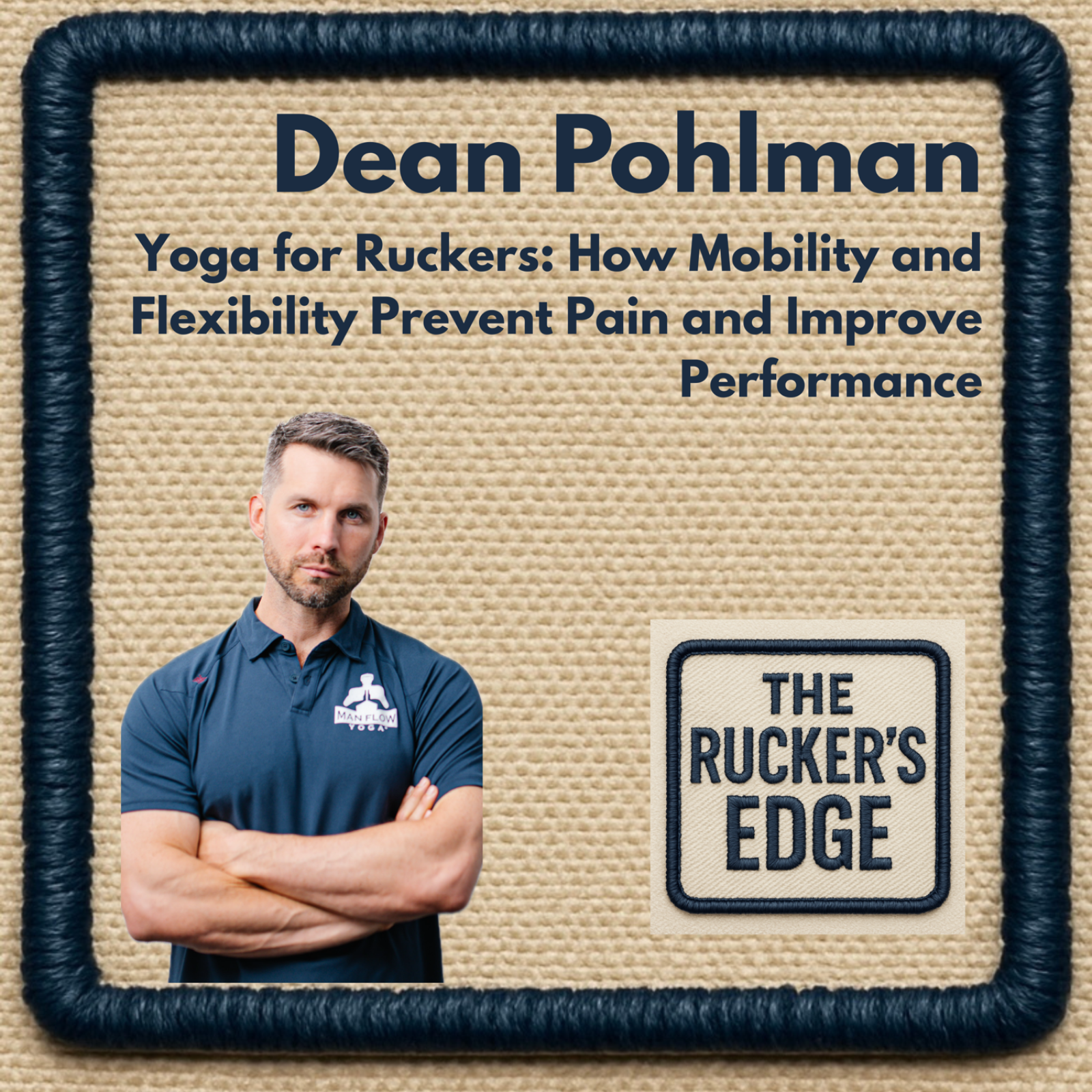


In this episode, I talk with Dean Pullman, founder and CEO of Man Flow Yoga, to break down how yoga for ruckers can improve posture, reduce pain, and increase longevity under load without requiring flexibility, experience, or long classes.
Dean explains why most ruckers struggle with mobility due to years of sitting, poor posture, and limited movement patterns and how rucking can expose those weaknesses if flexibility and stability are ignored. You’ll learn how rucking flexibility directly impacts back health, hip function, and recovery, and why short, consistent mobility sessions are more effective than doing nothing at all.
The episode also covers:
- Why flexibility is a performance tool, not just stretching
- Common yoga mistakes that lead to injury (and how to avoid them)
- Simple pre-ruck and post-ruck mobility routines
- How breathing improves movement, posture, and recovery
- How ruckers can build a sustainable rucking recovery routine with as little as 5–10 minutes a day
Whether you’re brand new to rucking or looking to keep rucking pain-free for decades, this episode provides practical, no-nonsense guidance you can apply immediately.
Links & Resources
- Man Flow Yoga – Official Site
- Free Beginner Yoga for Men 7-Day Challenge
- Follow The Rucker’s Edge on Instagram: @theruckersedgepod
Notes:
- Music Credit: "Play This Game" by Black Rhomb.
- I'm not a doctor, and this podcast is for informational and entertainment purposes only. Please consult with your physician before starting any new exercise or physical activity.
0:00 Have you ever started rucking, felt stronger, but noticed your hips, back, or shoulders tightening up week after week and wondered if that's just part of getting older? In this episode, we break down why stiffness and nagging pain aren't inevitable for ruckers and how improving mobility and flexibility can dramatically change how your body feels under load. You'll learn how yoga, when taught correctly, can help ruckers move better, recover faster, and stay in the game longer without needing hour -long classes or complicated routines. You're listening to the Rucker's Edge podcast, a show all about rucking that is designed to help you improve your rucking routine, lose weight, and ultimately gain your strength and energy back. Each episode dives into the science, stories, and strategies behind rucking. You'll learn from top ruckers, coaches, health experts, and performance specialists who break down what it takes to train smarter, recover faster, and stay ready for the next challenge. So whether you're new to rucking or an experienced rucker that's already logged hundreds of miles, this is the show for you.
0:55 I'm your host, Spencer. Thanks again for listening in. My guest today is Dean Pullman, certified yoga instructor and CEO and founder of Manflow Yoga. He explains exactly how ruckers can use simple practical mobility work to protect their spine, hips, knees, and shoulders, even if you've never done yoga before and don't think it's for you. Here's my conversation with Dean Pullman, certified yoga instructor and CEO and founder of Man Flow Yoga. Dean Pullman, thanks so much for joining the podcast today. I'm excited to get into how yoga can benefit ruckers and keep them limber between rucks. How are you doing today? I am doing well. I don't know if you want to give away dates, but as of now, we're two weeks into winter break. So it's, you know, you know, lots of lots of dadding. So I'm just just making it, you know. Yeah. I just recently put together an episode on doing a reflective rock and thinking about your previous year and getting ready for this next year. And I have yet to actually go on one. We're here into the new year and I haven't even done that yet. So that's a theme.
1:58 I felt like as a health and wellness professional influencer slash community leader, yoga expert, whatever I am, that I needed to have like all of my 2026 plans laid out like before it started. And the reality is I'm just not at all there yet. So my plan is and if maybe this resonates with you and your listeners, but my plan is just to use like as much of January and as much of February as I need to to kind of create some clarity and create some. orientation around what is 2026 mean or what do I want it to mean for me? So anyways, that's my plan. No, yeah. I mean, you're a real person and you want to set good intentions. And I think it deserves some respect in terms of a timeline. You can't do too much, especially when the holidays come up. It's like you want to make sure you do the job right and you want to use it to improve your life or help your life. So, yeah, I mean. That's just part of it. Plus, you're a dad and you have priorities that shift daily. So yeah, you got to make time for what you can. But I kind of want to start out just asking you if you don't mind giving us a quick version of your background and how you ended up working in mobility and yoga. And I should take a step back. Dean, you're the CEO and founder of Man Flow Yoga, which is a fitness program for men trying to regain their flexibility and rejuvenate their fitness. But yeah, how did you get into that? Give us a bit of your background.
3:19 Yeah, so I'm an athlete turned yoga instructor. And I don't say yogi because I don't really think of myself as, you know, like a yogi with a whole yoga lifestyle. My background is as a lifelong athlete, collegiate lacrosse player, went into a yoga studio completely on accident, was looking for the tailor, stumbled into a yoga studio. Did that first workout, was shocked at how challenging it was, and that inspired me to just keep up with yoga. One month in, I noticed my flexibility was... dramatically different for the better my body felt stronger but also kind of lighter at the same time I had more body awareness my breathing was so much better I had better balance my lifting was better so I was like wow this is really cool and I tried to get some of my friends to go with me and they're like yoga no and you know granted this was 2011 so I think that Our society's general beliefs about yoga have shifted as well. You go into a city, you're going to notice a lot more guys in their 20s and 30s doing yoga, going to yoga classes. But back then, and even now, especially with guys who are in their 50s, 60s, 70s, and even in their 40s too, they don't get excited about yoga because of all the connotations and associations that go with it. It's too feminine, it's too spiritual, it's not a good enough workout. That was kind of my experience. And I was like, well, that was kind of their experience when I asked them to come. And I was like, well, you know what?
4:48 I'll just I'll do it with you guys. Right. So I led them through a few workouts. I was a lacrosse captain and I was the kind of the conditioning coach at the same time. And so I led them through some yoga. I led them through yoga a couple of times a week. And they're like, oh, wow, this is really cool. And I started recording on YouTube. And so. 12 years later, now we've got this community of tens of thousands of guys. I've reached probably over a million people at this point through books and DVDs, my YouTube channel, all the social media. It's very much a fitness -focused approach for men, for guys who want to feel stronger, who want to feel younger, who want to feel more flexible. would be who are open to maybe some of the breathing and mindfulness aspects of it but don't want to do it in this super you know yogi quasi -spiritual new age type of approach this is very much an approach to yoga that's focused on a functional approach like a and that that includes breathing that includes body awareness there's nothing woo -woo about i say the word woo and a lot of people get offended especially if they are into yoga but i say woo in the sense of just things that concepts that don't seem approachable to day -to -day life and so but when you focus on when you're focusing on your body awareness when you're focusing on your breathing that comes with a whole bunch of other aspects that helps with your physical fitness helps with being more aware of your body, knowing which muscles you should be engaging as you're moving as you're going through exercise. But it also
6:19 helps with it carries over into other aspects of your life, you notice that, oh, I do have the ability to be patient in a stressful situation, or I do have the ability to notice when I'm stressed and start to check in with my breathing. Or I can notice my shoulders really tense right now. And I you know, why is why are my shoulders tense, maybe I can relax that. So There are tons of physical benefits. And if you're a lifter, you know, you're going to notice that lifting gets easier, that it doesn't hurt as much, that you have more awareness of your body. You're using the right muscles instead of relying on one muscle group and not using your glutes or not using your abs. you know, as that applies to rucking, that means that you're going to be using your core more, you're not going to be relying on your back, your knees aren't going to hurt as much because you're using your hips and your ankles properly. You're gonna have better posture just because you practice being in better posture.
7:04 So your shoulders won't hurt as much, your neck won't hurt as much. So there are tons of, you know, physical benefits that go with it. It's kind of just, well, how is it taught and is it done in a way that resonates with me? And if, you know, if my approach doesn't resonate with you and you want to go traditional yoga, cool. You know, like that's great. But for a lot of guys who are more interested in kind of, I just want my body to feel good and I want to have a high level of physical fitness. And we're talking relative here, right? I'm not like, you know, I'm not trying to reach the professional basketball. players of the world. I'm mostly working with guys who are in their fifties, who are in their sixties, who are coming back into fitness after, you know, 15 years off because they had kids, they had the job that they had to, you know, that professional lives. They didn't have time to do these, the workouts and the self -care that they wanted to do. So they're coming back into things now and they're realizing that, oh, you know what? My body doesn't feel the way that it used to. Maybe I need to do something differently.
7:59 And they do some research. They figure out, oh, you know what? I should work on my flexibility. I should work on my core strength. Or I need to do something that's going to undo this bad posture that I have. And that's kind of where I come in. But a ton of information there. And I appreciate that. And I think there are some similarities between the folks looking at your programs and some of the people getting into rucking. It's maybe they've been sidelined for X amount of time. They want to do something about their fitness. And it's like, where do I start? And so I know some people start picking up the rucksack and rucking. And then that's sort of like a gateway into other workouts. And I guess similarly with you, they might start doing a workout and realize how stiff they are and how maybe they're not nearly as limber as they were a decade or so ago. And so they turn to you for solutions. Full disclosure here, Dean, I don't do yoga regularly. I did yoga several years back with my then girlfriend, my now wife. We did some hot yoga sessions. She loves yoga. We've started to get my daughter into yoga. We do these kid yoga channels on YouTube. And I'll sit there and we'll do like a Disney themed yoga session with her. And it's not easy. Like the routines that they're doing. I mean. Kids are incredibly limber, and she's doing it no problem. Here I am, like, sweating, trying to reach, like, my ankle. I'm like, it's hard. And I remember the first time I did yoga back in, I think it also was, like, 2009, 2010. I was surprised. Like, looking around the room, you know, seeing people that have been going to that class routinely
9:30 just have no problem. And here I am, like, as green as can be, you know, a new timer and just struggling. So, yeah, that was one thing I was surprised about. It's not an easy thing to do. And with all things, the more you do it, the easier it becomes. But it's something you have to work at. Yeah. I think people go into it thinking, oh, I'm not flexible, so I don't do yoga. And, you know, yeah, flexibility is something that you do work on in yoga. But at the same time, like flexibility is something that is. beneficial to everybody. And just because you aren't as flexible as someone else in the class doesn't mean that you aren't also benefiting from it.
10:10 So I think what's really cool about working on your flexibility is it doesn't take that long to notice the results of flexibility work in the sense of your body feels better, you have less back pain, your knees feel better, you're recovering better because you're more flexible. You're not You're using your body more efficiently in the sense of you're using it the way that it evolved to be used rather than relying on certain muscle groups and not using other muscle groups. Like a lot of guys only use their quads when they're doing lower body stuff. And if you don't have flexibility, you're not going to be using all the other muscles in your hips. You're not going to be using the muscles in your ankles properly. You're not going to be using your abs properly. And so, you know, flexibility is not just something that. And it's not just a goal.
10:57 It's also working on it leads to a huge, leads to a bunch of fitness benefits. And a lot of guys who are in yoga classes, like you had the experience, right? You're supposed to reach down and touch your feet. I'm like, well, that's like loading up a bar with 225, you know, with like 245s on each side when you're brand new. appropriate. And so it also does create the sense of like, oh, well, yoga is not for me, or oh, it's too hard, or I'm discouraged because I couldn't do a basic pose. And it's just because most yoga isn't made for guys who are not flexible, right? It's made for women who are already flexible. Again, just kind of goes to you got to find something that is actually going to meet you where you are with your flexibility level now and help you feel encouraged about the work that you're doing and also is realistic for like where you are now. Yeah. I wanted to ask you, you know, what's the long -term cost for athletes or ruckers who ignore mobility at an early stage? Like let's just say a 40 year old completely ignoring mobility and stability. Longevity. I mean, longevity is the easiest way to answer that question, but also, you know, preventable injuries, you know, things that could sideline you for months. that could require, you know, surgery. And there are things that are preventable. I think there's also a mindset that people in their 40s, 50s tend to adopt when they realize that the workouts
12:28 that they used to do aren't working the same way anymore. And they say, oh, you know what, this is just part of getting older and I can't do these exercises anymore. And so the question becomes like, hey, how do I modify this? Or like, how do I avoid doing this? And my, you know, my kind of... my interjection is, well, how about you just work on the weakness that's causing that issue? You know, how about you work on having just a basic level of range of motion? Like, how about you work on your hip flexibility, work on your shoulder flexibility? Let's move your spine. Because the reality for most of us is that we are sitting down or inactive for, you know, 12 hours a day. So you have to do something to work on undoing that poor posture. You've got to do something that is going to open your hips. That's going to get you to twist from side to side. It's going to make you do a backbend or get your arms overhead or behind you and do all these things that your body is meant to do, but isn't doing. But, you know, to go to the, go to your question, like if you're not doing some sort of, and I don't care if it's yoga, like there's tons of different mobility. You know, I think the, I think why, I think the reason why people like yoga as a mobility flexibility program is because it's in the, it's in the format of flow. It's not like a lot of people don't like doing a workout when it's like do 10 of these, then do 10 of these. And if you're just going down a list, cause it's just not fun. It takes more willpower in some ways and it might just not be fun. So, you know, I think one reason why people who, I think one reason people might like yoga. versus that is because they you know
14:02 when you think of flexibility you do think of yoga so like okay yoga i'm gonna work on flexibility but also because if you can just press play and follow along it's a lot more it's a lot less mentally demanding than following a list of you know a list of exercises so point being is if you're not doing any sort of mobility work period then you are going to eventually run into some sort of injuries or you're going to deal with preventable pain in a way that yeah you can make it through it maybe you can push through it maybe you have to take some days off but like that's pain that you don't need to have that you could solve at the source with just you know, a few minutes of the appropriate movements on a daily basis. Or if you want to split it up and do like three times per week or even two times per week, you know, these are point being like, these are all, all those aches and pains that, that, that prevent you from doing what you want to do as you get older. Those are preventable with, to a certain extent, right? With the appropriate exercise and, you know, a well -structured yoga program, like, like what I do with Manful Yoga.
15:15 is going to help with addressing the majority of those weaknesses that do lead to pain. More with Dean in just a moment, including a simple pre -ruck and post -ruck mobility routine you can do in just a few minutes. But I want to take a quick break to say thanks for listening to the podcast. Please text this episode with a fellow rucker that might find it interesting or a friend that could benefit from rucking. Sharing this episode would help the show grow and help more people improve their health and lives. Okay, back to it. I did want to ask you about how you practice yoga. I always see these yoga classes being offered and they're always guided. It's almost like a routine. Is it possible to use certain yoga stretches just independently or is it more beneficial to go through a routine where you're kind of building on different movements or stretches? I think the sequence is important in the sense of like, it wouldn't, there are poses that are more demanding than other poses in the same way that like, like, let's look at a squat, for example, right? Most people don't go straight into a squat. You're going to do some sort of warmup for that. Or you look at like a strict press, right? A shoulder press, holding a barbell and pushing it overhead, or even dumbbells and pushing overhead. And you probably wouldn't go straight into that without some warmup, especially if you're going to do heavy, right? And it's kind of the same way with yoga in the sense. And you don't have to even call it yoga because a lot of it is just isometric body exercises. different variations of lunges or squats or planks or, you know, core exercises
16:47 or backbends or twists. So like, yeah, a lot of these are quote unquote yoga poses, but a lot of them are also just borrowed from other body weight exercises. The idea of what you're doing at a yoga studio being the same thing that, you know, an ancient yogi in the subcontinent of India was doing 2 ,500 years ago is, it's not true. Like a lot of the, most of the poses that they were doing, They are not found in modern yoga. Most of the poses found in yoga are borrowed from other types of exercise, notably British gymnastics. Like a lot of what we think of yoga now actually came over from like 19th century British gymnastics because Britain, you know, Britain colonized India. And so they looked at what the British soldiers were doing for their calisthenics and they integrated it into yoga.
17:39 So point of this being a lot of these bodyweight exercises, it makes sense to start with sooner in the routine, right? So you want to do something that doesn't. take a ton of flexibility right at the beginning. It makes sense to go through a progression of exercises, which you can somewhat learn on your own. Like that's actually, I think one of the coolest things that I hear about from people in our community is they do manful yoga for a couple of years, three years. And then they're like, you know what, Dean, I think I got it from here. I'm like, great, good job, man. That means I'm a pretty good teacher, I guess. Like if you were able to figure everything out, like from... you know, from that. So it isn't, I mean, it is helpful to go through a progression of exercises to make sure that you're warming up the proper muscles before you're going, you know, too deep into the movements. But it also doesn't have to take 60 minutes. Like most of my routines are in the 20 to 25 minute range.
18:28 I've got a ton on YouTube that are five minutes, 10 minutes, 15 minutes. So yes, like there should be, sequencing is somewhat science, somewhat of an art. Um, but you don't have to, you know, it doesn't have to be this 60 minute long process if that's kind of the answer you're looking for. Yeah, it does. And you just mentioned warmup and I'm curious using your expertise, can you enlighten us, maybe give us a few pointers pre and post ruck, what sort of poses or routines we should be doing? Like if someone can only pick up maybe three moves before going on a ruck, what would you guide them or what would you say to them? So since you have that weight on your back and you're going to be kind of, you know, leaning forward, what I would do is what's called a bridge position, which, you know, yes, it is a yoga pose, but it also you'll find this in tons of non -yoga exercises, workouts as well.
19:21 So I'd start with a bridge position because. That's going to get you in a bit of an open position with your chest. It's going to get your back into extension, meaning arching your back versus rounding your back, which is what you'll be rounding your back when you're rucking a little bit. Also get your glutes firing, which is going to help with your knees. I'd also do some sort of upper. back kind of thoracic opening so a standing side bend is a really good warm -up which basically if you can visualize standing up reaching up as tall as you can with your arms and then leaning over to one side while maintaining height that would be a really good one that's going to help open your rib cage that's going to help with your thoracic mobility and then inserting some sort of some sort of twist as well. So I like a side angle pose is a really good one for this.
20:11 So getting some mobility to the upper back side angle is a little hard to explain. But you can visualize going into a lunge position with your hips facing out to the side, and then reaching one arm up and one arm down and kind of twisting to open up your chest. to the sky or ceiling. Those are three that would be really good, just kind of off the top of my head. Awesome. What about post -ruck? Same thing, or would you recommend a few different poses? So post -ruck, you want to focus on recovery in the areas that you've worked the most. I would say probably a child's pose would be a good way to wind down from a ruck. That's going to be a good shoulder stretch.
20:58 That's going to allow your back to release at the same time. I'd also recommend probably a pigeon pose. A pigeon is just a really deep hip stretch for your glutes and your external hip rotators. So any sort of lower body workout, doing that afterwards would be a good idea. And then if you have a little bit of... I'd also go into that, maybe go into that cool down with a down dog. And since most people aren't, you know, yoga experts yet, what I would do is I would find a staircase where you can put your hands on maybe the second step. of that staircase. So you don't have to be as flexible versus if you did it like with your hands and your feet on the same level, you might have kind of crappy technique, but if you put your hands, maybe a foot up, right? So if you're using that staircase or a landing or something like that, where your hands are higher than your feet, that's going to help you with modifying for your, you know, your lack of flexibility slash yoga experience.
21:58 That's a great tip. I appreciate that. Yeah. We have a yoga block, but with my... inability to do some of these poses. I've had to stack a few on top of each other to achieve what I needed to. Yeah, we actually made, we're in the process of renaming it, but we call it the big ass block. Nice. It's 60 % taller than the standard yoga block. So for those guys. Yeah, entry level. You need it so you don't get, don't hurt yourself or you don't do it incorrectly. Speaking of, I want to go into maybe a routine between rucks, but I wanted to touch base on this since we're talking about form. What are some of the... more common mistakes people make when trying a new yoga pose or what do we need to look out for?
22:39 So I'm going to go through concepts instead. The first thing is mirroring, right? So most people approach yoga with the sense that I'm going to mirror what other people are doing. And some of this comes down to just poor instruction, right? If you're most yoga classes don't actually focus on technique and they say, everybody do a downward dog and breathe in and breathe out. And Imagine your body is a, I don't know, a tree and, you know, whatever it is, but like there's not enough focus on like actual technique. And so the first thing you want to do is avoid mirroring the instructor. You want to make sure that you're doing the poses or the postures, the stretches, exercises as it applies to your body. So you're not just trying, if you see the instructor like reaching down and touching her toes. or his toes, you don't want to go straight to touching your toes. You want to think, well, what's the goal of this pose? Well, it's a hamstring stretch.
23:31 Okay. So I'm going to focus on stretching my hamstrings instead of just getting my hands to touch the ground. So avoiding mirroring and focusing on like, well, what is the goal of the pose? What are the target muscles? What am I supposed to be? You know, how does this apply to my flexibility level? The second thing would be using props appropriately. So props bring the ground up to you, or they help with shoulder flexibility if you're holding a strap so holding a strap instead of bringing your hands together um they're going to help you just modify the pose so that instead of you again like doing a 225 pound back squat when you're just starting lifting now you're doing just the bar instead right that's what props do they make it so that you can modify the exercise to fit your flexibility level and then broadly speaking most guys should be bending their knees um more in in hip stretches when you bend your knees that means that you're not putting as much strain on your back so like if you're trying to reach down and touch your toes and you lock out your legs to try and get your hands to your feet your hamstrings are tight the limit there's flexibility that's limited there and so you're going to make up for that lack of flexibility by trying to use your lower back to compensate And that's a really easy way to overstretch and injure your back. There's actually a lot of injuries that happen in yoga because people are just trying to force themselves into positions they're not ready for. So bending your knees and using blocks is going to help
25:01 with hip stretches. Excellent. And sort of along the same lines as form, can you... Talk about breathing for a second, because I know breathing can be pretty critical to achieving these poses, if I remember correctly. How does breathing fit into a yoga routine and achieving these poses? So breathing helps you regulate your nervous system, and it complements whatever you're doing with your body. So if you're working on getting deeper into a posture and you are holding your breath, your body is going to resist. Your muscles are not going to open up. So if you can start... pause in a way where it doesn't feel that intense if you can aim for like the three four out of ten intensity range to start and Then you can use your breath to ease deeper into the pose.
25:46 That's going to help you. That's gonna help you stretch more That's gonna help you increase flexibility more versus if you go straight to I'm gonna go as far as I can I'm gonna go to this eight out of ten intensity to start right away, and I'm just gonna hope I can breathe so you do really want to be able to So maintain awareness of your breathing as you're doing it. And if you're new to yoga, it is really overwhelming because you're like, ah, where does my knee go? Where do my, where does my hand go? Where's my shoulder go? Oh, it's just breathing too. Right. So you have to be just going to it, knowing that you're not going to remember. to be present with every single breath that you do. You're not going to be locked in awareness -wise to every breath that you do. But every time that you recognize, oh, I'm supposed to be focusing on my breathing, that's actually a win. So that's a big piece of advice that I give to people who are starting out is, yes, breathing is very important, but it's going to take a lot of time and consistency to build awareness of your breathing. So you can... Every time you forget that you're breathing is actually a win because you're remembering that you're not breathing and therefore building awareness of it. Yeah, I like that. I appreciate you explaining that.
26:54 Starting out, I definitely fell into that role of trying to achieve the max amount of the stress immediately going into that pose. And that's just not how that works. So let's say a rucker wants to develop some sort of routine between rucks. How do I want to phrase this? How often or how long should that routine or that session be? Or should they do multiple sessions between rucks? Let's just say, you know, maybe they go on a long ruck on the weekends, a Saturday or Sunday, and they want to maintain some stability and some limberness, I guess, between those rucks. They want to maybe start doing a yoga routine.
27:34 Should they do it multiple days that week? Or how long should the average session be, I guess? I mean, it depends on what you have time for. Like, you know, it'd be great if everyone had time for a 60 minute, you know, active recovery yoga session on Sundays. But most people, myself included, don't always have time for that. So, you know, I think recognizing that even five minutes is beneficial is important. And there's also different approaches that you can use for your yoga routines. Like you mentioned wanting to do like a stability slash maybe a little bit of active recovery routine. And that's something that's great to do either, you know, maybe six to eight plus hours after your rucking session.
28:21 So if you do like a Saturday morning ruck and it's Saturday evening now and you're like me and your Saturday evenings don't involve. you know, going to the bar or, you know, a club, then you can do some stretching while you're in front of the TV. Or if it's Sunday and it's the day afterward, then that's a great time to, you know, do this combination of yoga, stability. light strength work plus flexibility and recovery work. But then you can also use it like it's I think it's great to do it as a warm up before other workouts. So like you could definitely do it as a warm up before rucking to kind of prime your muscles like we talked about. And then it also is great as a cool down either immediately after the rucking session or like I said at the beginning of this answer like six to eight plus hours afterward as a way to kind of get out in front of the soreness. And then you can also do it as a standalone workout. So if you want to do a more intense yoga session where you're focusing on building hip strength, building hip stability and ankle strength so that you can support your knees better and your back doesn't hurt as much, then that's a great thing to do kind of on your non -rucking days if you have a little bit more gas in the tank, so to speak.
29:33 yeah no that that makes sense and with that routine let's just say like everyone's crazy busy you know managing schedule for yourself your spouse your kids what's the number one like biggest bang for your buck mobility drill that you would recommend to ruckers if they only had you know just a few minutes a day to to maybe achieve some poses or some sort of routine I hate that question. I know, right? As I was asking, it's like, it's so dependent on each person. It's dependent on each person. And also like, I get a lot of people who are like, I'm just doing the same workout over and over again until I master it. I'm like, okay, that's, there's a lot of other exercises you could and should be doing. I think the important thing is just doing, I think the important thing is doing a sort of establishing some sort of cadence or a rhythm with it and doing. you know, again, five minutes is helpful, 10 minutes. The good thing about yoga is most of it is full body. So I mean, poses specifically for Rutgers, you and just for our modern kind of world, I do a lot of hip opening stretches, like with strength. So Something called a goddess or a horse pose is really good for your hip mobility, your groin. Something called like a high lunge or a crescent lunge is just a really good thing to do for opening your hip flexors, strengthening your core, opening up your chest. A standing backbend would be something that's really important, really good to do if
31:04 you're rucking in particular, just getting your chest open, getting an arch to your spine instead of rounding forward. Okay, gotcha. Now let's talk about Man Flow Yoga. Who does Man Flow Yoga usually serve? What's your usual clientele like? Our guys are men who are interested in longevity, who are interested in pain relief, who want to be able to do the exercises that they're doing now or would like to do. for as long as possible without pain. So they want to enjoy the things that they're physically doing. They want to be able to be capable of doing those things. And they want to do it for as long as possible. So, you know, most of our guys, I'd say the sweet spot is guys in their 50s and early 60s. We've got guys in their 40s and 70s as well, in addition to, you know, guys who are in their 30s and 80s.
32:01 the mostly it is in like that 40s to i would say the late 40s to 60s range for the most part It's not just guys who lift weights or guys who run. It's also guys who are office workers who have bad posture. They want to get back into fitness, and they don't know where to start. They know that they can't go straight to a boot camp class or a weightlifting program. They want to ease back into it. I've also had guys who have signed up because they're looking for sexual wellness. These are guys who need medication to... to perform. And so they're looking at this as a way to build that fitness. These are also guys who have chronic aches and pains, chronic back pain, chronic knee pain, chronic shoulder pain, poor posture from years of sitting at a desk and who are looking for fitness that will specifically work on these issues. And then we've also got a lot of guys, like I mentioned, kind of in that the athletes and runners category who have been lifelong, usually recreational athletes. I've got some pretty interesting professional athletes who have joined as well, but most of the guys are recreational athletes. And these are guys who just want to be able to keep doing what they're doing now. you know, they notice like, Hey, my knees hurt way more than they used to, or my back starting to hurt. And that never used to happen. So these are guys who understand, Oh, I do need to work on my flexibility, mobility.
33:27 Okay. So this program, this manful yoga thing will help with that. But for the most part within. A month or two months, guys notice the improvements. They notice that their bodies don't have as much pain. They notice that they can do their other workouts with less pain. They notice less pain day to day. They start to increase flexibility and they're more aware of their bodies. So yeah, that's what we work with. That's what we do. And the program, is it 100 % online? It's all online. We have some community events that we do. So that's something that I started doing within the last couple of years, putting more effort into doing weekend events in cities with high member populations. So like Chicago, this upcoming year, we went to Chicago, we did Washington, D .C., we'll be doing Boston, Seattle, Denver, and Atlanta next year. That's a lot. That's a lot in person. That's great, Dean. Yeah, but mostly online. And we also have a cool community, which makes it more fun, more enjoyable, and also adds an element to it that ultimately makes it easier and helps with you doing it more. Because if you're just doing it by yourself, there are some people who like that. don't need any sort of extra motivation or push. But for a lot of people, they want more of a community sense.
34:53 They want some sense of like, oh, I'm not the only person doing this. And so the community aspect really does help with that. And then it also, people get to, you know, meet each other at these in -person events that we do from time to time, people that they know from the community and the members area, community section. And also we have a Facebook group where a lot of that interaction happens. Okay. Good deal. Yeah. Lastly, if any of the listeners would like to learn more about it, where should they go to check it out? We've got a free seven day challenge. It's a beginner's yoga for men challenge, which is a really good way for you to see what this looks like and try it out. There's no credit card required. This is just solely like delivered via email. So those are 15 minute workouts. They're made with beginners in mind and to help you understand and kind of notice for yourself firsthand the benefits of what doing yoga on a, you know, regular basis can be. And it is a seven day challenge.
35:45 So it's seven days in a row. But, you know, most of our guys are doing these probably about three times per week. So don't feel obligated to do, you know, or overwhelmed by daily, you know, things. So even two or three times a week will help with noticeable results. And that said, a link for that we'll put in the show notes for sure. But ManfulYoga .com slash 7DC. Excellent. Well, I'm gonna go. Check it out right now. I'm curious. Instead of doing Elsa yoga for the 13th time in a row, I'm going to mix it up. I'm sure this will resonate with your daughter. Well, Dean, thanks so much for coming on, man. I think you've provided a lot of value to us Rutgers, but I've enjoyed our conversation and I just want to say thanks again for joining us today and good luck to you with Manful of Yoga. Yeah, man. I appreciate you having me. This was a good conversation and best of luck to everything and let me know if there's anything else I can do for your community. All right, that wraps up my conversation with Dean Pullman for Manflow Yoga. To learn more about his program, head on over to manfloyoga .com or check out the seven -day challenge he mentioned at manfloyoga .com slash 7DC. That's the number seven, Delta, Charlie.
36:57 If you want to reach out to me, head on over to theruckersedge .com or on Instagram at theruckersedgepod. If you enjoyed today's episode, make sure to follow or subscribe to the show in your favorite podcast app so you're notified of new episodes. And in next week's episode, we sit down with Dan Vinson from Wild Gem. We talk about rucking in the snow and the packs that Wild Gem offers. Okay, that's it for today. Thanks again for listening to this episode of The Rucker's Edge.