Blister Prevention for Ruckers: Socks, Shoes, and Foot Care with Alex Thrasher from Mudgear (Part 2 of 2)


Most ruckers don't quit because of fitness.
They quit because their feet hurt.
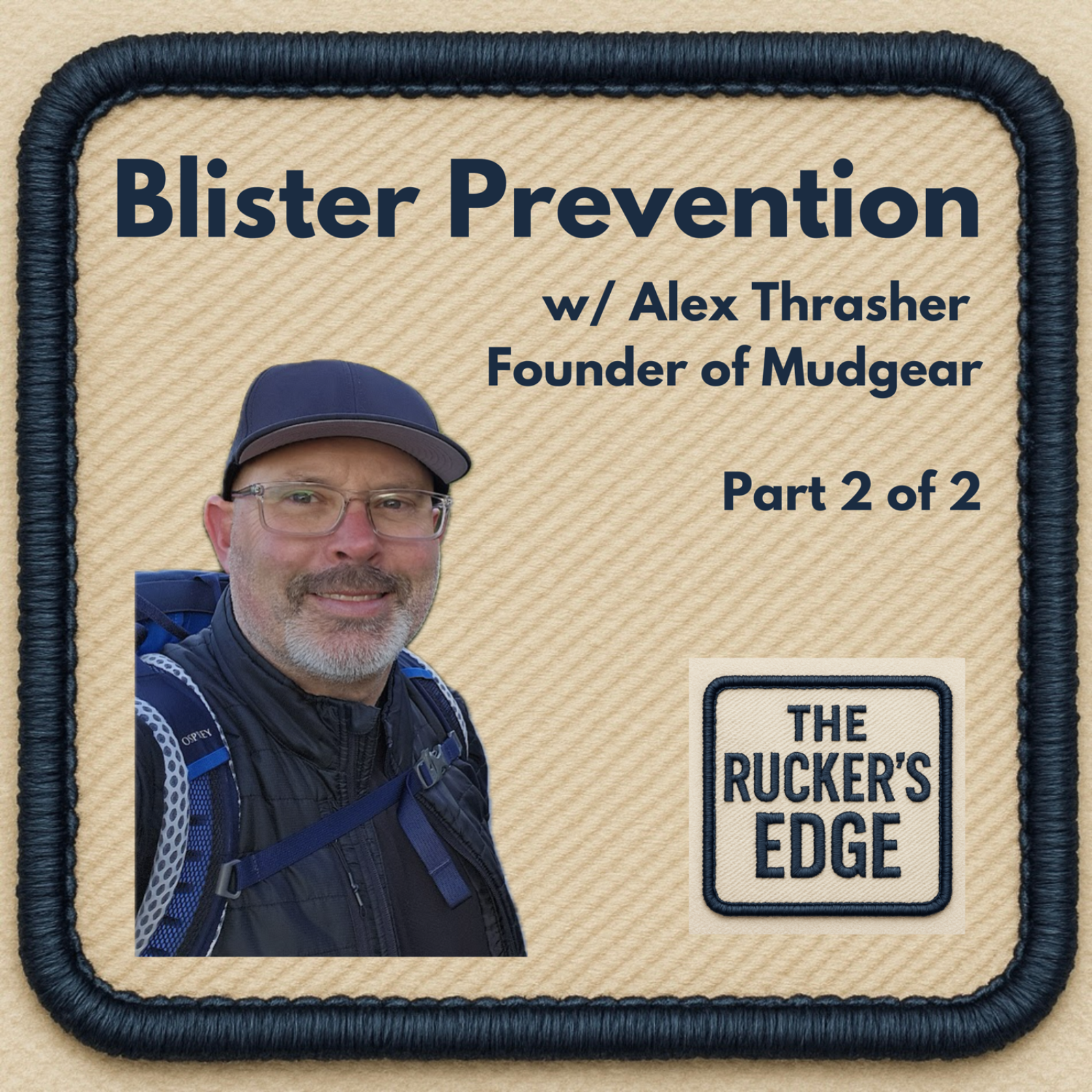
In Part 2 of my conversation with MudGear founder, Alex Thrasher, we move from understanding blisters to preventing them. Alex shares a foot care system that covers what to do before, during, and after a ruck to reduce hot spots, prevent blisters, and keep your training on track.
We discuss sock selection, toenail care, foot preparation, lacing techniques, when to stop and address a hot spot, blister management strategies, compression socks, recovery methods, and common myths about foot toughness and expensive boots.
Alex also shares stories from the Appalachian Trail and the Camino de Santiago, including lessons learned from hiking through rain-soaked trails where foot care became the difference between finishing strong and suffering through every step.
If you've ever struggled with blisters, hot spots, foot pain, or simply want to keep your feet healthy during longer rucks, this episode is packed with practical advice you can use immediately.
In This Episode
- Why toenail care matters more than most ruckers realize
- The importance of clean feet and debris-free socks
- How to choose the right sock for rucking
- Why Alex prefers thin merino wool socks over thick hiking socks
- The pros and cons of toe socks and sock liners
- When to stop and address a hot spot during a ruck
- How to treat blisters in the field
- Why changing socks can save a training session
- Post-ruck recovery strategies for healthier feet
- Compression socks: during the ruck or after?
- The truth about "toughening up" your feet
- Why expensive boots don't guarantee blister prevention
- Lessons learned from the Appalachian Trail and Camino de Santiago
- Alex's number one foot care takeaway for every rucker
Links & Resources:
- The Rucker's Edge – Official Site
- Follow The Rucker's Edge on Instagram: @theruckersedgepod
- MudGear's Website
Episodes Mentioned in the Episode:
- Episode 46: Blister Prevention for Ruckers: Socks, Shoes, and Foot Care with Alex Thrasher (Part 1 of 2)
- Episode 35: Foot Health and Injury Prevention with Dr. John Ritter
- Episode 39: Mark Jones on Rucking Performance and World Record Preparation
Notes:
- Music Credit: "Play This Game" by Black Rhomb.
- Disclaimer: The information presented in this episode is for educational purposes only and should not be considered medical advice. Always consult a qualified healthcare professional before beginning any exercise program or making changes to your health, fitness, or nutrition routine.
0:00 Have you ever wondered why some ruckers can cover mile after mile without foot problems while others end up sidelined by blisters? Well, today my guest Alex Thrasher, the founder of Mudgear, and I discuss some of the methods that we can use to prevent blisters and stay on the trail. This is part two of my conversation with Alex. If you're interested in learning about how blisters form in the first place, I suggest you go back and listen to the previous episode. But in this episode, we're focused entirely on prevention. Alex walks us through a complete foot care system for ruckers, including what to do before a ruck, how to identify and manage hot spots during a ruck, and how to recover afterwards so you can get back out there faster. If blisters have ever slowed down your training, this episode will give you a practical framework for keeping your feet healthy and staying consistent with your rucking goals. You're listening to the Rucker's Edge podcast, a show all about rucking that is designed to help you improve your rucking routine, lose weight, and ultimately gain your strength and energy back. Each episode dives into the science, stories, and strategies behind rucking.
0:57 You'll learn from top ruckers, coaches, health experts, and performance specialists who break down what it takes to train smarter, recover faster, and stay ready for the next challenge. So whether you're new to rucking or an experienced rucker that's already logged hundreds of miles, this is the show for you. I'm your host, Spencer. Thanks for joining me today. Please enjoy part two of my conversation with Alex Thrasher from Mudgear. Okay. So now we understand what's actually happening that causes a blister. Let's talk about implementation or like a foot care system before we go on a ruck, during a ruck and after a ruck. So pre -ruck, walk me through what a good pre -ruck routine or foot prep looks like. Yep. All right. Number one. day before or even the day of, cut your toenails. I mean, a lot of people don't think about that, but toenails can be a big problem, especially if you have one that's just, you know, touching another toe because you haven't kept them trimmed up nice and clean.
1:54 I always try to make a reminder to cut toenails before I go out on any, especially a multi -day thing, if I'm not going to have a pair on me. But it is a good thing to have in your pack. If you have the weight to spare, you can take a pair of small toenail clippers. It's good to have. I'm finding many non -toenail related reasons to use it here and there as well. But yeah, make sure you start with nicely clipped toenails. And then just before you set out, I would say, you know, clean and dry is how you want to start. So as you're putting on your socks, you know, take that just couple extra seconds to Make sure your feet are clean of any debris. Think about even just a little bit of dirt or sand that's in between your toes or under your foot can make a huge difference several miles down the road.
2:49 So clean off your feet really good before you put on your socks. Turn your sock inside out and brush it off. You don't know what was stuck on it after it came out of the dryer. For me, it's usually dog hair. My dog's here beside me and her hair tends to get on my socks and stay there. So even if you have a clean pair of socks right out of the laundry, just turn them inside out and make sure there's no debris in there that's going to give you a problem later down the path. And start with a good pair of socks. It's the cheapest. Part of your gear chain, most likely, and easiest way to prevent, you know, many of the blisters and things that could take you off trail or out of your ruck or out of your event. Start with a good pair of socks. We talked about looking for natural fibers, merino wool, but I'm not against synthetic fibers. We put a blend of merino wool and synthetic fibers into our ruck socks in the final version for different reasons. But stay away from cotton. And I would look for the thinnest sock that you're comfortable in. I have usually a medium cushioned footbed in the socks that I prefer to wear in hikes and rocks. I find that really thick socks that you might associate with traditional. hiking and backpacking uh that i call those cabin socks you know maybe after a ruck you might want to
4:20 put that on to put your feet by the fire but it's just too much heat um in my experience to have a very thick sock on i would rather have a sports performance style sock with the right fibers um that is a cushion but but you know minimum to medium cushion not a really thick sock um those are my tips what else do you have gotcha no that's that's pretty much all of mine i one thing that I noted here was brushing your socks out. You're absolutely right. We lost, our dogs passed about four years ago. We're still finding dog hair around the house, like in the crack between the dishwasher and the side of the wall. So I'm adding that to my routine. So yeah, shimmering nails, another good one that I hadn't considered, but yeah, make sure your feet are clean and dry. Brush your socks out.
5:04 And in terms of sock selection, you want a good sock that's a natural fiber like wool, merino wool specifically, and a thin sock. I have recently been rucking in some thicker hiking socks. But yeah, I think it is time to make that switch to a thinner sock. So thanks for that, Alex. Appreciate that. Okay, so transitioning from pre -ruck to during the ruck. What do we need to be looking out for in terms of listening to our body, maybe identifying hot spots kind of? Absolutely. Well, I can't move ahead without one more note on the pre -rock side. So we talked about the proper fit of the shoes and the heel locking. So go ahead and watch that. Look up and watch those videos on heel lock method for tying your shoes. And that'll make sure you have a nice, comfortable tie that doesn't slip around there. But I do want to say a couple extra things about. heat and thickness in socks. So I'm not a fan of liners. You'll hear a lot of guys that do like wearing liners, but basically for me, that means you're wearing two pair of socks.
6:08 When we were designing our rucksack, that was one of the things I wanted to avoid, which was having extra gear. A lot of people will say, you know, if there's a piece of gear that you need. You know, the mantra is two is one and one is none. But when it comes to socks, I don't think my socks need to have an extra piece of gear to go with them. Like socks are socks. It's like your socks have a comfort animal or something if they need a liner to go with your socks. Why not just make a sock? Why not just have a sock that does the job you need it to do without a companion piece of gear that is more to pack and more weight? I personally don't wear a liner and haven't found them to be worthwhile versus having a really good fitting single pair of socks.
6:56 The other thing that I hear a lot and get questions about is toe socks. And this relates to heat as well for me. I think that there are some people who have a foot anatomy that lends itself to benefiting from toe socks. I think it's a minority of foot shapes that are out there. And there's a couple reasons why I don't like toe socks. Number one, think about how much extra material is in the front of your shoe if you're wearing toe socks. Not only do you have the normal sock that's surrounding the outside of your foot, but each toe has its own mini sock. And if you add that up, that's eight additional layers of fabric inside the front of your shoe. Ten total layers from the outside of your pinky toe to the outside of your big toe. I would much prefer to have a single layer surrounding the toe box.
7:50 And if I have a hotspot, if I have a couple of toes that tend to run together, they give me trouble. I would rather tape that individual toe and provide a little layer there of friction control than I would adding extra heat and extra layers inside the toe box where... You want to have a little bit of freedom of movement up there and anything that also restricts that freedom of movement. So it's the two things it's restricting freedom of movement by extra layers and adding the potential for more heat because of those extra layers. That's why I'm not a fan and it doesn't it doesn't work for me in my foot. I know others that swear by it. And, you know, if it works for you, it works for you. But those are the reasons I'm not a toe sock fan. Yeah.
8:34 The other thing while you were talking about toe socks, it reminded me of something that. A lot of like long distance ruckers do. I've done a couple of half marathons. I've done a few 10 milers. But I can imagine if you're going a long distance, some people talk about putting Vaseline on their skin and then putting a sock on. What are your thoughts on that? I've never had to try that. So I have no experience with it. I don't know if you have. So I have used like a body glide before. That was after several days and noticing an area that was getting a little raw. I've used that as sort of a prevention technique to keep from developing a blister in that spot. I find that Bodyglide is good because it's sort of formulated to not retain moisture.
9:26 I don't use Vaseline because I do think it has a little more tendency to sort of trap moisture in a way. That a good body glide does not. Gotcha. And then lastly, Band -Aids. I think obviously if you know you're prone to having a hot spot and a blister at one specific spot, you want to put some tape or Band -Aid on it as well. Do you have a recommendation on a type of Band -Aid? I'm thinking to prevent moisture, you don't want to go with those like plasticky ones. You might want something that has more breathability, like those fiber type of Band -Aids. Yeah. And I guess one thing that I have learned about blisters that I think is just really cool from a human anatomy and nature standpoint is, you know, think about. especially an early stage blister as nature's own, God's own Band -Aid. I mean, your body is basically producing its own Band -Aid that will be effective to a certain extent. Now, if that thing grows and swells and has a lot of fluid in it, it's sort of gone beyond its useful lifespan and needs to be drained and treated properly.
10:42 But it is cool to think about how your body can basically produce its own bandaid in a spot where that friction is occurring. So, you know, rather than completely taping over or covering those things, they make, they sell the pads that can provide some cushion around a blister. And I found those to be very effective as long as you have a small early stage blister that just needs some protection. But, you know, I don't pop those things. I let them do their job as long as they don't. expand and grow beyond their useful life. So don't be afraid to protect a small blister. But then when it comes to tape, especially once you've had to pop a blister or have raw exposed skin, just be sure you're not putting tape directly on top of that because getting that off is going to be problematic and may cause more damage in the removal. So once you have had to pop a blister or you have exposed skin, that's where something like a Neosporin, an antifungal, something that's going to keep you from getting an infection that layers there before you'll tape it over with a Band -Aid becomes important. Yeah, that's an excellent tip. I appreciate that. And if any listeners want to go see some gnarly pictures of giant blisters, go check out Clint Carr's Instagram and his blog. It's pretty gnarly. He does some Greenbrae Fitness type events and he blogs about it and about his experience and what he's learning along the way. And foot care is definitely one of them. So one of the hardest
12:16 judgment calls in the ruck is whether, you know, you stop and deal with something or you keep going. When it comes to foot care, mid -ruck, what's the rule? You feel a hot spot coming on, do you stop immediately? Do you keep pushing? What are your thoughts on that? Yeah, don't be a hero, but the environment or the occasion also matters a lot. So are you on the first day of a multi -day trip here? Are you in training and need to be able to put on some weight? and get out there again tomorrow or the day after? Or is this the event you've been training for and you're on day nine of 10 or you're under the gun to finish something or you're in the middle of a challenge event? I mean. There is a time in life to suck it up and push through. But that's usually going to be the culmination of a lot of training, a lot of work to get to a point that you're trying to accomplish something. And that last little push can get you across the finish line. No problem. I've got no problem with pushing through a blister and dealing with it later for that. Most of the time, 95 % of the time. That's not the situation. And you are training. You're getting ready for an event or you are at the beginning of what you hope will be a enjoyable two weeks on the trail. All of those times are the times where you need to listen to your body and you need to be smart about it and not try to push through something that's going to mess up the rest of your training or
13:46 mess up the rest of your trip because you're going to be constantly dealing with this problem you've created by not taking care of it. early. So that's the way I think about it is it's time and place dependent, but almost always a situation where you want to stop, take care of this thing. Unless, unless this is, you know, you're on the one yard line about to finish this thing off. Leaving it on the table, sort of all on the track or on the field situation. Agreed. So if people do have to stop and address a hotspot mid rock. Walk me through what you think the Rutgers should be doing there. Yeah. You know, just pull over.
14:31 You know, the people you're with will understand, especially if this isn't the ninth time it's happened today. I mean, I've been I've been there, though, where on a long day with a buddy. I was the one in the pain box in terms of my feet just not having a good day. And I was probably having to pull over, you know, that eighth or ninth time during the day when we're just trying to get into the next town where we were headed. It was annoying for me being the one who was having to pull over, but I'm sure for him it was as well. So the earlier you can take care of this, the better. But the best thing to do is say, hey. Sorry, but I've got, you know, I've got a blister. I've got to deal with my feet here for a minute. And, you know, you're going to take off the shoes. If you're going to do it, I go ahead and take off both shoes, take off the socks. And it's almost like a repeat of getting ready the first time around. Check your feet, you know, in the spot that was hurting or had a hot spot. Is there something there debris -wise that was causing it? So check your feet, check your socks. Is there something on your socks that was causing that? And then if I've stopped early enough and I don't have a blister already, this is when I will go ahead and apply either some tape or a Band -Aid in that spot just to give it some extra friction control.
15:57 And if we've been on the hike, you know, more than say three or four or five miles, I will probably go ahead and change those socks at that point if needed. Now, I've done it the other way too. I have done a... a week -long, you know, seven -night camping trip on the AT and used only one pair of socks. That was for a specific reason. That was when we were testing out our ruck sock, and I wanted to be sure if you had to, you could wear the same pair of socks for the entire time. Yeah. Which, you know... And those were probably 15 mile to 17 mile days. And they didn't smell great at the end, but they performed well. And I actually did not get blisters during that trip, but I don't recommend that.
16:40 I don't recommend that. I always recommend having two or three pairs of socks so that if you need to, you can change your socks midway through a hike or a rock. And starting with a fresh pair can solve a lot of problems. Just something was bunching the wrong way or a fit was wrong. Switching those out can make a difference. And lace back up well. You're basically going through the same checklist that you did in the beginning of your ruck. And then hopefully that little extra layer of tape that you've done or the changing of the socks will make a difference. And you'll know then the first, usually the first half miles a mile, if you can feel a difference there, if things have cleaned up or if... you're going to have a larger problem to deal with. Excellent.
17:27 Yeah, I think not being afraid to pull over, like you said, and address it then and there is probably the smart move, like we mentioned before, unless it's like we're leaving it all on the table for a big accomplishment we've been working months up towards. But yeah, thanks for those tips. Let's move into post -ruck recovery. So we finished a long ruck. We had some hot spots and a blister did form. What do you recommend for... for managing that blister so that you can get back out on the trail, you know, the next day or two days from then? So one of my favorite parts of a long day on trail is taking the shoes off and letting my feet air out. When I can, I love to pack a very lightweight pair of sandals, flip -flops, slides, and just having a different shoe on my foot, even a flat. flip -flop can feel really good after your feet have been in the same pair of shoes or boots for the last however many hours. So I like to get out of my socks and shoes, let my feet just breathe and put on something different as soon as I get to camp or as soon as I'm done for the afternoon.
18:40 That's when you can inspect any damage that you have as well. And like we mentioned, small blisters are okay. That's nature's band -aid. Anything that is squishy, I like to, you know, take a sterilized needle, put a flame under it for a little bit and pop that, you know, get the excess fluid out. And I will still let that breathe overnight. I don't want to put a Band -Aid or tape over that when I'm not out on trail. So it'll help it toughen up a little bit, you know, overnight. And, you know, just let those puppies breathe as soon as you can after you get to camp or after you are done for the day. Yeah. Agreed.
19:21 Yeah. Get it, get it, uh, get your feet dry. You get comfortable. Yep. Remove all that friction, remove the heat, remove the moisture. Yeah. I like to get my feet up, you know, your, uh, your blood pools down there. And, um, a lot of people will, will use a compression socks to help with that afterwards and really like the recovery benefits of, uh, uh, graduated compression. That's basically a sock that has the tighter ankle and, and less compression as you go up and it helps to. stimulate blood flow and can aid in a faster recovery. So either that, or just get on your back and put your feet up. That'll get your blood moving in the right direction as well, but that can definitely help with recovery. Awesome. Yeah.
20:02 I did a post -rec recovery episode a while back and my post -rec recovery without having that managed blisters is pop on some compression socks, hop into my slides and ice. Feels so good. Yeah. It's like night and day. We talked about compression socks. Is it recommended to ruck in compression socks or specifically use them post -ruck? What are your thoughts on that? So I have seen it. I've seen it out on the Appalachian Trail. I would say that I run, again, I run hot. So I'm not a fan of having... I wear shorts even in, you know, some 30 degrees, but I'm not a fan of having my shins and calves covered up just because of the heat factor. I think a lot of people that wear them find that there's a lot of muscle stability that comes from that. Distance runners, for example, as well, will find that the less... your calf muscles sort of bounce around as you are running or rucking, the longer they'll last. I mean, that stability really makes a difference in longevity. So I know that they do benefit a lot of people and there are people who swear by wearing them during events or during long rucks. But for me, just for heat management, I like to put them on as a recovery device more
21:32 than during the event. piece of gear. Yeah, I agree. I agree with that. I guess, yeah, the other alternative to the full compression sock is maybe getting a sleeve or something that might have a little bit more breathability or something like that. But I haven't, I haven't rucked in compression socks or used any sleeves. I was just kind of curious about that. Yeah. So, okay, we did a pre -ruck, we did a ruck, post -ruck, and post -ruck is basically doing everything the opposite way you did pre -ruck. So moving on from that, I've seen a few questions pop up on social media, various forums and whatnot.
22:14 I was curious if we can kind of go through those and get your take on them. So there's this toughen up argument. So plenty of people swear that if you just kind of ruck through it or rucking up, your feet will condition themselves and the blisters stop. Is that true? Is there some truth to that? Is that actually, is that a good strategy? I don't know. I'm just kind of curious. I'm going to vote myth on that one. I think from personal experience, I have very naturally tough, especially the bottoms of my feet, but around the heel and around the bottoms of my feet. You know, it is not pretty to look at. I'm not going to be a foot fashion model in anybody's catalog. And it's just, I guess, you know, from childhood or, I don't know, playing a lot of soccer growing up or whatever else, you know, my wife tells me I basically have hooves on the bottom of my foot bed. I mean, you can knock on these things.
23:16 So there's no additional amount of toughening up at the bottom of my feet that would ever make a difference from how tough they are. Right now, that's not a that's not a brag. I mean, they are they are beyond reasonably hard balls of the feet. So I would say that even with that, I have had experiences where that part of my foot has this is kind of disgusting, but cracked also formed like sub layer blisters in that area from the same reasons that we talked about before. excess friction, excess moisture, excess heat. And in my case specifically, it was the moisture side. This was not a rainy day, but an extremely hot day where it was like poor water over your head, sweating profusely. And that just kept draining down into my shoes. And I had soaking wet feet from heat. And on that day, I remember specifically that the ball of my foot, the most calloused, tough hoof -like part of my foot even even that part uh formed blisters so from my personal experience i don't think that there's a level of uh broken of toughness of a foot that could ever uh combat that based on you know that area of mind actually having blisters here's another one um expensive boots is the expensive boot i guarantee that you're not gonna get blisters
24:47 Big myth. I think that's an easy one. It's more fit than it is expense. And yeah, sure, a more expensive boot probably has some better materials that are in there and may last you longer. But any footwear that you purchase doesn't have to be expensive, but make sure it fits well and make sure that you get some time. in those boots before you are either, you know, on a multi -day trip or in an event. Never want to be breaking in a new pair of shoes, you know, during an event or a long hike. You need to be training in the gear that you're going to be performing in and not waiting until race day or event day to test out a new pair of shoes for the first time. Yeah, yeah, that is critical. Don't, don't. Don't change anything. Yeah, exactly. Whatever you were using to train for that, keep with that. I appreciate you busting those myths there. And I want to get back to, because I'm just genuinely so curious about the Appalachian Trail and your experience on, is it the El Camino de Santiago? Yeah, so this is in Spain. There are some other pilgrimages like this, but the Camino de Santiago, the most famous one, is a route that... Crosses across northern Spain. It actually begins in France and it goes up into Pamplona and it goes through the Pyrenees and then over across to the Cathedral of St. James in Santiago, Spain. And so that's the most famous route. It probably takes at least three or four weeks. But the interesting thing
26:18 is. There's a network of other trails that all lead to the same end point there at the cathedral. And I think it's 19 famous ones. So I've done the French Way, they call it, and then the Portuguese Way coastal version, which I started that one in Porto and walked up the coast with a buddy. That's the one who had to sit through nine times of me wrapping feet on one bad day. Oh, man. Yeah. Yeah. But that's a beautiful, beautiful trail. And it is. It is unlike the Appalachian Trail in that there are accommodations on the trail. You don't have to primitive camp this thing. So you'll have all sorts of people who do this, some for religious reasons. You'll see Catholics that actually live in the small towns around Spain and Portugal that are on a pilgrimage.
27:09 I think a lot of the people in those areas. Try to do it at least once in their life, maybe multiple times in their life as part of their religious experience. And in the 70s, it became popular with backpackers and hikers and got popularized by some books, a big German book and popular movie here in the States called The Way, which has brought more tourists over. But this these pilgrimages and these trails have been around for over a thousand years. So there are. guest houses and pensions and hostels all along the way. So, you know, most people will take their clothing with them, but you don't have to pack a tent and you don't have to pack your own food along most of these ways. There are some that are more primitive than others, but it is a little more bougie than the Appalachian Trail can be.
28:03 There are people that, you know, take services to. Even move your bag by van from one stop to the next. So it can be a lot less primitive if you want it to be. And a different experience than the AT. The AT, I think, I call it more of a gnarly, grisly, grimy type of experience because you are packing in all of your food, your cooking utensils, your tents, mainly, unless you're planning to just sleep in some of those shelters. And you're not going to get a shower the whole time. You're going to jump in some water somewhere along the way or find a stream. So it's a different kind of fun, a different type of experience. I've loved both of them for different reasons. But yeah, I would recommend it to anybody who likes long distance hiking, rucking. The scenery is amazing. The culture over there, the food is fantastic along the way.
28:58 That's great. Yeah, it's... through hiking parts of the Appalachian Trail has always been on my bucket list. Just have never made time to do it. I'm hopeful in a few years I can carve out some time and actually get on the trail for maybe two weeks at a time or something like that. More with Alex in just a moment, including a tale from his time spent on the Appalachian Trail. But I want to take a quick break to say thanks for listening to the podcast. If you know a rucker that has been battling blisters or someone just getting into rucking, please text this episode to them. It could help them figure out a blister prevention system that works for them and keep them on the trail longer. Okay, back to it. So all your experience on the AT and the Camino, do you have a story where maybe foot care kind of was sort of a make or break situation for you getting to your destination? Well, I would just say that something I've learned is that you're going to have things out of your control.
29:56 And you're going to have situations where as much as you plan ahead and prepare your feet and feel like you're in a really good spot to prevent blisters, Mother Nature's not going to cooperate with you. And we just had the skies open up on us in the Smoky Mountains. We were fortunately in a shelter when things started up. But we knew that the next morning we were going to have to get out and throw on the ponchos and just make the best of it. So we were trying to stay trying to stay dry as much as we could. But it was just a downpour and it got so bad that the trail. became more or less a small Creek.
30:41 Um, so water was over ankle deep, uh, walking down and through a bunch of, uh, down the pathway, but a lot of it was very rocky section. So got dangerous, slipped a few times, but the worst part was we were pretty much under, uh, our feet were underwater for most of the morning. Um, which you just, you can't plan for it. And there's nothing you can do to, uh, uh, to come out of that with, um, with, you know, decent feet. So when we finally finished up, it had stopped raining, but we were, I think we were walking through rain and in the water six to seven hours that day and feet were just destroyed. I mean, waterlogged, blisters had stopped along the way and basically just changed socks for no good reason other than I needed to get out of the way that I was in.
31:34 And yeah, that was a... Tough, tough dry out to spend that next night just trying to get the socks and shoes as dry as possible. But by the time you woke up the next day, things were still wet. Everything around you was wet. And I had to put on wet socks. And I knew it was going to be a bad next stretch. And, yeah, pretty much got very large, annoying blisters on both feet and just couldn't find a way around it. That was the last day of that trip. Yeah, it was. It was planned. It did knock us off because it was already the last day, but I was so glad it was. Well, there you go. That's another example of pushing through when to push through. That's the last one. Let's get it done. Well, thanks for sharing that, Alex. And before we close, I wanted to ask you in one sentence, you know, every listener is going to walk away with something from this episode. What would you think the most important one would be? Nearly every blister is preventable. Nearly. You're going to run into the Mother Nature's throwing things at you. You just can't combat. But most blisters are preventable and it's very cheap to prevent them. Good pair of socks and taking a little extra time when you're getting going. But nearly all blisters are preventable if you just take the time to do it. Excellent. And I think you've given the listener a gift. You've set up a promo code for listeners of the Rutgers Edge. I believe it's mudgear .com slash T -R -E. Is that correct?
33:05 That's it for just remember the Rutgers Edge. Mudgear .com is our brand site where we have all of our socks and shoes and rucking related apparel. But you'll type in mudgear .com slash T -R -E. And what we've done is we've. created a redirect that'll bring you to our rucking collection and it will automatically apply our best discounts that are available on socks and shoes at that link. So please check us out. That's excellent. Thank you. That's very generous of you, Alex. And I'm appreciative. I'm going to go check out the website, maybe pick up a few Merino socks myself. Well, Alex, I really appreciate your time here. Thanks so much for sharing so much of your knowledge with us. I enjoyed it. Thank you. All right. That wraps up my conversation with Alex. Again, if you're curious about how blisters form in the first place, go check out the first part of our conversation with Alex.
33:54 It's the previous episode to this one. If you're curious about the products that Mud Gear has to offer, head on over to mudgear .com slash T -R -E and check out the rucking -related gear that they have. If you enjoyed today's episode, make sure to follow or subscribe to the show in your favorite podcast app so you're notified of new episodes, including next week's episode where I sit down with Ashley the Amazing and we have a talk about why people that strength train should be rucking. You're not going to want to miss it. Okay, that's it for today. Thanks again for listening to this episode of The Rutgers Edge.